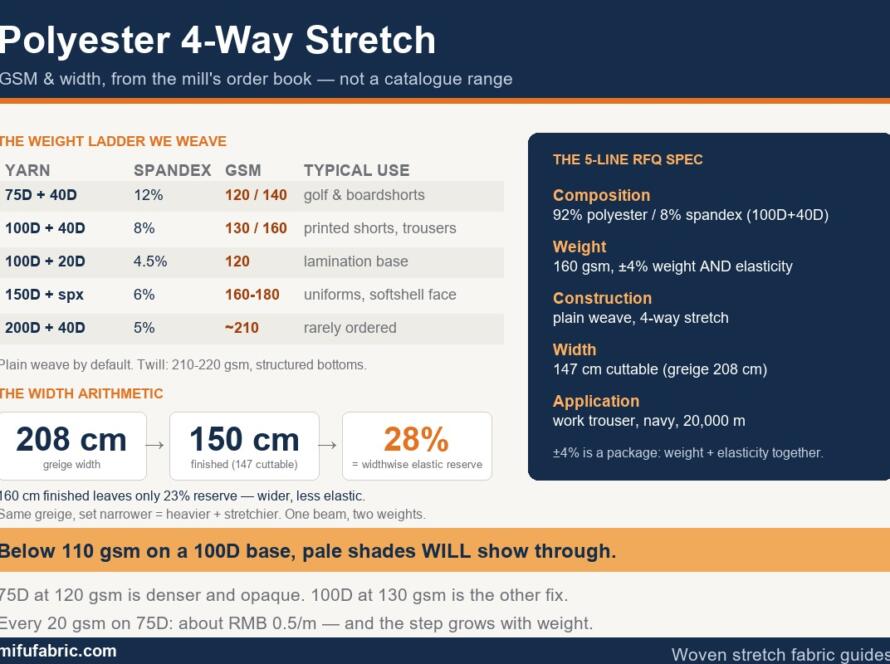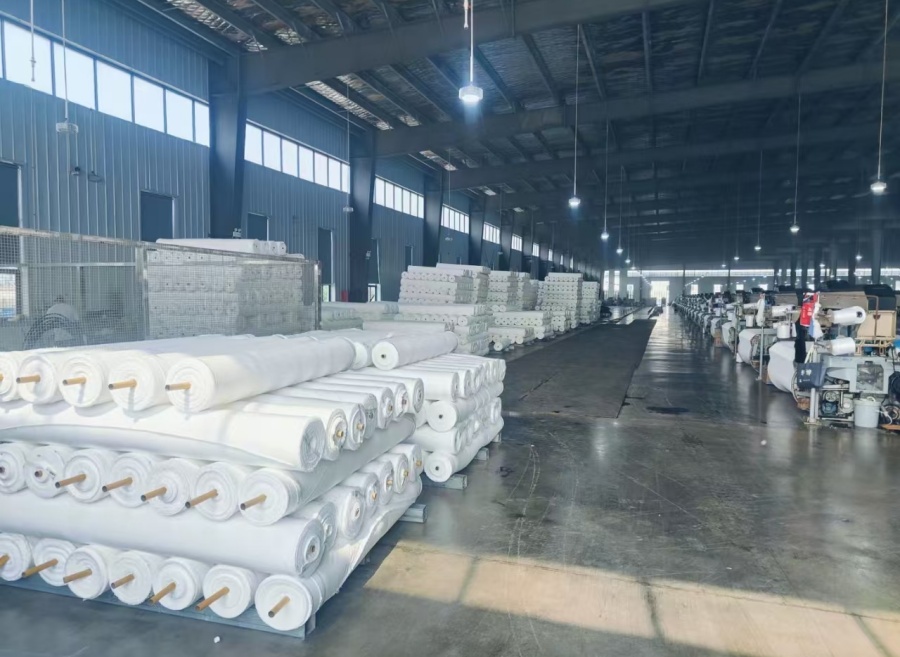
Knee bags on trousers that fitted perfectly at approval are not a fit problem, and they are usually not a shrinkage problem either. They are a recovery problem. The fabric did not shrink — it grew, and it grew because the elastane or the bicomponent weft never came back to the length it was woven at.
Fabric recovery is the ability of a woven stretch fabric to return to its woven dimensions after being stretched and after repeated laundering. When recovery is lost, the symptom is not a tighter garment but a looser one: knees, seats, waistbands and elbows keep a permanent set, and the growth compounds with every wash instead of settling.
This guide is for the buyer who already knows the first wash is a risk and is now dealing with the second, fifth and twentieth. It separates recovery from shrinkage, gives you four mechanisms and three questions that eliminate most of them, sets out the two-stage setting route we run — including the temperatures most mills keep to themselves — and ends with the checks you can run before you order. The material and construction side sits in the rest of our woven stretch fabric guides.
1. Recovery, Shrinkage and Growth Are Three Different Failures
Buyers use these three words interchangeably in emails and then argue about them in claims. They are not the same measurement, they do not fail for the same reason, and only two of them are normally a mill’s fault.
- Shrinkage is a negative dimensional change: the washed piece is smaller than the marked one. It is dominated by relaxation of stresses built up in spinning, weaving and wet processing, and it is largely finished after the first two or three home launderings.
- Growth is a positive dimensional change: the washed piece is larger. It is the visible result of elastic loss, and unlike shrinkage it does not stop on its own — a fabric that grows 2% by the third wash will usually grow again by the tenth.
- Recovery is the mechanism behind growth. It is the elastic return of the stretch component, measured as the percentage of stretch that does not come back after a defined recovery interval.
That distinction matters commercially. A shrinkage claim is settled against a dimensional-change tolerance and is usually a first-wash event. A growth claim is settled against a repeatability tolerance — how much the fabric still moves at cycle 5, 10 or 20 — and it is the one that turns into a seasonal problem, because the first shipment passes and the repeat order comes back.
For the dimensional-change side — tolerances, the five production stages that decide them, and two claims that cost 460,000 CNY and 93,000 CNY — the detailed treatment is in our guide to woven stretch fabric shrinkage. Read that one first if your problem appears after wash one. Read this one if your problem appears after wash ten.
1.1 Why “3% Shrinkage” in a Spec Does Not Cover Growth
Most tech packs state a dimensional change of ±3% and stop there. A fabric can be inside that window on the first wash and still be unusable, because the tolerance says nothing about direction of movement, number of cycles, or recovery time. A piece that measures −2% on wash one and +4% by wash ten has passed the spec as written and failed the garment.
If you write only one number, write the one that hurts: growth after a stated number of launderings, measured in both directions, with the recovery interval named. Section 7 gives a block you can paste into a tech pack.
2. What Lost Recovery Looks Like on a Garment
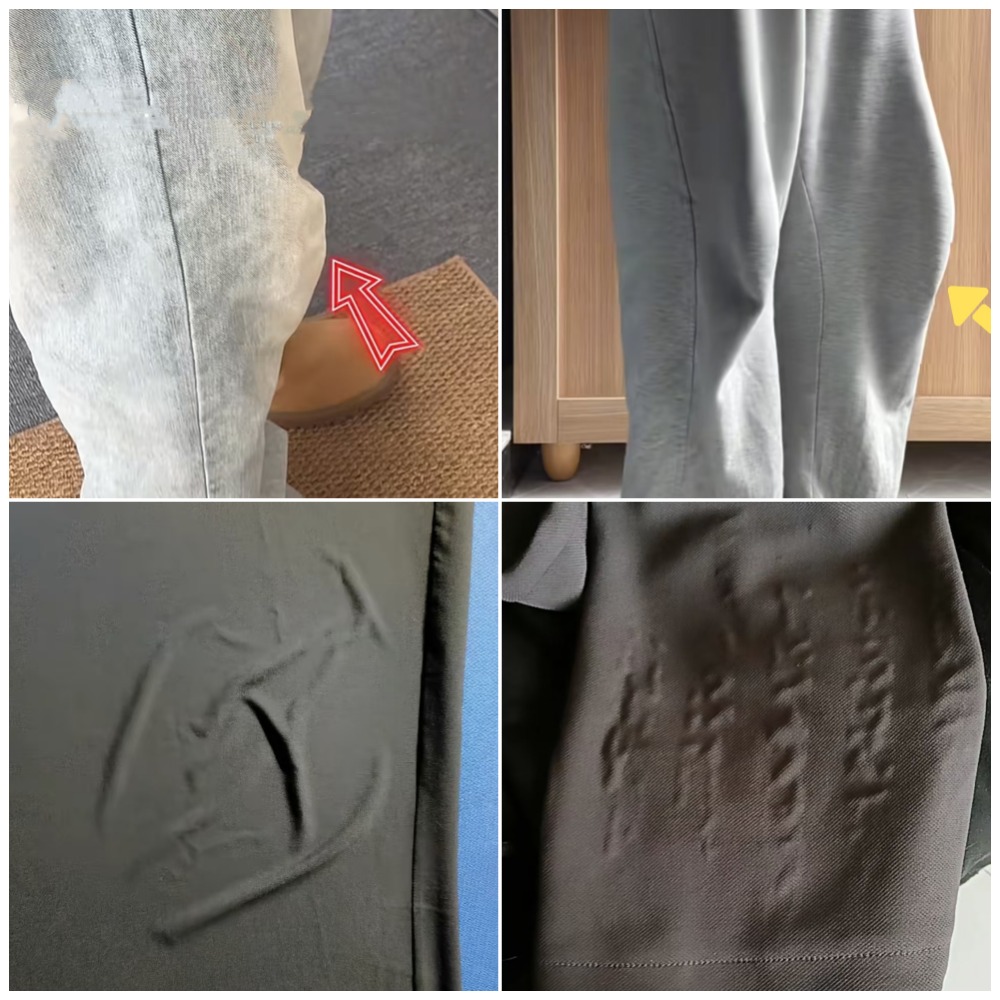
Recovery failure has a small set of signatures. Learning to read them on a returned garment tells you more than a lab report, because the location of the distortion points at the mechanism.
- Knee and seat bags. The weft has been held at extension for hours at body temperature. A fabric with good recovery returns within minutes of standing up; a fabric with tired elastane stays bagged for the rest of the day, and the bag gets deeper over the life of the garment.
- A waistband that no longer grips. Circumference growth with no change in the elastic itself usually means the spandex has been allowed to slide or has degraded, not that the waistband elastic is slack.
- A wavy fly or pocket mouth. Local growth next to a seam is a tension story — the panel was stretched during sewing, or the fabric was delivered under width tension, and it has now relaxed at a different rate than the seam.
- A hem that drops. Vertical growth, usually small in percentage and very visible in centimetres on a long leg.
- Grin-through after washing. White elastane showing through the face at the highest-stretch points is late-stage: the yarn has migrated or the cover has been abraded, and recovery is already gone.
2.1 The Tape-Measure Test We Use in the Sample Room
We do not start with a laboratory. We mark 50 cm on a relaxed swatch with a tape and a pen, stretch it by hand to the limit the garment will see, release it, and measure again after 30 minutes flat.
Most orders ask for 50 cm to reach 58 cm, or 16% stretch; our higher-stretch qualities reach 64–65 cm, or 28–30%. But the stretched figure is only half the measurement. A quality that reaches 65 cm and returns to 50.5 cm is a better garment fabric than one that reaches 58 and returns to 56.
Two rules apply. Measure relaxed, never straight off the roll — a fabric wound under tension reads several percent short and will “grow” in the customer’s warehouse before it reaches a washing machine. And if the return is still drifting at 30 minutes, read it again at two hours: a slow return that keeps improving is a much better problem than one that stops at 54 cm.
2.2 A Three-Wash Record, for Buyers Without a Lab
For the laundering side, cut a 40 × 40 cm swatch, mark 30 cm in warp and weft, and measure after each of three home launderings at the temperature the care label will carry, drying the way the end customer will dry it. Measure after 30 minutes of flat relaxation, not immediately out of the drum.
A fabric that gains more than half a percent per cycle by the third wash, in either direction, has a recovery problem that no amount of garment engineering will fix. This is the cheapest filter we know, and it is the one most buyers skip because the first wash looks acceptable.
3. Four Mechanisms and How to Tell Them Apart
There are four ways a woven stretch fabric loses recovery. They are routinely confused with each other because all four end in the same place — a garment that measures bigger — but they originate in different parts of the supply chain and only some of them can be fixed at the finishing line.
| Mechanism | What happens | Where growth appears | Cycles before it shows | Who can fix it |
| Elastane hydrolysis / ageing | The polyurethane backbone breaks down under heat, moisture, oxygen, residual alkali or chlorine; the filament loses its ability to return | Both directions, worse where the fabric is thin; often paired with a “dead” hand | 5–20 washes, faster with hot wash and tumble dry | Yarn selection and dyehouse discipline at the mill; care conditions at the brand |
| Elastane core slippage / migration | The spandex is not locked into the weave structure and slides along the filament path under tension | Local, asymmetric: one panel, one direction, often near a seam or at maximum stretch | 1–3 washes, sometimes on the first | Softener dosage and weft density at the mill; tension control in finishing |
| Bicomponent crimp fatigue | In spandex-free constructions the self-crimped bicomponent weft (T400-type) loses crimp under repeated extension and heat; the fabric goes flat rather than springy | Weft-led growth, with a visible loss of bulk and cover | 10–30 washes; slow and cumulative | Yarn ratio and weft density at the mill |
| Set-in stretch memory | The fabric is delivered at a width and tension that was heat-set into it; washing releases the cloth back toward that set state | Width first, then length; early, then plateaus | 1–5 washes | Overfeed, width and temperature at the stenter |
3.1 Hydrolysis Is Chemistry, Not Craft
Elastane is a block copolymer; the soft segment carries the stretch, and it is attacked by heat, humidity, oxygen and — the fastest route — chlorine and peroxides. Polyether-based elastane resists hydrolysis considerably better than the older polyester-based types, which is why two fabrics with identical construction and identical percentages can behave completely differently over twenty washes.
This mechanism is the main reason a care label matters. A 60 °C wash with a chlorine bleach dose and a hot tumble dry will destroy in five cycles what would have taken thirty at 30 °C and line drying. If your growth complaints come from one market and not another, check the laundry habit before you check the mill.
Temperature is usually not the culprit inside the dyehouse, either. Polyester is dyed at around 130 °C and nylon at around 100 °C, both comfortably inside what a good elastane will take. The damage we have actually seen came from chemistry rather than heat: on a nylon climbing fabric order, insufficient cleaning of the dyeing machine left alkali on the cloth, and the cobalt-bearing yellow dye catalysed the reaction. The elastane hydrolysed and melted, and the fabric bubbled in the dyed piece. The full sequence is written up in that order’s case study — it is worth reading if your mill quotes you a dyeing temperature and stops there, because the temperature was not what went wrong.
3.2 Slippage Is a Structure Problem
When the spandex is too loose in the weave, or the weft density is too low for the elongation being sold, the filament slides instead of stretching in place. The fabric looks fine on the roll and fails locally — one knee, one pocket, one side of a garment. This is the mechanism behind the “why did only half the shipment fail” question. It is also the one most often misdiagnosed as bad spandex, when the yarn is fine and the construction is not.
The most common trigger is not a machine setting at all. It is the softener. A heavy silicone finish improves hand and can lift the measured stretch, but under heat it lubricates the filament path, and the spandex walks. We have seen the result on a real order: 23,000 metres of nylon stretch for an export jacket programme, an extra dose of silicone in the padding mangle to hit a soft hand, and 5.8% warp growth after three washes — the fabric got longer, not shorter. That case is written up from the shrinkage side in our guide to heat washing and shrinkage control; from the recovery side, the lesson is that the fault was decided at the finishing trough, weeks before anyone washed anything.
3.3 Crimp Fatigue Is the Spandex-Free Trade-Off
Mechanical stretch fabrics built on bicomponent polyester weft do not hydrolyse, so they solve the ageing problem, but their recovery comes from a spiral crimp rather than a rubber-like filament. That crimp fatigues. Under repeated extension and heat it opens up, the fabric loses bulk and cover, and the growth is permanent. A well-built mechanical stretch gives excellent recovery per cycle but has a lower ceiling on total cycles than a good spandex woven — the construction side of that trade-off is set out in our guide to why stretch fabric elasticity differs between qualities.
Whether a T400 quality is well built is largely a density question, and it is one a buyer can check with a pick glass. See section 6.
3.4 Set-In Memory: Where the Width Reserve Went
This is the mechanism buyers misread most often, and the two routes behave differently.
We do not set polyester/spandex four-way stretch over-width. The greige is set to the width we intend to deliver, and width stability comes from the setting route in section 5, not from a reserve that shrinks back later.
T400 is different: a T400 quality is stentered about 2 cm wider than the ordered width and then allowed to relax back into it. That reserve is deliberate — a mechanical-stretch weft has to contract after setting or the crimp never develops properly. What matters is where it is released. In our warehouse, the customer receives the ordered width. In the customer’s first wash, the customer sees width growth on a fabric that measured correctly at the stenter, and the garment factory gets the blame for a problem created upstream.
So for a T400, measure width after the roll has rested, and expect wash one to take back the reserve rather than to add to it. If it grows instead, the reserve was already gone when the roll was wound: either it was set to the ordered width, or it was wound under tension. Both are delivery faults, and both are visible before cutting.
4. Three Questions That Narrow It Down
Before any testing, three questions eliminate most of the field. Ask them in this order and write the answers down — they are also the first three things a mill will ask you.
1. How many washes before the garment changed? Growth on the first wash points to set-in memory or slippage. Growth that appears gradually and keeps increasing points to hydrolysis or crimp fatigue.
2. Which direction grew? Width-first and then plateauing is a stenter story. Both directions, steadily, is an elastic-loss story. One panel only is a tension or construction story.
3. What is the actual laundry condition? Temperature, detergent type, bleach, dryer. A “recovery failure” that only occurs in one market, on one wash programme, is often a care-condition failure rather than a fabric failure — and no mill can finish a fabric against an unknown wash.
| Answer pattern | Most likely mechanism | First thing to check |
| Growth on wash 1, width-led, then stable (T400) | Set-in width reserve released late | Delivered width measured after rest; roll tension |
| Growth on wash 1–3, local and asymmetric | Elastane slippage / migration | Softener dosage, weft density, elongation vs. sold stretch |
| Steady growth from wash 5, both directions | Elastane hydrolysis | Care label, chlorine, dyehouse residue, elastane type |
| Gradual growth from wash 10, weft, flat hand | Bicomponent crimp fatigue | T400 ratio to warp, weft density, total cycles promised |
5. What the Mill Actually Changes
Everything below happens on the finishing line or before the greige is woven. Two of the levers — yarn choice and construction — have to be decided before weaving, which is why the cheapest time to solve a recovery problem is at the sampling stage and the most expensive is after the first bulk delivery.
5.1 The Two-Stage Set We Run
Conventional literature quotes 190–195 °C for polyester/spandex. We do not run a single set at that temperature. On polyester/spandex four-way stretch we run:
- Pre-setting at 200–210 °C, before dyeing;
- Final setting at 140–150 °C, after dyeing.
The logic is that the two passes are doing two different jobs. The pre-set does the structural work: it releases the stress built up in weaving and winding while there is no dye on the cloth to protect, and it fixes the width at the point where the fabric is still able to take high heat. The final pass is not asked to set anything. It removes the creases from dyeing, brings the cloth back to width and dries it, at a temperature low enough not to soften the elastane a second time and not to move the disperse dye that was fixed in the dyebath.
Two results follow from that, and both are measurable. Heat-setting shrinkage is more stable, because the structure was fixed once, at the stage designed for it, instead of being asked to hold a set imposed after dyeing. Colour fastness is better, because the fabric does not see a second high-temperature pass with dye on it. A mill that sets at 190 °C twice can also make a stable fabric; what it cannot do is protect the dye and the elastane in the same pass.
We are not claiming this is the only route, and we would not recommend copying the numbers without the rest of it: the numbers alone do not reproduce.
5.2 Speed and Overfeed Cannot Be Copied From a Specification
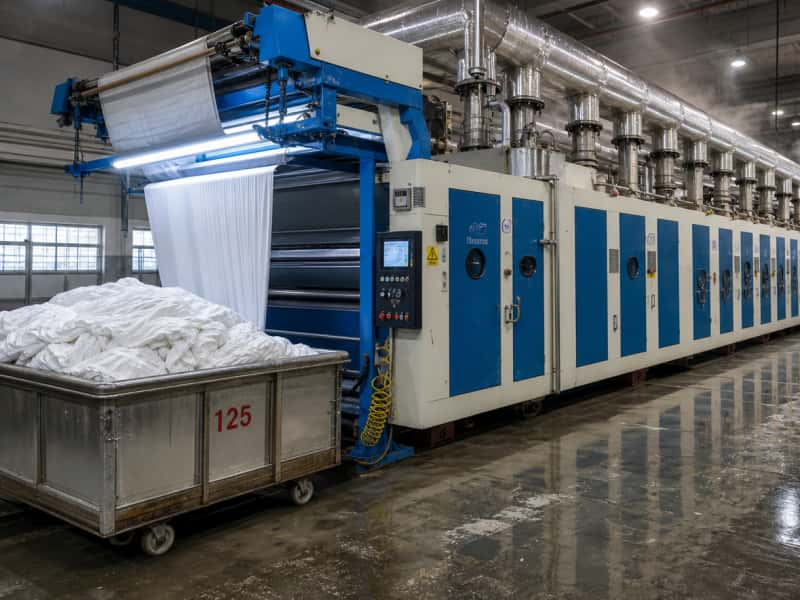
Setting speed is the parameter buyers ask for most and the one that transfers least. A stenter with six chambers and a stenter with eight, running the same fabric, need different speeds to deliver the same thermal dose, and the air volume and nozzle arrangement change the answer again. The speed is therefore set at the machine, from the number of chambers and the airflow, and adjusted during the run.
Overfeed on our four-way stretch sits at 10–20 on the stenter’s overfeed setting. That number is a machine unit, not a percentage — the dial means something only on a given frame — and it is chosen from the finished GSM and the stretch being sold. Both ends of the range exist because the requirements pull against each other: overfeed buys stretch and cover, and costs width stability. That is why we do not publish one number per quality.
This is also why a merchandiser stands at the stenter during stretch setting. It is not a courtesy visit. Temperature, speed and overfeed interact in real time — raise the speed and the set weakens unless the temperature goes up; raise the overfeed and the cloth gets wider and heavier; over-dry and the hand changes. A parameter sheet signed in the office does not survive the first hour of a real run, and the person who can correct it is the one standing at the exit of the last chamber with a pair of scissors and a tape.
5.3 T400: One Pass, and the Cost of Running Fast
T400 takes a single setting pass, at 180–190 °C and 45–65 m/min depending on fabric thickness. There is no pre-set, because there is no elastane to protect and no dye-migration problem of the same kind.
The failure mode to watch is speed. Run too fast and the cloth leaves the chamber under-set: the crimp has not developed fully, so the fabric continues to shrink when it meets heat later — in the customer’s wash, dryer or iron. In practice that shows up as two complaints at once: heat shrinkage larger than the sample, and a width that varies from one end of a roll to the other, because under-setting exaggerates any temperature difference across the chamber.
The width is where T400 differs from spandex most visibly. As section 3.4 sets out, T400 is set about 2 cm over the ordered width and relaxed back; polyester/spandex is not set over-width at all. If you are comparing the two routes, compare the width after rest, and ask whether the mill measured at the stenter or in the warehouse.
5.4 The Order We Actually Meet These Problems In
Ranked by how often we meet them on real orders, not by how they appear in a textbook:
1. Softener / silicone overdose. The most common cause, and the only one on this list that is a hand-feel decision rather than a stretch decision. 2. Under-setting, mainly a final setting temperature too low for the speed being run, or a T400 line run too fast. 3. Overfeed or tension errors — cloth delivered stretched, measured stretched, sold stretched. 4. Pre-setting skipped as a cost shortcut, which shows up as width growth a few washes later. 5. Raw-material batch variation and customer wash conditions. We put these together because in a claim they are genuinely hard to separate: a slightly different elastane lot and a hotter wash programme produce the same number on the same test report.
If a mill gives you a different order and cannot explain the evidence behind it, ask what they measured. The ranking above comes from what we see at the stenter and in the claim file, and it is the reason our softener dosage is capped rather than dialled up to hit a hand-feel target.
6. How to Check a Stretch Quality Before You Order
None of this needs a laboratory. All of it can be done on a sample bench, and all of it is hard to fake.
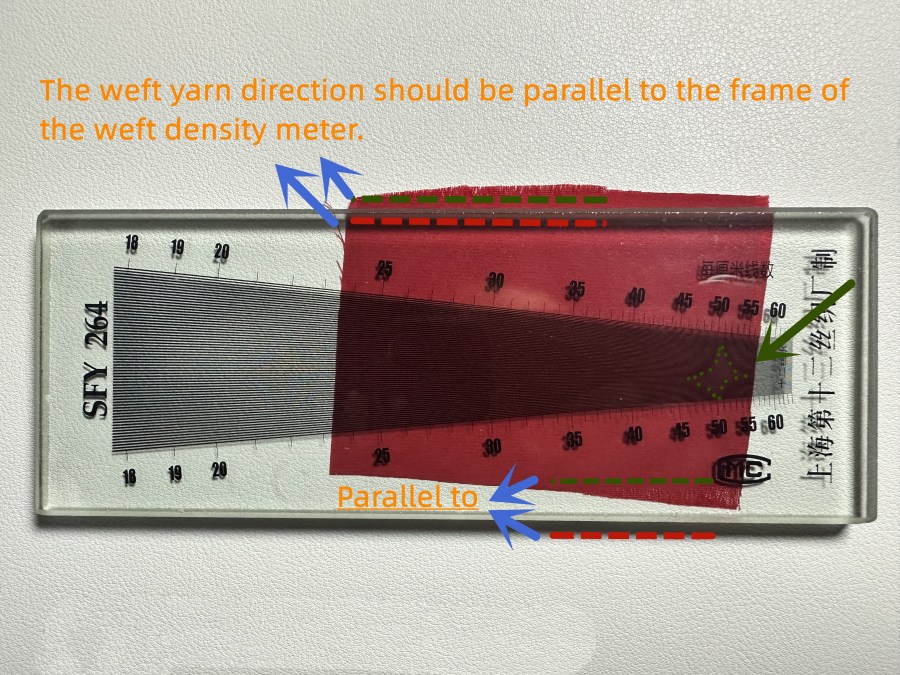
For a T400 quality, count the picks. With a normal polyester warp and a T400 weft, the weft density should be no looser than a 3:2 warp-to-weft ratio — 100 warp ends to at least 66 picks. Below that ratio the weft cannot deliver the cover or the recovery, and no amount of finishing will put it back. It takes five minutes with a pick glass, and it settles most arguments about why a cheap T400 feels thin after ten washes.
For a spandex four-way, anchor two numbers, not one. Take the sample you approved and lock its GSM and its stretch. Then compare any counter-sample on both axes: at the same GSM, compare stretch; at the same stretch, compare GSM. Bulk should land within about 4% of the anchor GSM while holding the stretch. A supplier who tells you that you can have the weight or the stretch but not both is telling you the construction is not under control — on a four-way stretch quality that is not a normal trade-off, it is a warning.
For both, run the 50 cm tape test in section 2.1, and write down the return as well as the stretch.
And ask one question about the route. What is the pre-setting temperature, is there a pre-set at all, and what is the final setting temperature? A mill that runs a genuine two-stage route will answer in numbers. A mill that does not will answer in adjectives.
7. How to Write Recovery Into the Spec
A recovery specification needs five things: the laundering procedure, the number of cycles, the direction of measurement, the recovery interval, and the pass value. Miss any one and the number is not reproducible — two labs can test the same fabric and disagree by a full percentage point.
| Test | What it measures | Typical reference | What to write into the tech pack |
| Dimensional change after laundering | Shrinkage and growth, warp and weft separately | AATCC 135 (home laundering) or ISO 6330, measured to ISO 5077 | “After 3 cycles at [profile], change ≤ ±3% warp and weft, reported separately” |
| Stretch and growth | Extension at a specified load, and the percentage that does not return | ASTM D3107 | “Growth ≤ [x]% after 30 min recovery at [load]” |
| Heat / ironing shrinkage | Dimensional change under pressing or dry heat | Buyer’s pressing method, or in-house protocol | “Ironing shrinkage ≤ 3.0%” |
| Cyclic recovery | Behaviour after repeated extension, not one pull | Internal or buyer protocol | “≤ [x]% growth after [n] cycles” |
Two practical notes. First, ASTM D3107 is the woven-stretch method; the low-power knit method (ASTM D2594) is not a substitute, and quoting it for a woven invites a dispute. Second, always state the recovery interval. Growth read at 30 seconds and growth read at 30 minutes are different numbers on the same fabric, and the difference is exactly the elastic behaviour you are trying to buy.
7.1 A Spec Block You Can Paste
Test method: AATCC 135, cycle and temperature per the care label; drying per the care label.
Cycles: 3, measured after cycle 1 and cycle 3.
Dimensional change: ≤ ±3.0% warp, ≤ ±3.0% weft, reported separately; growth not to exceed 2.0%.
Stretch: ASTM D3107, extension and load as agreed at sampling.
Growth: ≤ 2.0% after 30 minutes recovery, warp and weft.
Ironing / heat shrinkage: ≤ 3.0%.
Care: no chlorine bleach, tumble dry low; growth under high-heat drying excluded from the tolerance.
That last line is the one buyers forget. If the care label says tumble dry low and the market tumble dries high, the resulting growth is a care failure, not a fabric failure — but the argument only ends quickly if the spec said so before the order. If you are writing this into an enquiry rather than a tech pack, our RFQ guide for woven stretch fabric covers the other clauses that decide whether a mill quotes the same fabric you think you asked for.
8. What We Commit To
We hold growth at ≤2% in our internal control, measured warp and weft after a stated number of launderings, and ironing shrinkage at ≤3%. Both figures are on the qualities we run regularly; neither is a generic industry number borrowed for a web page.
If you need a figure tested to a named standard, say so at the enquiry stage. Once we take the order, meeting that figure is our problem rather than yours: refund or replacement is negotiable, and we sample and send to a third-party laboratory before shipment, so the report exists before the container does.
What we do not promise is recovery under conditions the fabric was never finished for: chlorine bleach, high-heat tumble drying, industrial laundry with peroxide, or continuous high-temperature drying. Those must be declared at order. If your end market dries hot, the honest answer is a different construction, not a different finishing recipe — our polyester four-way stretch fabric page covers the qualities we run regularly, and the spandex-free route is the one to look at when chlorine is unavoidable.
The last commitment is the least comfortable one to write. We would rather lose a process than a claim, and we have done it: we have declined to coat a down-jacket fabric whose colour fastness would not survive the coating and supplied only the dyed semi-finished cloth (that order); and we have told a customer that Level 4 oil repellency plus Level 4 soil release in one finish was a contradiction before the fabric was developed (that enquiry). Recovery is the same kind of conversation held earlier: if the quality you are asking for cannot hold 2% growth, we would rather say so at quotation than defend it at claim.
Finally, on price: within the same quality, high recovery is a different article. Expect roughly 5–8% more and a slightly heavier cloth, because recovery is bought with yarn ratio and density, not with a finishing additive. A quotation that offers both weights at the same price is worth a second look at the GSM.
FAQ
Why does my stretch fabric grow after washing instead of shrinking?
Because the elastic component is not returning to its woven length. Shrinkage is the release of production stress and usually settles after the first washes; growth is elastic loss and keeps accumulating. The two are measured differently and need different tolerances in the spec.
How many washes should a stretch fabric survive before growth is a problem?
Growth should be inside tolerance from the first wash and stay there. We hold ≤2% in our internal control on polyester/spandex four-way stretch, with little further movement at cycle ten. If a fabric is still gaining half a percent per cycle at wash five, the mechanism is active and will not self-correct.
Is growth after washing the mill’s fault or the laundry’s fault?
It depends on the mechanism. Set-in width reserve, softener overdose and slippage are mill-side. Hydrolysis and crimp fatigue are accelerated by wash temperature, chlorine, dyehouse residue and tumble drying, so the same fabric can pass in one market and fail in another. The way to settle it is a wash profile written into the spec before the order.
Can a finishing change fix a fabric that already grows?
Partly. Re-setting at the correct width and overfeed can recover the set-in component, and a T400 that was rolled before its width reserve was released can be relaxed back. It cannot restore elastane that has already hydrolysed or rebuild crimp that has fatigued — those are irreversible, and re-finishing such a fabric only hides the number for one or two washes.
Does spandex-free stretch fabric hold recovery better?
It holds it differently. Mechanical stretch on bicomponent polyester weft does not hydrolyse and is the better choice where chlorine or hot industrial washing is unavoidable, but its recovery comes from crimp, which fatigues over a longer cycle count. Spandex gives higher recovery per cycle but has a chemical ageing limit. The construction trade-off is covered in our T400 vs spandex comparison.
How do I check that a T400 quality is properly built?
Count the picks. With a polyester warp and a T400 weft, the weft density should be no looser than 3:2 against the warp — 100 ends to at least 66 picks. Then run the 50 cm tape test and look at the return after 30 minutes, not the maximum stretch.
What is a realistic growth tolerance to ask for?
Two percent after three launderings, measured in both directions after a stated recovery interval, is what we hold internally. Three percent is the common commercial tolerance where the quality has not been developed for recovery. Anything tighter than 2% needs to be agreed against a specific yarn and construction at the sampling stage, not added to a spec at the last minute.
References
- AATCC 135 — Dimensional Changes of Fabrics after Home Laundering
- ASTM D3107 — Stretch Properties of Fabrics Woven from Stretch Yarns
- ASTM D2594 — Stretch Properties of Knitted Fabrics Having Low Power (knits only; not applicable to wovens)
- ISO 6330 — Domestic washing and drying procedures for textile testing
- ISO 5077 — Determination of dimensional change in washing and drying
- ISO 3759 — Preparation, marking and measuring of fabric specimens and garments in tests for determination of dimensional change