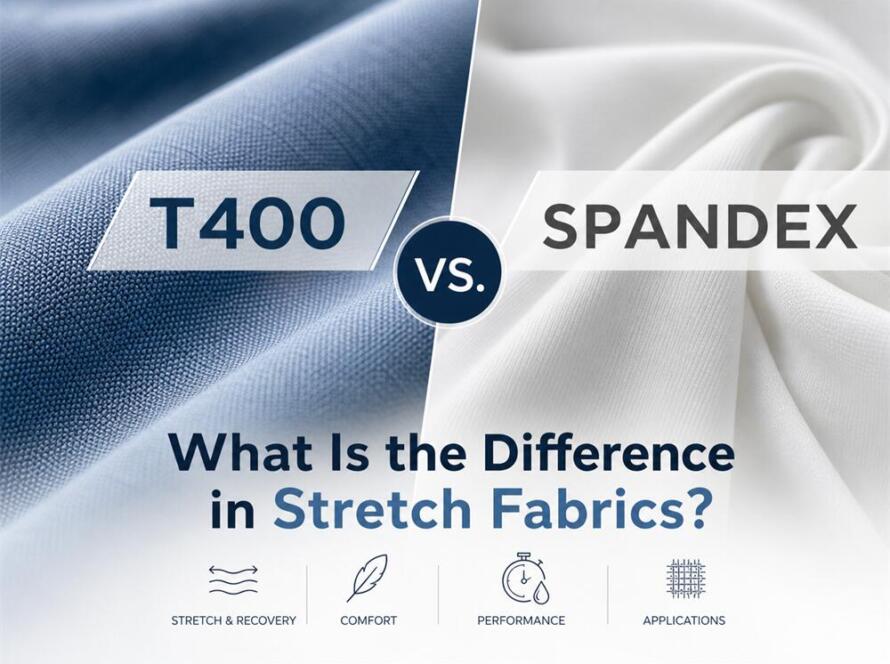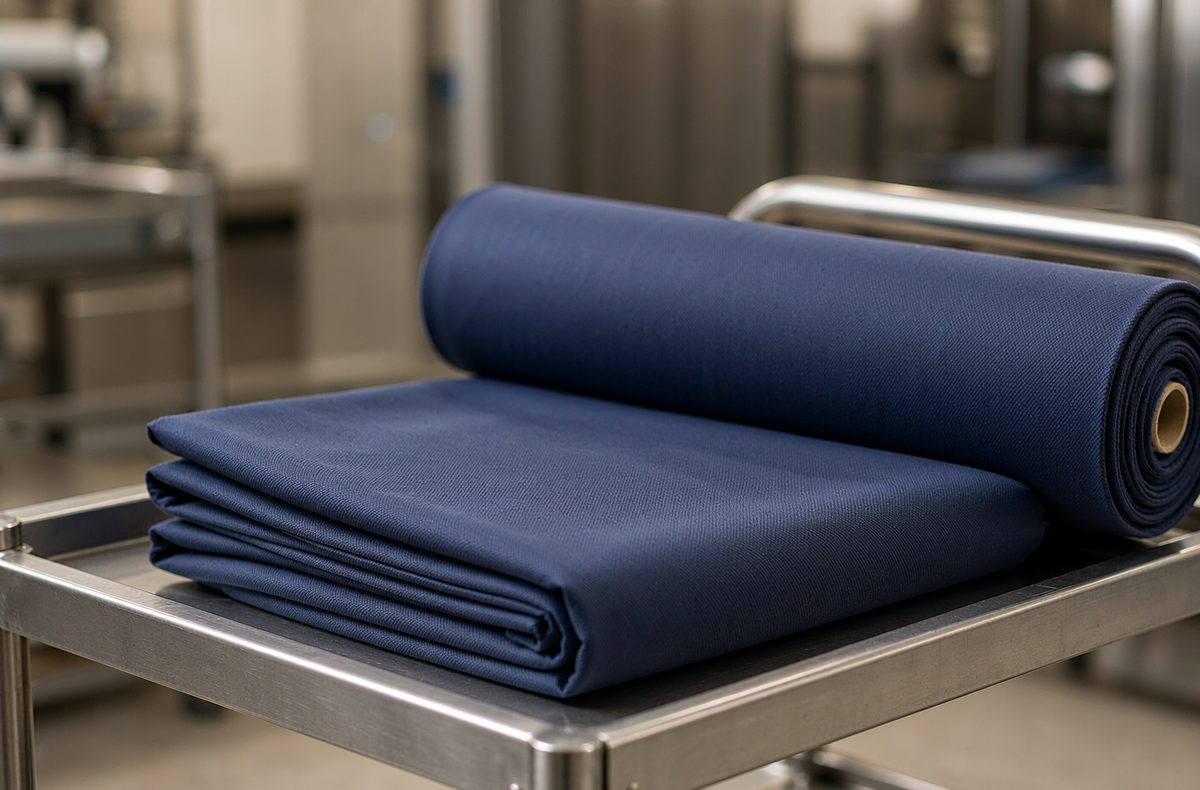
Spandex-free workwear fabric takes its stretch from bicomponent polyester — T400 or elastomultiester (EME) — rather than from a polyurethane filament, so there is no elastane in the cloth to break down under repeated laundering. And when the base fabric is 100% polyester, a second weak point disappears with it: nylon, the fibre that actually fails first where chlorine is present.
Most buyers ask a reasonable question the wrong way. They ask is it chlorine resistant, or how many washes will it survive, when the answer depends less on the stretch system than on the fibre written on the first page of the tech pack. We weave mechanical stretch fabrics for workwear programmes on both sides of our order book — domestic Chinese issue garments and export orders — and two failure modes dominate the claims we see. Both of them trace back to the same decision.
This article sets out what workwear laundering actually looks like, why nylon and elastane fail in it, how mechanical stretch behaves instead, three spandex-free constructions we build on that principle, and the numbers you can hold us to.
What Workwear Laundering Actually Looks Like
Before comparing fibre systems, it is worth being honest about how workwear is really washed, because the laboratory protocol a buyer quotes is often not the laundry the garment will see. Most volume in this category is not hotel or bank uniforms — it is issue clothing for workshop and production-line staff, and its laundering picture is more ordinary than most spec sheets imply.
Three laundering routes, three different requirements
| Laundering route | Where you see it | Typical temperature | Chemistry involved | What it attacks |
| Individual home washing | Workers laundering issue garments themselves — the default in domestic Chinese programmes | Cold to warm household wash | Household detergent, no disinfectant | Dimensional stability, colour fastness, appearance retention |
| Collective laundering | Uniform rental and commercial laundries, common on export programmes | Up to about 60 °C | Commercial detergent; peracetic acid or hydrogen peroxide disinfection | Alkaline washing, mechanical agitation, seam and fold abrasion |
| Disinfection-heavy laundering | Hospitals, food processing, some institutional contracts | Varies by contract | May include chlorine bleach | Nylon dye chromophores and elastane urethane bonds |
Two observations follow from that table, and both come up in real enquiries.
The disinfectant is a minority variable — until it isn’t
Peracetic acid and hydrogen peroxide now do most of the disinfection work in commercial laundries; chlorine bleach has become the minority branch, concentrated in hospitals, food plants and a few markets. But “minority” is not “none”, and a fabric that is fine in route two can still be destroyed in route three. If you do not know which branch your programme is on, ask the laundry two questions before anything else: which disinfectant is used, and what is the peak temperature? Everything else in the spec follows from those two answers.
Cycle counts are usually negotiated less than buyers assume
Very few tenders we see specify 25, 50 or 100 wash cycles. Garments are retired on condition — when the knees go, when the colour goes, when the fit goes — not when a counter runs out. That makes the rate of change per wash the property that matters, not a lab-scale cycle number. A fabric that loses a little elasticity every wash loses the programme; a fabric that doesn’t, doesn’t.
The Two Failure Modes Buyers Get Wrong
Failure mode one: the stretch fades while the cloth still looks perfect
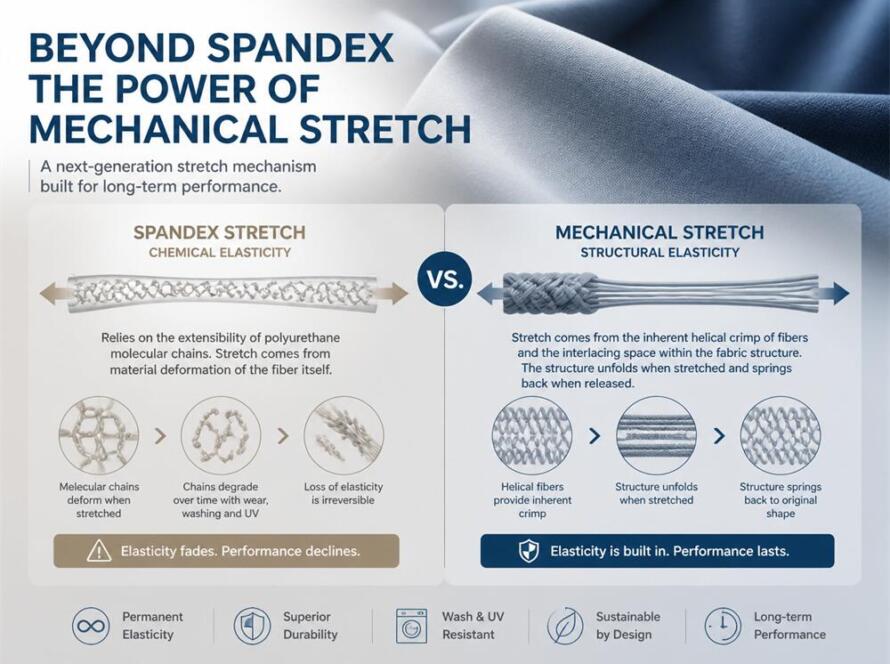
Elastane is a polyurethane–urea block copolymer: soft segments stretch, hard segments pull the fibre back. Three things in laundering attack those hard segments — oxidising disinfectants break the urethane bonds, alkaline washing hydrolyses them, and sustained heat above roughly 60 °C lets the hard segments reorganise and lose their memory. The damage is cumulative and irreversible.
The symptom sequence is always the same and always expensive: recovery rate declines first, then the knees and elbows bag out, then the surface yellows or chalks — while the fabric itself still passes every cloth-level test. A garment that fails this way looks intact on a QC table and unwearable on a worker. That gap between what the cloth tests at and what the garment does is what makes elastane loss the most expensive failure mode in a workwear claim: it surfaces after delivery, in the field, across the whole programme at once.
Failure mode two: the colour dies and the garment becomes unsellable
The second mode is quieter and faster. Nylon takes dye well, which is one reason it is everywhere in stretch workwear — but the chromophores of most nylon dye classes are easily oxidised by active chlorine. One swim in a chlorinated pool is enough to shift colour irreversibly on some nylon constructions; add the high-temperature heat setting that every spandex-containing fabric requires, which further weakens the bond between dye and fibre, and the construction is exposed from two directions.
We documented one of these in a chlorine-resistant fabric case — 4,500 beach shorts that faded unevenly in pool water because the customer moved the fabric from shirts to swim shorts without updating the performance spec. Workwear versions of the same mistake are less dramatic and more common: a uniform programme adds a laundering contract mid-life, nobody revisits the fabric, and the first complaint arrives with the second wash invoice.
Both failure modes point at the same conclusion, which is the premise of this whole article: remove the elastane, remove the nylon, and both modes disappear together. That is exactly what a 100% polyester spandex-free construction does — and it is why mechanical stretch has become the default answer for issue garments that have to survive a laundry contract.
Why Mechanical Stretch Beats Spandex in the Laundry
If you have read what elastomultiester (EME) actually is, the mechanism will be familiar: T400-type yarn is a bicomponent filament of two polyesters with different shrinkage behaviour side by side. After drawing, the differential shrinkage coils the filament into a permanent spiral crimp. Stretch comes from that geometry, not from an elastic polymer — so there are no urethane bonds to oxidise, and the fibre is the same chemistry as the rest of a polyester garment.
That is why the recovery story inks out so differently. In our experience a T400 mechanical stretch fabric comes out of repeated washing with its stretch and recovery essentially unchanged, while a comparable poly-spandex build measurably loses recovery over the same cycles — not because anyone wove it badly, but because the elastane is chemically consumed. For workwear, where the garment has to survive the laundry rather than flatter the fitting room, that difference decides the programme.
| Stretch system | Stretch range | Recovery after repeated washing | Alkali + heat around 60 °C | Chlorine exposure | Cost position | Workwear fit |
| High-twist mechanical stretch (no elastic fibre) | 10–18%, mostly weft | Good | Excellent | Excellent | Lowest | Hardest wash specs on tight budgets |
| T400 / EME bicomponent polyester | 10–13%, weft or 4-way | Essentially unchanged | Excellent | Excellent | 15–25% below a poly-spandex build | The default choice for issue garments |
| Polyester + spandex | 15–25%+ | Falls with every cycle | Poor — elastane hydrolyses | Poor | Baseline | Comfort-first garments, short service life |
| Nylon + spandex | 15–25%+ | Falls with every cycle | Poor | Fails first — dye attack | Baseline or above | Avoid wherever chlorine is possible |
Cost deserves its own sentence. A T400 mechanical stretch build prices 15–25% below the equivalent polyester-spandex fabric, because bicomponent filament replaces the spandex yarn and simplifies heat setting. Spandex earns its premium in garments bought for wearing comfort; workwear is bought for service life. Where those two priorities conflict, the laundry usually settles the argument. We have set out T400 versus spandex, side by side in more detail if you are comparing for a specific garment.
How much stretch does a workwear garment actually need?
Less than most buyers specify. A workshop trouser moves through crouch, reach and step — about 10% weft stretch covers it. Tailored fits that must follow the body through movement, like service suits or blazers, justify 13% four-way. Chasing the 20%-plus numbers of a spandex build buys nothing in service life and costs you the durability that mechanical stretch was chosen for in the first place.
Three Spandex-Free Workwear Fabrics, Three Different Jobs
The same principle — 100% polyester, bicomponent stretch, no elastane, no nylon — reaches three very different garments through three different constructions. These are running fabrics from our workwear programme, with the actual build values.
Workshop floor: cotton-look spun polyester × 75D T400, cavalry twill
40S cotton-look spun polyester warp × 75D T400 weft · cavalry twill · 155 cm · 170 gsm · weft stretch ≈10% · 100% polyester
The warp is a cotton-look spun polyester — known in the Chinese trade by names that all translate to “cotton-resembling” — chosen because a matte, natural hand is what makes issue garments acceptable to the people wearing them. The cavalry twill does two jobs at once: its steep, dense line resists abrasion where plain weaves wear through, and it gives enough body for the garment to hold its shape off the hanger. At 170 gsm the fabric stays breathable on a production floor, and 10% weft stretch is all a crouch-and-reach workday demands.
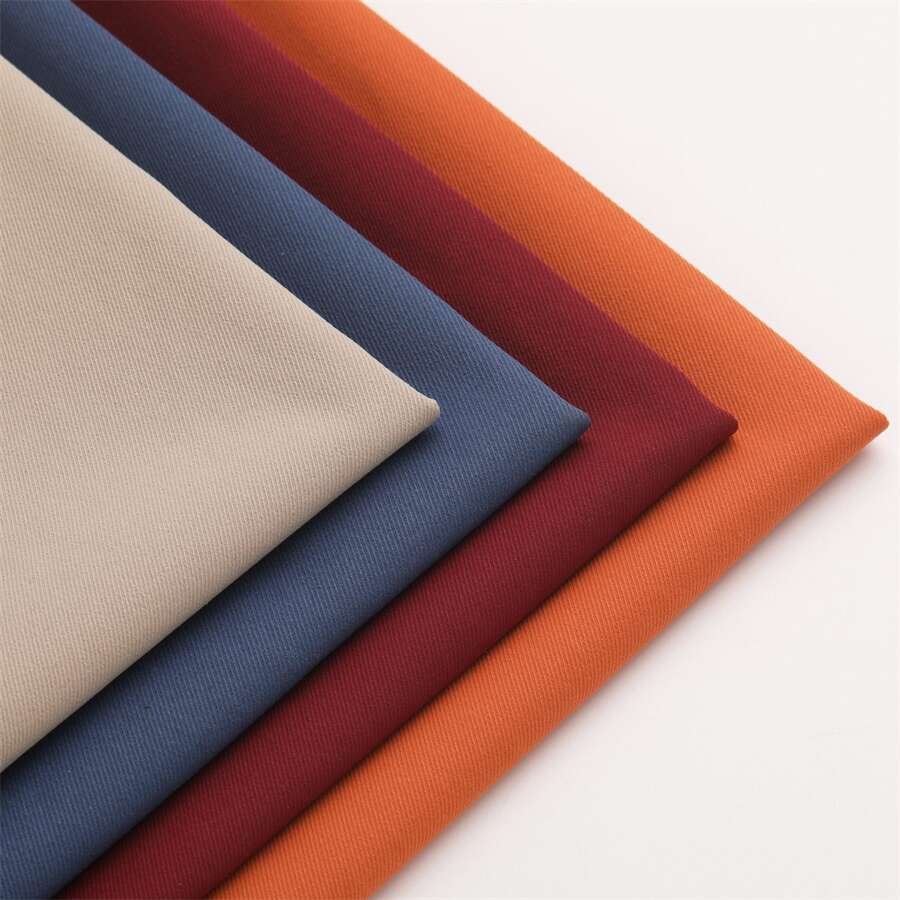
Uniform service: double-layer T400, 150D × 150D
150D × 150D double-layer · 150 cm · 330 gsm · four-way stretch ≈13% · 100% polyester
Hotel, banking and service uniforms need suit weight with suit behaviour: opaque under counter lighting, structured enough to carry a jacket line, comfortable enough to wear for a full shift. The double-layer construction delivers opacity and body at 330 gsm without stiffness, and the four-way stretch at 13% is what lets a tailored garment keep tailored lines on a body that is moving all day. This is the build we recommend when the garment must read as formalwear and still survive an industrial laundry contract.
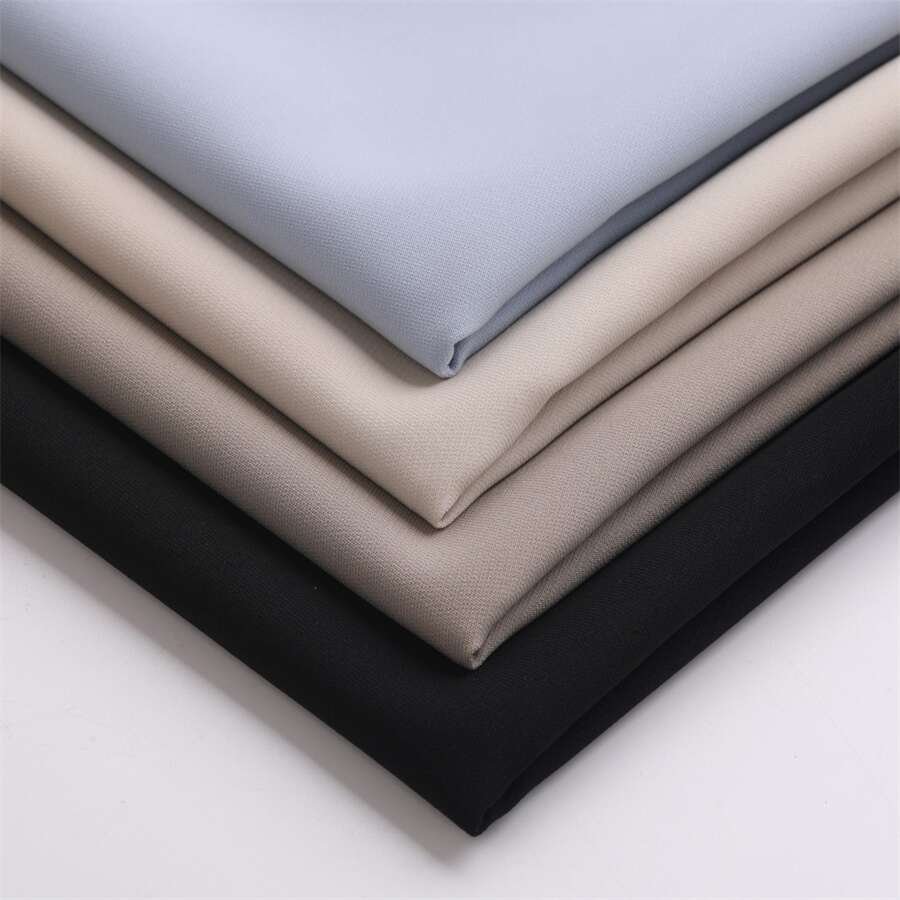
Office and tailoring: linen-look 3/3 twill T400
170D × 170D · 3/3 twill · 150 cm · 260 gsm · four-way stretch ≈13% · 100% polyester · slub linen-look surface
Corporate and office programmes want a fabric that photographs as tailoring. The 3/3 twill carries a slub, linen-look surface texture that reads as natural fibre from conversational distance, at 260 gsm — a genuine blazer weight that still moves. Four-way stretch at 13% keeps close-cut jackets wearable through a desk-and-meeting day. Where the workshop fabric is chosen for what it survives, this one is chosen for what it signals; the laundry durability comes free with the fibre system.
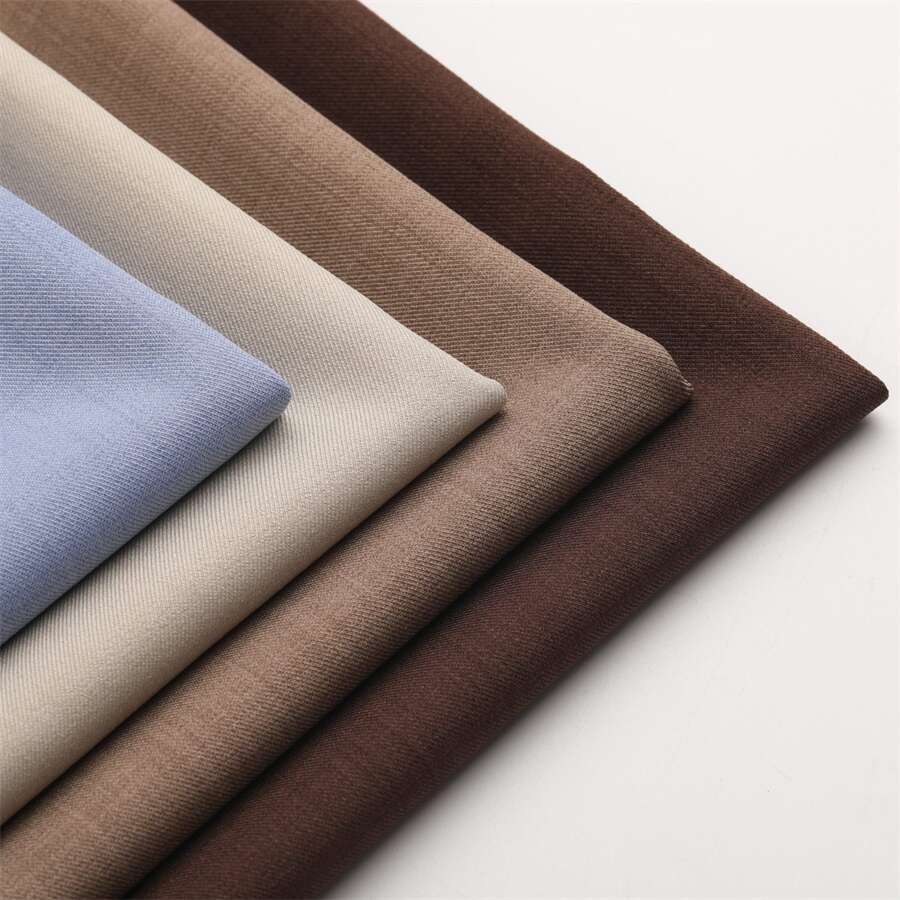
| Fabric | Construction | Weight / width | Stretch | What the construction buys | Best fit |
| Cotton-look cavalry twill | 40S cotton-look spun × 75D T400 | 170 gsm / 155 cm | Weft ≈10% | Abrasion line + natural hand at low weight | Workshop issue garments |
| Double-layer T400 | 150D × 150D double-layer | 330 gsm / 150 cm | 4-way ≈13% | Opaque suit weight with drape | Hotel / banking / service uniforms |
| Linen-look 3/3 twill | 170D × 170D, slub surface | 260 gsm / 150 cm | 4-way ≈13% | Tailoring aesthetics, blazer weight | Office and corporate programmes |
If your programme sits between these — our workwear development project shows how the same brief swings between durability and comfort, round by round, and why the fibre choice is where that negotiation gets settled.
Five Production Decisions That Decide Pass or Fail
Fabric chemistry sets the ceiling; production sets how close a bulk lot gets to it. These are the five decisions that separate a programme that runs for years from one that produces a claim in month two.
1. Set the stretch target from the garment, not from the sample
The sample that wins a development round is often stretchier than the garment needs, because stretch reads as quality in the hand. Specify what the movement requires — 10% weft for trousers, 13% four-way for tailored fits — and let the extra budget go into density and abrasion instead.
What to write in the spec: stretch direction and percentage with full recovery, not “high stretch”.
2. Name the weave, not just the weight
Cavalry twill, 3/3 twill and double-layer constructions behave differently in exactly the ways a laundering programme cares about: abrasion line, alkali penetration, and opacity per gram. Two 260 gsm fabrics can differ by a full grade in service life depending on which of these they use.
What to write in the spec: the weave by name, with thread density if it is a repeat programme.
3. Heat setting is where shrinkage is won or lost
Bicomponent stretch fabrics are heat-set at 180–190 °C, running at 45–65 m/min depending on fabric thickness. This is the step with the sharpest failure mode we see in-house: when the machine runs too fast for the fabric’s thickness, the setting is incomplete — the crimp is not fully stabilised, and the first collective wash pulls the cloth beyond its 3% shrinkage allowance. Every shrinkage failure we have traced came back to under-setting, not to the fibre.
We treat shrinkage as a heat-setting problem first and a washing problem second; the same logic runs through our article on shrinkage control after heat washing.
What to write in the spec: maximum 3% shrinkage, warp and weft, after the wash procedure your programme actually uses.
4. Choose the warp yarn for the wearer, not the lab report
A spun, cotton-look warp costs a little efficiency in weaving and buys a matte hand, better anti-pilling behaviour, and garments that workers accept as “fabric” rather than plastic. Filament warps weave cleaner and photograph flatter, and read as uniform-plastic on the shop floor. There is no universal answer, but there is a wrong answer for every wearer population.
What to write in the spec: warp yarn by construction — spun-look or filament — because it decides the hand the programme will be judged on.
5. Finishing: buy what the workplace needs, not what sounds complete
Most of our workwear fabrics carry anti-static finishing, because polyester in dry workshops generates charge that cotton never did. Simple water repellency is the next most common request. Full three-proof finishing — water, stain and oil repellent — exists for a specific and uncommon scenario: the “oil” in oil repellency means industrial mineral oil, machine environments, not cooking oil, and the fluorine chemistry that delivers it costs real money and declines over garment life. Specify it when the workplace requires it, not as standard.
What to write in the spec: the finish by function, plus the honest expectation that repellency declines with washing — see below.
The Colour and Shrinkage Numbers You Can Hold Us To
Buyers are trained to distrust spec sheets, and mostly for good reason. These are the values we build to as standard, what can be pushed, and what pushing costs.
| Property | Standard build | Can be raised to | What raising it costs |
| Dimensional shrinkage | Max 3% warp and weft | — | Fixed by heat-setting discipline, not negotiable upward |
| Wash colour fastness | Grade 3–3.5 (darker shades lower, lighter shades higher) | Grade 4 | Achievable through process control at modest cost |
| Wash colour fastness, top tier | — | Grade 5 | Yarn-dyed: meaningfully larger MOQ, restricted shade range |
| Stretch recovery after washing | Essentially unchanged on T400 builds | — | Inherent to the fibre system |
The colourfastness grade is a price-and-quantity decision
The 3 → 4 → 5 ladder is not a quality ladder — it is a cost and logistics ladder. Grade 3–3.5 covers most dark-shade workwear honestly. Grade 4 is the right call where dark garments sit against light interiors or lighter garments. Grade 5 is real and worth paying for in a handful of programmes — but it is bought with yarn-dyed production, which means committing to larger minimums and a much narrower shade range. Buy the grade your programme’s laundry and colour scheme actually need; buying five when you need three-and-a-half is a premium paid for nothing. Where colour fastness is won and lost in the production sequence is its own subject, which we cover in detail elsewhere.
How we test — and what we do not test by default
Standard physical and colour testing runs through CNTAC (the China Textile Industry Federation’s testing network) and SGS, against the standards the spec references; results generally land where the standards predict, and lots that do not pass go back for correction before shipment.
Cycle-wash testing is not a default line item. We run it to the protocol the buyer specifies and quote it accordingly — so if your programme needs a fifty-wash performance report, raise it at enquiry stage, not after sampling, and it will be in the price and the plan.
You will also not find an “hours of chlorine exposure” figure on our spec sheets. Polyester with disperse dyes is inherently resistant to chlorine — that is fibre chemistry, verifiable anywhere, not a proprietary number — and we would rather be quoted on what we can test than on what sounds impressive.
What We Can and Cannot Promise
A programme’s fabric partner gets judged on the gap between the spec sheet and year two. This is where we stand, in both directions.
What we will commit to
- No colour bleeding from darks onto light garments in the wash. A navy jacket will not tint the shirt beside it. This is a controllable, testable property and we hold it.
- Shrinkage within 3% in both directions, provided the garment is laundered within the temperature and chemistry it was specified for.
- Recovery that holds. T400 mechanical stretch fabrics keep their stretch and recovery through repeated laundering — that is the point of the fibre system.
What no fabric can commit to
Zero colour change over a garment’s life. Sunlight fades shade; daily wear rubs high-contact points; and every added function — water repellency, anti-static, soil release — declines from the day the garment is issued. None of that is a defect; it is what happens to textiles that are used. A supplier who promises a fabric that will not age is describing a lab sample, not a bulk lot.
What to Put in the Tech Pack
Most laundering disputes we see trace back to a tech pack that named the fabric but not the conditions it was chosen for. This block can be copied directly and filled per garment:
FABRIC:        Spandex-free mechanical stretch woven fabric, 100% polyester
               (bicomponent stretch weft, T400/EME type — no elastane, no nylon)
WEAVE:         [cavalry twill / 3/3 twill / double-layer]
WEIGHT:        [170 / 260 / 330] gsm        WIDTH: [155 / 150] cm
STRETCH:       [weft 10% / four-way 13%], full recovery
SHRINKAGE:     max 3% warp and weft after specified wash procedure
FASTNESS:      wash colour fastness grade [3–4 / 4] (ISO 105-C06)
FINISH:        [anti-static / water repellent / three-proof]
LAUNDERING:    suitable for commercial laundering up to 60 °C;
               compatible with peracetic acid / hydrogen peroxide disinfection
For collective-laundering programmes, put the disinfectant compatibility and peak temperature on the care communication, not just the garment label — the laundry reads the contract, the wearer reads the label, and the two audiences need different lines. If the spec block above is your starting point, our guide on how to write the RFQ covers how to turn it into an enquiry a mill can quote accurately.
Frequently Asked Questions
Is spandex-free fabric really necessary for workwear?
Where garments are laundered repeatedly by or for an institution, yes. Elastane loses recovery cumulatively and irreversibly in hot alkaline washing, and the garment fails while the cloth still tests fine. Mechanical stretch removes that failure mode and prices 15–25% below the equivalent spandex build.
Does chlorine bleach damage 100% polyester the way it damages nylon?
No. Nylon’s dye chromophores are oxidised by active chlorine; polyester dyed with disperse dyes has no comparable weak point, which is why a 100% polyester mechanical stretch construction is the default wherever chlorine might appear in the wash chemistry.
Can I keep my nylon-spandex workwear spec if the laundry uses peracetic acid?
For peracetic acid or hydrogen peroxide disinfection, nylon-spandex can perform — but confirm the peak temperature and whether chlorine is ever used, and re-check recovery over time, because the elastane still degrades with every hot alkaline cycle even when the colour survives.
How much stretch does a workwear trouser actually need?
About 10% weft stretch with full recovery covers crouch, reach and step. Tailored service garments justify 13% four-way. Numbers beyond that buy comfort-signalling, not service life, and trade away durability to get it.
Can you provide performance data for 50 industrial washes?
Yes — as a specified, quoted test item. Cycle-wash testing is not our default line item; tell us the protocol (temperature, chemistry, cycles) at enquiry stage and we will test through CNTAC or SGS and include the report.
Why is T400 cheaper than spandex if it performs better?
Because it is optimised for a different objective. Spandex maximises comfort and stretch range; T400 mechanical stretch maximises service life under laundering at 15–25% lower cost. For workwear the second objective is the one that decides whether the programme survives its second year.
Ready to spec a spandex-free workwear fabric? Our T400 mechanical stretch fabrics cover workshop, uniform and tailoring weights — and where none of the running constructions fit, we develop to the garment. Every order behind these guides is documented, faults included, in our production case records.