There are two honest ways to get a custom woven stretch fabric, and they cost very different amounts of money and time. You can develop a fabric that does not exist yet — fiber blend, weave, dyeing and finishing all built from your garment brief. Or you can take a fabric that already works and change it: add a yarn, shift the weight, put a new finish on it. The first buys you exclusivity; the second buys you speed. This page explains what each route actually involves, who it fits, and how to pick between them before you commit a development budget.
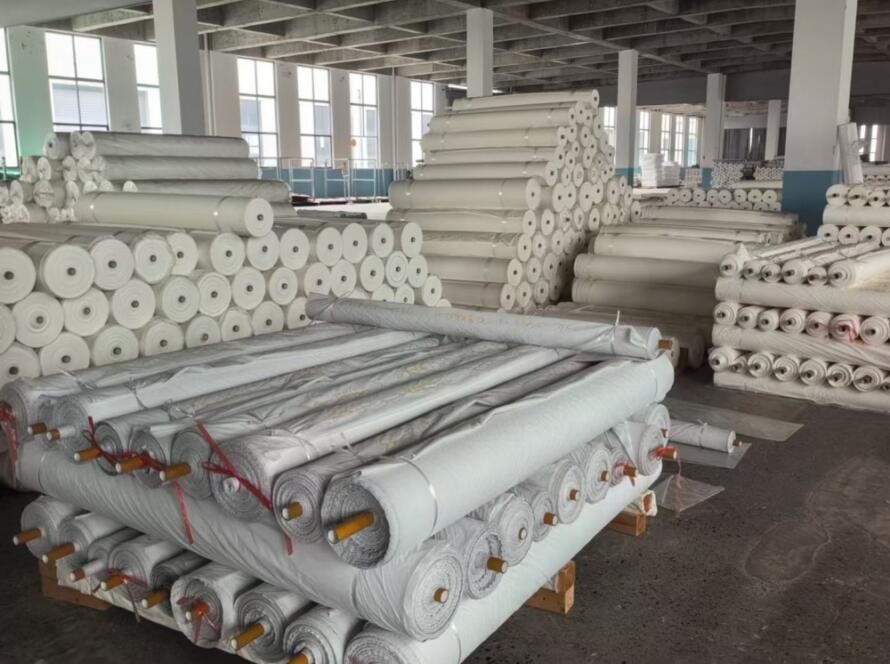
Mifu Textile runs both routes on 298 of our own looms, with yarn sourcing, weaving, dyeing and finishing under one roof. For the commercial side of the service, see custom woven fabric development services.

The Two Routes at a Glance
- Full custom development — a new fabric built from scratch: fiber proportions, weave structure, weight, dyeing recipe and finishing all specified to your garment. Higher cost, longer cycle, exclusive result.
- Existing fabric upgrading — a mature base cloth from our greige stock, modified on one or more axes: yarns added, density and grammage adjusted, functional finishing layered on. Lower cost, short cycle, no new weaving set-up.
Route A: Full Custom Development From Scratch
This route is for brands that need a fabric nobody else can buy: a signature hand feel, a specific stretch profile, or a performance combination that off-the-shelf ranges cannot deliver. Nothing is chosen before your garment brief is — the fabric is reverse-engineered from how it will be worn, what it has to survive, and what the label has to be able to claim.
1. Demand confirmation — what gets fixed before anything is woven
Development starts with the end use, not with a yarn. We work through the wearing scenario, the target consumer and the quality standard your market enforces, then translate them into fabric parameters:
- Business apparel — skin-friendly, wrinkle-resistant, low shrinkage, controlled drape.
- Outdoor apparel — high stretch, abrasion resistance, moisture management, permanent UV protection.
- Industrial workwear — high tensile strength, dimensional stability, anti-static for heavy-duty use.
- Luxury fashion — distinctive texture, controlled luster, a stretch hand that reads as comfort rather than performance.
Certification requirements (OEKO-TEX, GRS and market-specific standards) are settled at this stage rather than at the end, because recycled content and restricted-substance limits constrain which yarns we can spin in the first place.
2. Fiber blending — what each base fiber buys you
Composition decides hand feel, elasticity, breathability, durability and price. We blend across four base fibers plus functional filament yarns:
- Cotton — natural softness and moisture absorption, the right face for skin-contact garments. Blended with spandex, polyester or nylon it loses the drawbacks that make 100% cotton wrong for stretch programs: wrinkling, high shrinkage, zero elasticity.
- Polyester — dimensional stability, wrinkle resistance and cost efficiency, but stiff and airtight alone. Blended with cotton or nylon it gains softness and breathability while keeping its easy-care properties — the volume base for uniforms and outerwear, and for our polyester 4-way stretch ranges.
- Nylon (polyamide) — the best abrasion resistance of the regular textile fibers, with a smooth touch and strong elastic recovery. The base for lightweight outdoor stretch, and for our nylon 4-way stretch fabrics.
- Spandex — the elastic component of woven stretch goods. We run 2% to 8%: the low end for tailored business cloth where stretch should be felt but not seen, the high end for fitted sportswear that needs sustained recovery under load.
- Functional filament yarns — moisture-wicking quick-dry, anti-UV and conductive anti-static yarns are woven into the greige itself rather than coated on afterwards, so the function survives washing instead of fading out of the garment after a season.
- Specialty fibers — Tencel, wool, cupro and other fibers are available on consultation. Their spinning and finishing behavior changes the whole process route rather than just the composition, so we quote them case by case instead of listing them as standard.

3. Weave structure — where texture and stretch direction are decided
Once the fiber blend is fixed, the construction controls weight, thickness, stiffness, air permeability, surface texture and how much of the yarn’s stretch actually reaches the garment. We weave plain, twill, satin, basket and jacquard structures, and the choice is never cosmetic:
- Plain weave — compact and durable; high-count, high-density versions give a fine premium surface for stretch shirts and light workwear.
- Twill weave — visible grain, softness and superior drape for casual coats and autumn/winter workwear.
- Satin weave — long floats produce the glossy, fluid surface luxury programs want.
- Jacquard and modified structures — relief texture and market-exclusive looks that are hard for a competitor to copy from a photograph.
Density and cover matter as much as the structure name. A tightly set warp grips the weft and can lock a stretch yarn’s crimp almost dead — the single most common reason a fabric that tested well at the swatch stage feels stiff in bulk. We specify ends and picks per inch, finished weight and width together, and state them on the development sheet so the approved sample and the shipping bulk are the same cloth.
4. Dyeing and finishing — where stretch fabrics are won or lost
Stretch wovens shrink, distort and drift out of tolerance more readily than rigid cloth, so finishing is where a well-designed fabric becomes a repeatable one. Our sequence runs alkaline washing, cold-batch desizing, high-temperature pre-setting, selvedge binding, targeted dyeing, re-setting and pre-shrinking:
- Pre-setting locks the yarn arrangement so bulk production does not develop uneven elasticity or surface creasing.
- Mercerization for cotton-based stretch raises luster, smoothness, color fastness and dimensional stability in one pass.
- Pre-shrinking holds residual shrinkage inside export tolerances, so the garment does not move after the first wash — the failure that shows up as an out-of-tolerance size run, not as a sample complaint.
- Dye routing by fiber — reactive for cotton, disperse for polyester, acid for nylon — plus fixation steps that hold grade on deep shades without the yellowing that pale shades show when the route is wrong.
5. Functional finishing — turning a fabric into a product
Performance that has to survive the care label is added here: PFAS-free water, oil and stain repellent, anti-static, wrinkle-free, peach-skin softening and moisture-permeable finishing. The combinations that pay back fastest are program-specific:
- Outdoor — permanent anti-UV yarn plus a PFAS-free DWR, or lamination with a membrane if the brief calls for a fully laminated fabric.
- Sportswear — moisture-transfer finishing engineered to the garment’s sweat map.
- Business shirts — wrinkle-free finishing that holds through a working week.
- Special workwear — anti-static treatment where static discharge is a safety issue, not a comfort one.
Every finish goes through wash-durability curing and is formulated without hazardous residues, so the function you approve is the function still present after 20 domestic washes.
Route B: Upgrading a Fabric You Already Have
Route B is for programs on a tight calendar or a controlled budget that do not need a new fabric — they need a better version of a familiar one. We start from our greige stock of mature woven stretch cloths and change the fabric on the axis that solves your problem. No new weaving set-up is required, which is what shortens the sampling cycle and removes the tooling cost from the equation.
Adding yarns to fix a specific weakness
We introduce spandex, nylon, polyester, cotton or functional filaments into an existing composition and re-balance the blend: raise spandex content for better recovery, add nylon to soften the hand and lift tear strength, weave in moisture-wicking yarn to cut stuffiness, or bring in anti-UV filament for sun protection that washing cannot remove. The engineering risk here is distribution — a blend that is uneven shows up as patchy elasticity or surface spots, which is why we verify homogeneity rather than just quoting a percentage.
Adjusting weave and grammage to reshape hand and silhouette
By revising warp and weft density, weaving tension and yarn matching, we can make a thin, floppy cloth stiffer and more structured, or take weight out of a bulky one for breathable lightweight wear — then fine-tune grain and surface smoothness to match the design. This is a low-cost way to move a garment’s silhouette without touching the fiber story the label has already committed to.
Layering functional finishing for fast performance upgrades
Finishing is the fastest axis of all: no change to yarn or weave, no new sampling round on the loom. Moisture management, reinforced UV protection, PFAS-free three-proof, anti-static, sanding, wrinkle-free and antibacterial treatments can be applied singly or combined, with short lead time and bulk quality that tracks the sample.
How to Choose: Full Development vs Upgrading
The decision is usually about how much differentiation the garment actually needs, and how much time the calendar allows. Compare the two routes on the points that drive cost and risk:
| Comparison dimension | Full custom development | Existing fabric upgrading |
| Who it fits | Brands needing exclusive positioning, patentable constructions or performance no stock fabric delivers | Brands on a tight calendar or budget, seasonal launches and small-batch iteration |
| Development cycle | Longer — yarn matching, weaving trials and full-process finishing all have to be proven | Short — no new set-up, faster sampling and production |
| Cost structure | Higher, justified by added value in the finished garment | Low modification cost, no tooling fee, high cost performance |
| What can be changed | Everything: fiber proportions, weave, yarn count and grammage, dyeing route, functional finishing | Part of it: added yarns, density and grammage, hand feel, finishing stack |
| Differentiation | High — the fabric is not on the market unless you put it there | Moderate — performance upgrade on a proven base cloth |
| Batch fit | Medium and large stable programs, long-term brand partnerships | Small-batch trials, seasonal quick orders, short product cycles |
| Quality risk | Parameters are specified precisely, so shrinkage, elasticity and fastness are locked before bulk | Risk concentrates in blend distribution and finish durability — both are verified before bulk |
| Eco-claim options | Can be built around GRS-certified recycled polyester or other certified inputs from the yarn up | Usually inherits the base cloth’s fiber story; finishing can be PFAS-free |
What We Need From You to Quote
Development moves fastest when the brief arrives complete. These five points are enough for us to tell you whether the fabric you want already exists in our range, needs upgrading, or has to be developed:
- Garment and end use — product type, wearing scenario, and what it has to survive (industrial laundering, chlorine, sunlight, heavy abrasion).
- Target construction — weight and width, stretch direction and level, hand feel, and whether there is an existing swatch to match.
- Fiber preference or restriction — preferred fibers, fibers to avoid, and recycled or certification requirements.
- Compliance and testing — OEKO-TEX, GRS, PFAS-free, or a market-specific standard the finished garment must pass.
- Volume and timing — expected order quantity per color, launch window, and whether this is a first run or a repeat.
MOQ, Sampling and Lead Times
Concrete numbers, because they usually decide the route before the fabric does:
- Development MOQ — from 200 m greige, so a first trial does not have to be a bulk commitment.
- Custom dyeing — from 1,000 m per color.
- Sampling — hand samples in 4–7 working days; lab dips in about 4 days for approval.
- Bulk — dyeing 10–15 days after approval, plus roughly 3 days finishing.
Timing is quoted against your specification, so tell us the launch window up front and we will confirm whether the route fits it — that answer is usually more useful than a price on its own.

Custom Fabric Development Case Studies
Three programs that show how the routes work in practice — full fabric production cases are documented on the mill floor, with the specification, the problem and the shipped result:
- Workwear: 0-to-1 custom nylon fabric — a workwear fabric developed from a garment brief with no existing base cloth.
- Case report: custom woven 70D nylon spandex — construction and finish specified around a target hand feel.
- Chlorine-resistant fabric for 4.5K swim trunks — performance requirement that drove the fiber and dyeing decisions.
Frequently Asked Questions
What is the minimum order for a custom woven fabric?
Development starts from 200 m greige if you are trialling a construction, and custom dyeing runs from 1,000 m per color. Programs that begin as a trial usually move to a 1,000 m+ per-color volume once the sample is approved.
Can you develop cupro, Tencel or wool blends?
Yes, on consultation. Our volume base is cotton, polyester, nylon and spandex, with functional filament yarns woven in as needed; Tencel, wool and cupro are developed case by case, because their spinning and finishing behavior changes the whole process route rather than just the composition. Send the brief and we will tell you honestly whether the blend is worth developing.
Is woven fabric stretchable?
Yes, and in two different ways. Woven stretch usually comes from spandex blended into the weft at 2–8%, or from a spandex-free mechanical stretch yarn whose elasticity is built into the fiber structure — see our spandex-free mechanical stretch fabric range for that option. What separates a good woven stretch from a bad one is not the stretch percentage but how much of it comes back, and how long it keeps coming back.
How do I know the bulk will match the sample I approve?
We lock the specification before bulk: declared fiber proportions, ends and picks per inch, finished weight and width, dyeing route and finishing sequence all go on the development sheet, and bulk is released against that sheet rather than against the salesman’s memory. Every lot ships with its measured shrinkage and fastness data, so you can verify the goods on arrival instead of discovering a drift after the garments are cut.
Start With Your Brief
Send the garment, the target specification and your launch window, and we will tell you within one working day whether your fabric already exists in our range, can be upgraded from stock greige, or needs full development. Our custom fabric supplier FAQ on MOQ and quality control answers the next set of questions, and part 2 covers payment, shipping and inspection terms.
Request a quote or send your development brief →