Part One: Production Control Points for Heat Shrinkage and Washing Shrinkage in Woven Stretch Fabrics
General Introduction
Woven stretch fabrics are composed of cotton/nylon/polyester combined with spandex. The inherent residual stress within the spandex is the core reason for excessive washing shrinkage and heat shrinkage in the fabric.
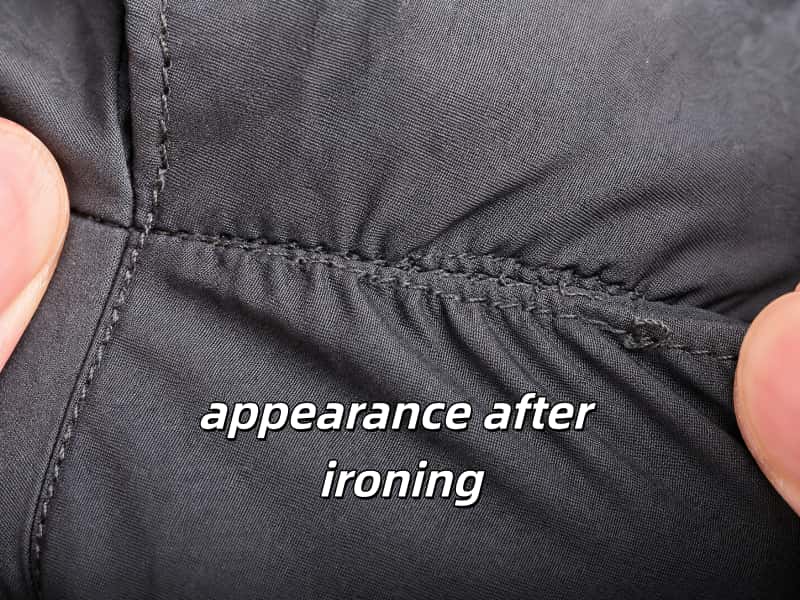
Only through segmented control across the entire production process can shrinkage rates be stabilized. (Typical internal control standards: washing shrinkage ≤ ±3%, ironing/heat shrinkage ≤ ±2%.)
1. Yarn and Weaving Stage
Specific Controls
- Perform pre-setting on the spandex yarn beforehand to eliminate internal spinning stress. Select low-shrinkage, stable spandex types.
- Use DTY fully-covered spandex yarns to avoid exposed spandex which leads to uneven tension.
Function & Effect
- Maintain constant warp and weft loom tensions to prevent uneven fabric tightness from edge to edge.
- After weaving, let the greige fabric relax and rest for more than 24 hours in a loose roll to allow natural release of weaving stress. Do not proceed immediately to pre-treatment.
2. Pre-treatment and Pre-setting (The Most Critical Step for Shrinkage Control)
Specific Controls
- Nylon/Spandex: Pre-set at 210-220°C.
- Polyester/Spandex: Pre-set at 200-210°C.
- Process at medium-slow speed to fully fix the width and fabric structure, locking in the spandex stress.
Supporting Measures
- Use cold pad batch (CPB) desizing and open-width scouring. Do not use rope-form scouring in a jet machine, as rope-form agitation easily creates latent shrinkage in the fabric, leading to significant later shrinkage after washing.
- Pre-set width should be 5-10 cm wider than the final finished width.
- The pre-set fabric weight (grammage) should be higher than the final finished weight. For example, if the final requirement is 100 g/m², the pre-set weight should be around 105 g/m². This reserves allowance for subsequent processing.
3. Dyeing Process
Specific Controls
- Select room-temperature or compatible dyes.
- Strictly control the heating and cooling rates. Heat slowly to avoid sudden thermal shock to the fibers.
Function & Effect
- After dyeing, let the fabric come off the machine in an open-width state and cool naturally in a loose pile. Avoid forceful stretching or widening.
4. Final Setting + Pre-shrinking (Compacting)
Specific Controls – Final Setting
- Final setting at low temperature: Nylon/Spandex 150-160°C; Polyester/Spandex 140-150°C.
- Note: This temperature range differs from conventional industry practice. Most peers believe that such low final setting temperatures will fail heat shrinkage requirements. However, this range is derived from our company’s long-term production practice and optimally balances colorfastness and dimensional stability.
Core Principle
- The key to controlling heat shrinkage in stretch fabrics lies in pre-setting. It is the pre-setting stage—with on-site recording and process adjustment by the coordinator—that matters most, not final setting as with most conventional fabrics. Pre-setting is the foundation of high-quality elastic fabric production. This is the primary reason our production of woven elastic fabrics avoids errors.
- Set the final width according to the garment’s required allowance. Do not forcibly over-stretch the fabric to widen it (over-stretching is the number one cause of failing heat shrinkage and washing shrinkage).
Specific Controls – Pre-shrinking (Compacting)
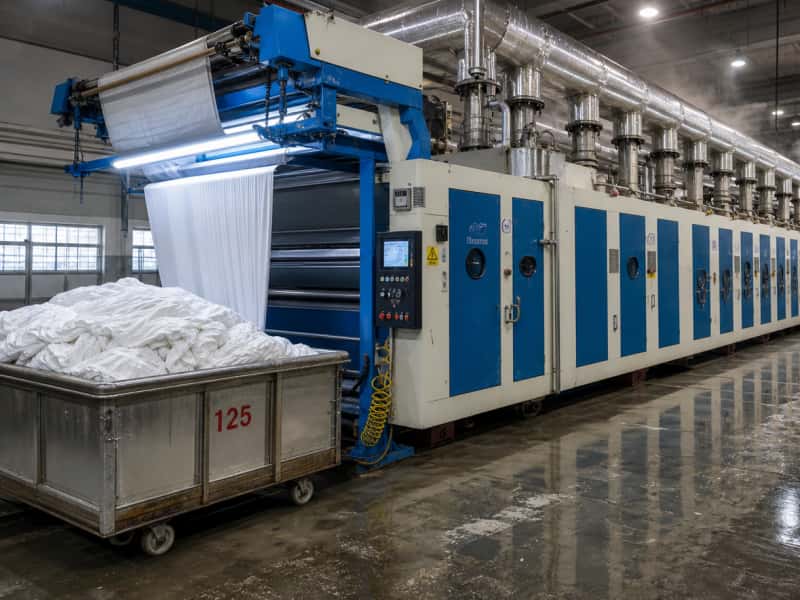
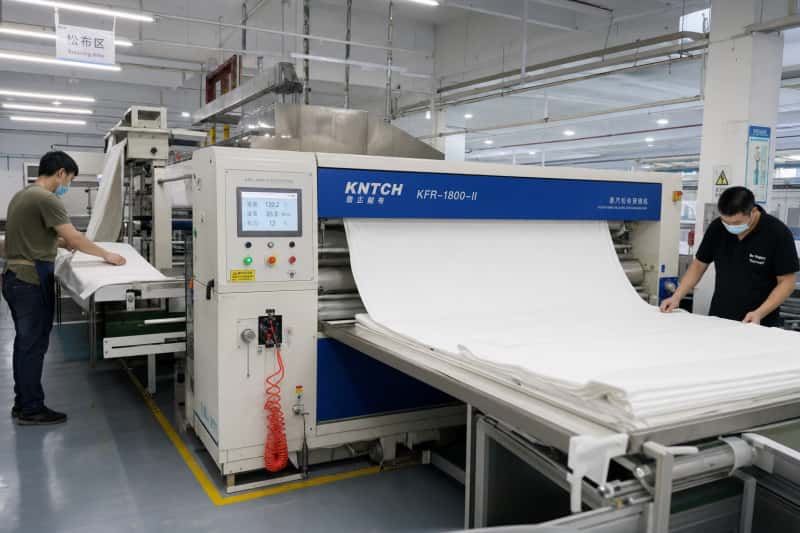
- For all types of stretch fabrics, add a steam pre-shrinking (compacting) process. The core equipment features a high-temperature Teflon mesh/slat conveyor belt that supports the fabric without tension. It contains an enclosed steam box (steaming downward to moisten the fabric) and a hot-air drying duct. Using overfeed, the fabric is allowed to shrink naturally at the source, reducing the final washing shrinkage rate.
5. Warehouse Storage After Production
Specific Controls
- Before packaging, allow the finished fabric to rest at room temperature for 6-12 hours, then roll it.
- Avoid storing in hot, stuffy environments. High-temperature storage will cause slow, natural shrinkage.
Part Two: The Importance of Dimensional Stability in Woven Elastic Fabrics – Two Real-World Case Studies
Case Study 1: A Failed Export Sportswear Jacket Order
Background
An export-oriented garment trading company purchased 23,000 meters of nylon hiking fabric (woven stretch) from Supplier K for a European/American sportswear jacket order. During acceptance inspection, the company only checked fabric hand feel and color; they did not rigorously test the washing shrinkage rate.
What Happened
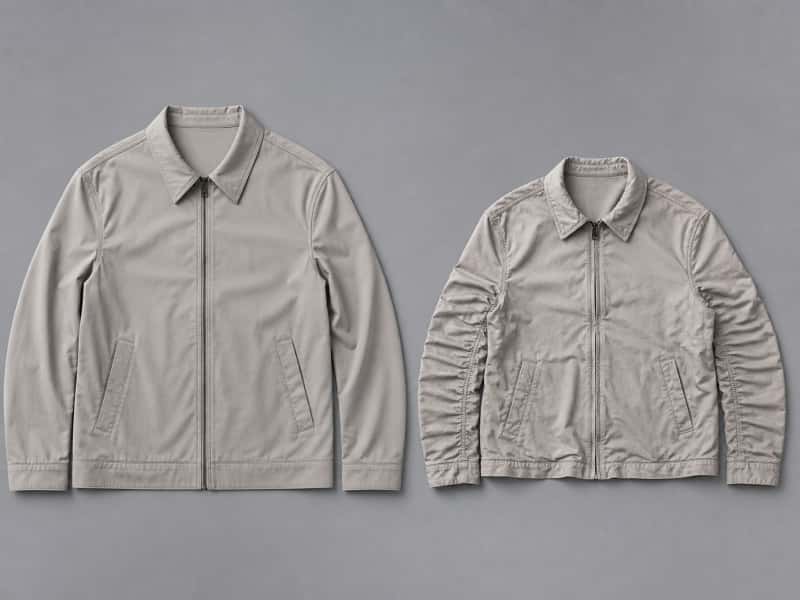
The fabric was cut and sewn directly upon arrival. The finished garments were shipped in bulk to an overseas warehouse. Upon random inspection by the customer, it was found that after gentle warm-water washing, the jacket body length had shrunk by 5 cm and the chest circumference by 3.5 cm. The entire batch of jackets was too tight to be sold.
Consequences
- The entire order was returned for rework.
- The garment company suffered losses exceeding 460,000 CNY in freight and processing fees.
- The fabric mill had to compensate the full fabric payment.
- The foreign brand permanently terminated its cooperation with the garment company.
Post-Inspection Findings
Testing later revealed that the fabric’s shrinkage rate was only borderline acceptable after final setting. Subsequently, the fabric underwent a brushed/napped finish but was not re-set afterwards, leading to the production failure.
| Special Note: Brushing/napping processes destroy the surface structure of the fabric, creating microscopically visible gaps that reduce fabric compactness. Such fabric will inevitably shrink after washing. |
Case Study 2: The Skirt That Grew Longer With Every Wash
Background
A fabric trading company in Keqiao, Shaoxing, received an order from a fast-fashion brand for 47,000 meters of polyester woven stretch fabric to make the season’s popular A-line skirt. The customer required a washing shrinkage rate of ≤ 2.5% in both warp and weft directions.
The Mistake
This trading company normally sold various woven and knitted fabrics but was not specialized in stretch fabric production. They compared prices and chose a Fujian dyeing mill whose quote was 15% lower than others. The mill owner confidently stated, “We know polyester stretch fabrics well; we produce tens of thousands of meters daily with no issues.”
What Happened
Mass production proceeded smoothly and was completed in 20 days. The garment factory cut and sewed immediately and shipped the 60,000 skirts just before the peak season. After the skirts hit the shelves, customers began posting photos comparing unwashed skirts with washed ones. The skirts were clearly longer after washing: the hem dropped from above the knee to below the knee, the waistband slipped from the navel to the hip, and the fit became loose and sloppy.
Viral Fallout
One influencer posted a comparison video titled, “Wash this skirt once and it becomes a midi skirt, wash it twice and it’s a maxi dress, wash it three times and it’s a nightgown.” The video gained over 170,000 likes within a week.
Investigation Results
The brand urgently pulled all inventory and sent samples for testing. The test report showed: after three washes, the warp shrinkage was -5.8% (i.e., 5.8% growth), and the weft shrinkage was -3.2%.
Root Cause
During final setting, an excessive amount of silicone softener was added to the padding mangle to achieve a soft hand feel. The excess softener acted as a lubricant under high temperature, causing the spandex filaments to slip within the polyester covering layer. In simple terms: the mechanical force of washing caused the spandex to slip and stretch within the yarn core, and it could not recover.
Compounding Factor
The brand’s care label specified “gentle machine wash,” but consumers ignored that, tossing the skirts into regular 40-minute wash cycles.
Consequences
- The remaining 54,000 skirts were returned to the fabric company.
- After deducting the fabric payment, the fabric company also paid an additional 93,000 CNY in compensation.
- The brand’s flagship product for the season ended in failure, resulting in a significant loss of consumer trust.
| Final Reminder: To achieve a good hand feel in spandex elastic fabrics, the pre-treatment process must be thorough and complete. Do not cut corners or rely on excessive amounts of finishing agents. Excessive softener causes spandex “slippage,” leading to stretch fabrics that grow longer with each wash. |