
Polyester 4-Way Stretch Fabric Manufacturer — Volume Programs, Mill-Direct Prices
Wholesale polyester/spandex 4-way stretch — covering specifications from 30D, 50D, 75D up to 200D, with weights ranging 65 gsm to 320 gsm. Greige goods in ample stock for prompt custom color dyeing upon request. Printing and functional lamination services are also available, steady lead times for trading companies and garment factories running large repeat orders. Constructions outside the standard range — different weave, weight or finish — run through our custom woven fabric development route.
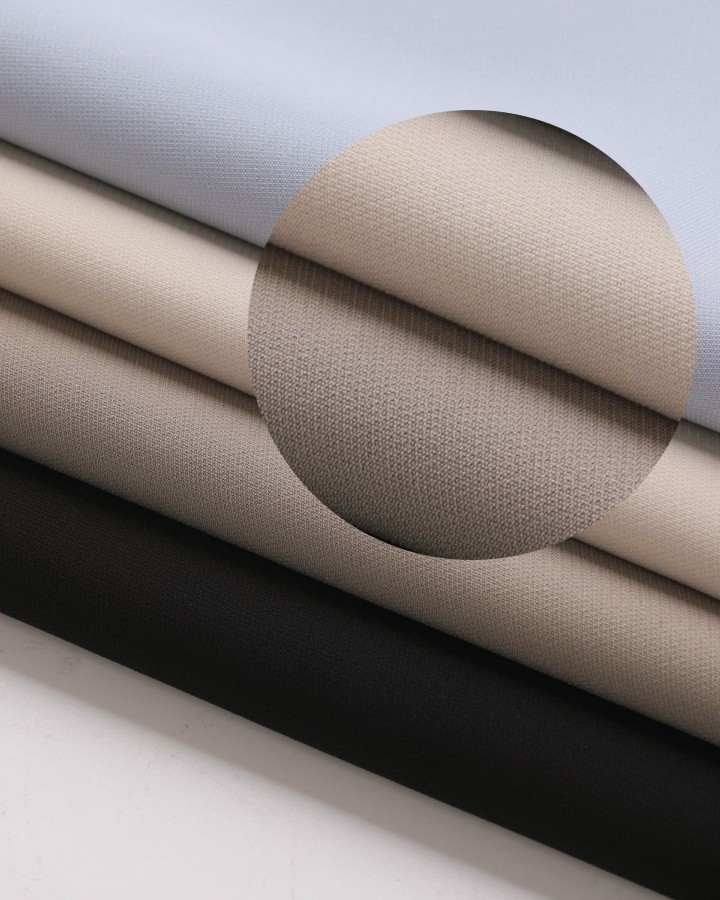
Double Layer
Polyester 4-Way
Stretch Fabric
What is Polyester 4-Way Stretch Fabric?
A woven fabric that stretches in all four directions (warp, weft, and on the bias) by combining polyester DTY yarns with spandex — typically 5–10% spandex content for stable recovery. Polyester DTY delivers quick drying, UV resistance and consistent pricing; spandex provides elastic recovery. The finished fabric retains its shape after repeated wear and can withstand rigorous industrial finishing and washing.
How the four-way stretch is built?
Woven 4-way stretch starts from a balanced plain, twill, or satin weave — never a knit. Spandex (also called elastane or Lycra®) is covered within polyester yarn during yarn preparation. During weaving, tension on the warp beams must be carefully regulated and kept from over-tightening. Later in the dyeing stage, the grey fabric undergoes high-temperature dyeing: heat triggers spandex shrinkage, which delivers the fabric’s final elasticity.
Why B2B buyers choose polyester over nylon for large orders?
Polyester delivers three key advantages nylon cannot match at a comparable price point: low moisture regain (0.4% vs nylon’s 4.5%), letting the fabric dry roughly 20% faster; robust UV resistance that retains over 85% of its breaking strength after prolonged sun exposure; and excellent compatibility for sublimation printing. Heat-set graphics adhere firmly to polyester at 200°C without yellowing, and the cost of sublimation printing on polyester is only one-fifth that of nylon. This is why nearly all printed sportswear relies on polyester base fabric.
For bulk orders over 5,000 metres, polyester 4-way stretch typically costs 15–30% less than its nylon counterpart, while offering comparable elastic recovery (92–95% vs nylon’s 95–97%). Polyester 4-way stretch benefits from mature production processes and strong market acceptance. Benchmark styles including 100D 4-way stretch at 125gsm and 75D double-layer 4-way stretch at 200gsm consistently rank among top exported 4-way stretch fabric items worldwide.
The main trade-off lies in hand feel: nylon features a softer, more premium drape. Polyester arrives with a slightly crisper touch straight off the roll, but softens after the first wash.
Polyester 4-Way Stretch · Basic Data
| Spec | Value |
|---|---|
| Composition | Polyester + Spandex (spandex content 5%~10%) |
| Polyester Yarn spec | DTY / FDY- 30D、50D、75D、100D、150D、200D |
| Spandex Yarn spec | 20D / 40D / 70D |
| Weight range | 65–320 g/m²(Production Scope) |
| Width range | 140–155 cm(According to elasticity) |
| Color Fastness | Standard: Dark 3, Light ≥ 3.5 High fastness: Dark & light ≥ 4 |
| Washing shrinkage | Strictly controlled ≤ 3% |
| Weave options | Plain, twill, satin, dobby, Checkered |
| Finishing | Lamination / Printing / Wicking & Quick-Dry Finish |
| MOQ (custom colour) | 1200 m / colour for classic; |
| Eco-friendliness | GRS / 100% PFAS-Free |
Applications & Recommended Construction
Polyester 4-way stretch covers a wider B2B application range than nylon — primarily because of sublimation printability, lower per-metre cost, and the option to bond with fleece or film. The four profiles below are where we see the most repeat orders.
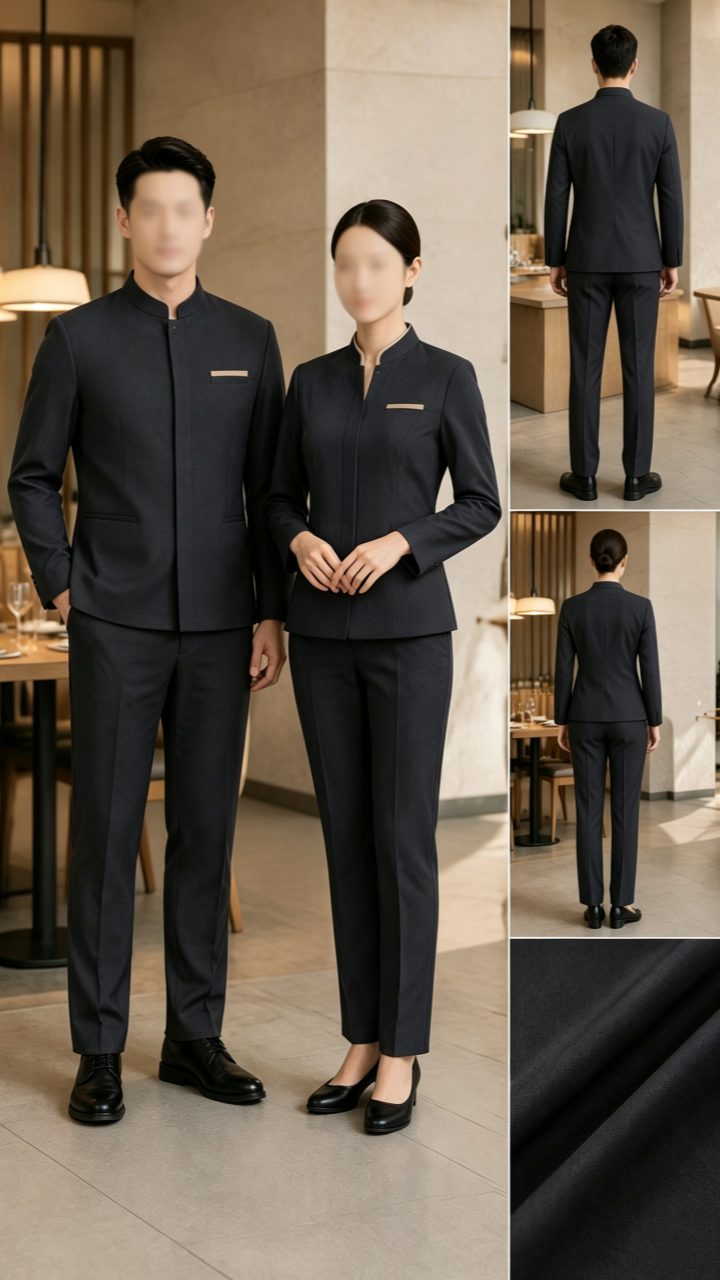
Workwear · Uniforms · School Wear
Stretch trousers and coat for security, school uniforms, hotel staff, restaurant chains. Polyester’s colour-fastness to industrial laundering and lower price point on large contracts make it the default choice. Often paired with anti-static finishes for electronics manufacturing lines.
Recommended spec: 75D × 75D, 200 gsm, double-layer
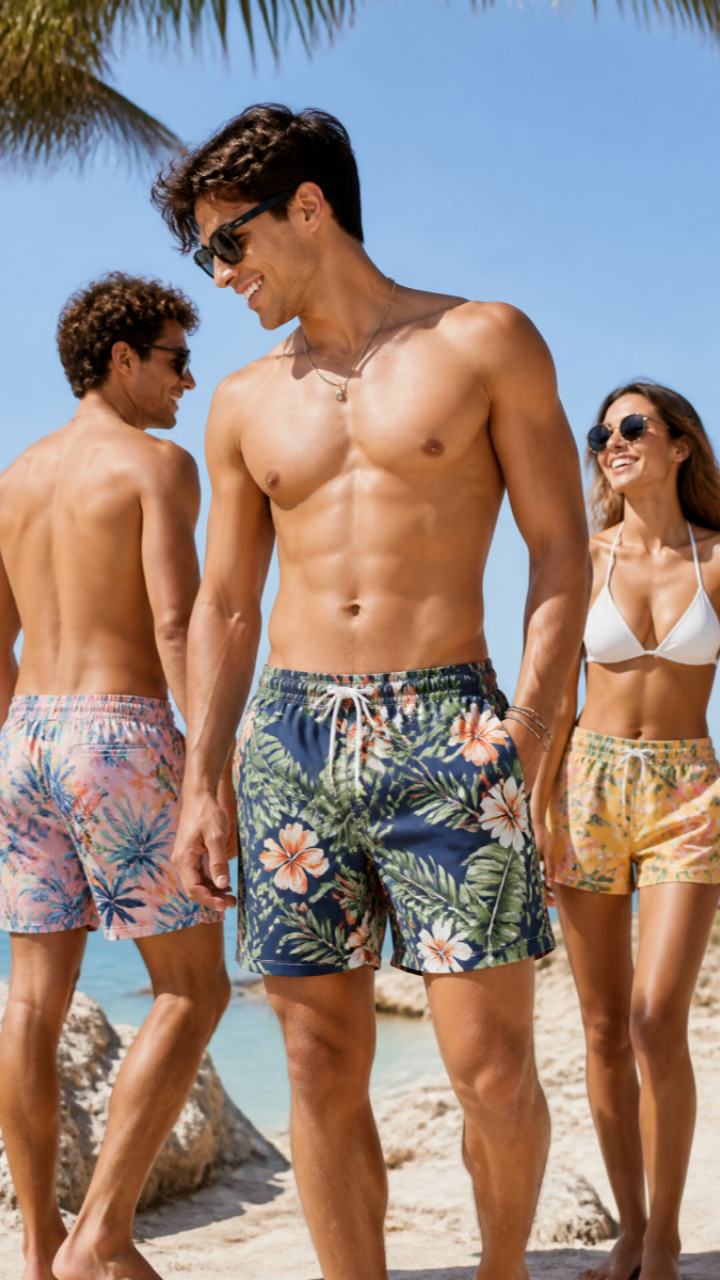
Beachwear & Sublimation Print Shorts
Polyester 4-way stretch has replaced peach-skin for printed men’s beach shorts. Peach-skin’s sanding process creates hard-to-treat wastewater and is perceived as low-end. Polyester 4-way stretch brings stretch for outdoor use and superior comfort. Most Asian exported printed beach shorts use 75D or 100D polyester 4-way stretch.
Recommended spec: 75D 、100D, 120–150 gsm, plain weave, disperse-print ready
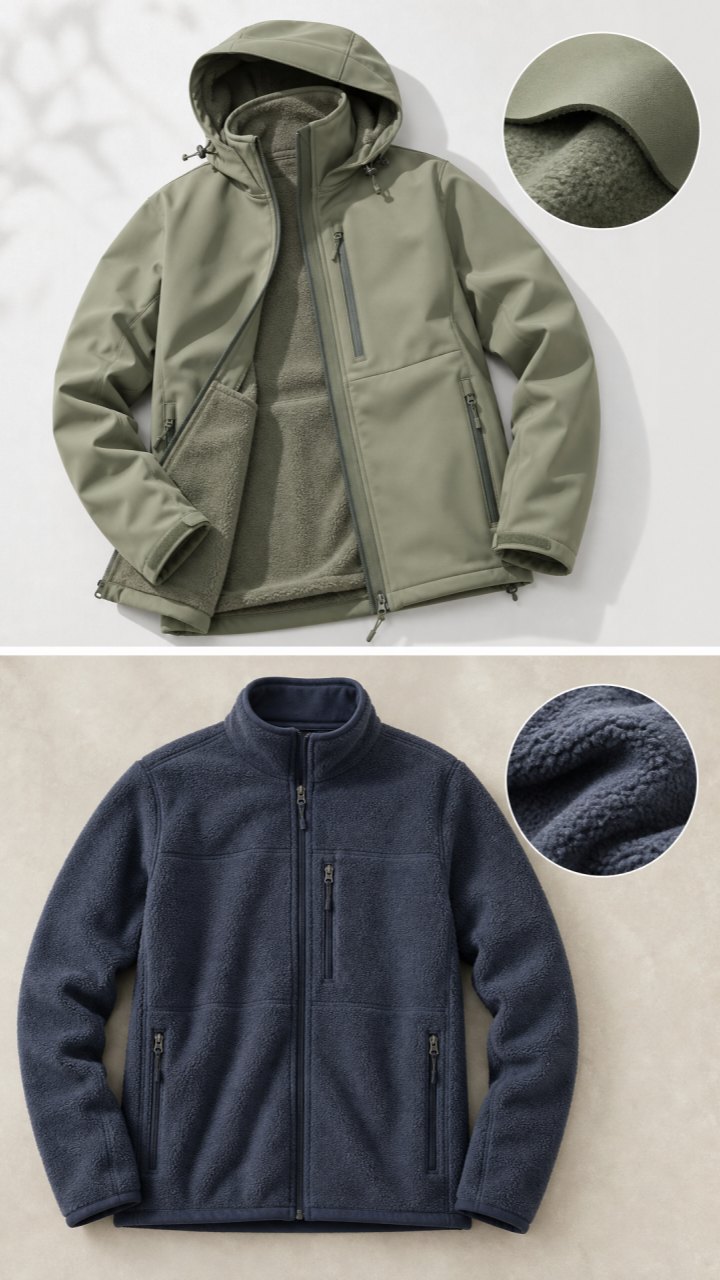
Outdoor · Thermal Insulation Apparel
We offer two polyester 4-way stretch thermal solutions. Woven one-piece fleece is a non-laminated single-layer fabric brushed post dyeing & setting; pile finish adjustable to sample. Suitable for indoor use or mid-layers, with no wind or water resistance. Laminated polar fleece bonds a functional membrane for windproof and water-resistant performance, widely used for softshell outerwear.
Recommended spec: A: >150D Dobby Weave, >180 gsm, B: 100D 4-Way Stretch Bonded Polar Fleece, 300 gsm
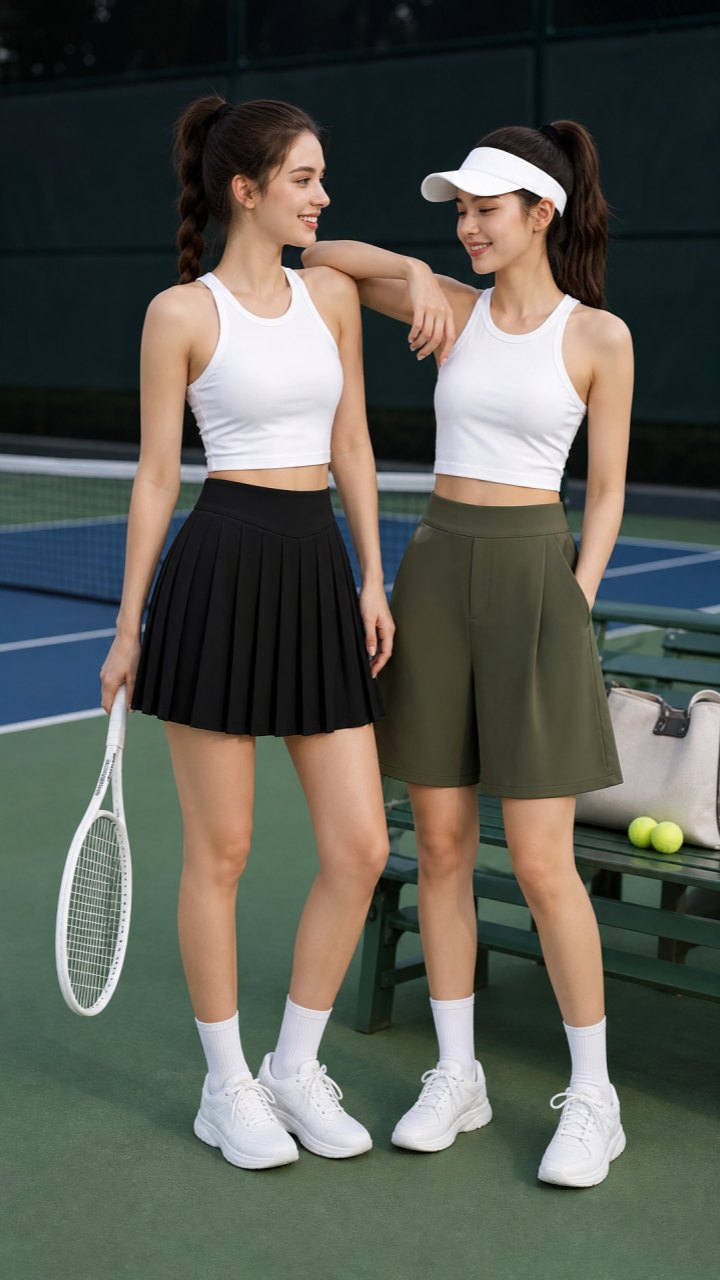
Activewear · Pleated Skirts & Skort Wear
Pleated skirts and skorts are popular applications for polyester 4-way stretch. Polyester maintains long-lasting pleat retention after heat setting. Skorts usually adopt a double-layer construction: a knit lining sits against the skin, while the outer layer uses woven polyester 4-way stretch to deliver structure and crisp silhouette. Where ultra-soft feel is the priority, our nylon 4-way stretch page covers the alternative spec set.
Recommended spec: 50D × 50D, 100 gsm, 75D · 144F, 140 gsm
Stretch Fleece & Softshell Composite Line
Polyester 4-way stretch fabrics support two distinct thermal solutions for outdoor apparel, engineered for different end-use requirements. The non-laminated woven one-piece fleece leverages a post-dye brushing process to create lofted warmth, with eco-friendly benefits. The laminated version bonds a functional membrane via hot-melt adhesive, delivering windproof and water-resistant performance for outer-layer softshell jackets.
Mid-layer・Woven One-piece Fleece
This non-laminated fabric is comparable to classic fleece styles seen in brands like Patagonia. It is constructed as a single layer, with brushing carried out after dyeing and setting. The pile texture can be customized to match client samples, followed by a secondary setting step.This fabric delivers fluffy warmth for indoor wear or mid-layer use, with no wind resistance or hydrostatic performance.
Best for: mid-layers, Patagonia-style pullover fleece, indoor loungewear, lining layers. No glue is used for bonding.
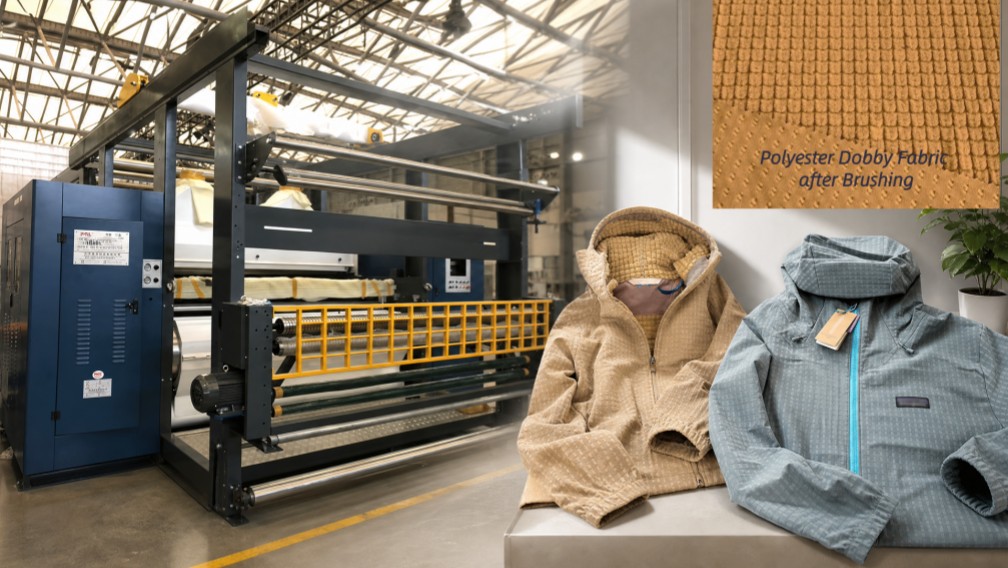
- Weaving
- Dye & Set
- Raising (brush back)
- Re-set
- Inspection
- Pack & Ship
Bonded with Film & Polar Fleece
This Lamination fabric starts with dyed and pre-set base fabric, then goes to a bonding factory for hot-melt membrane lamination with polar fleece backing.
The functional membrane provides reliable windproof performance and hydrostatic resistance. It is widely used for outerwear, especially softshell hiking jackets.
Best for: Outdoor scene · softshell jackets, ski-touring outerwear, technical hiking trousers.
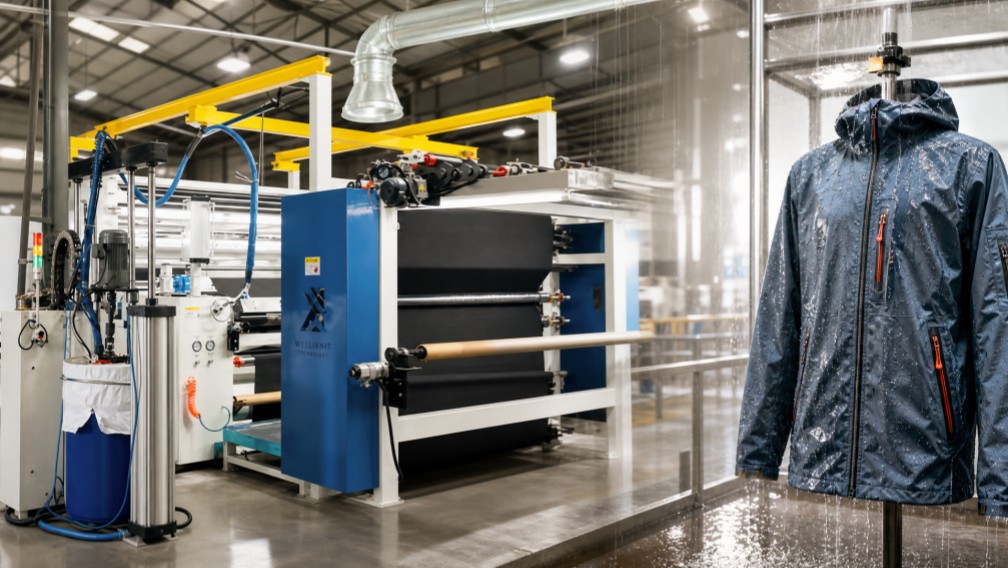
- Weaving
- Dye & Set
- Film + Fleece Bonding
- 12 h Cooling
- Peel Test
- Pack & Ship
Polyester 4-Way Stretch fabric Sublimation Printing — Rotary vs Digital Transfer
Polyester is the only major stretch substrate that accepts heat-transfer sublimation. Nylon yellows above 180°C; cotton burns. That is why printed sportswear, beach shorts and team uniforms are almost all polyester-based.
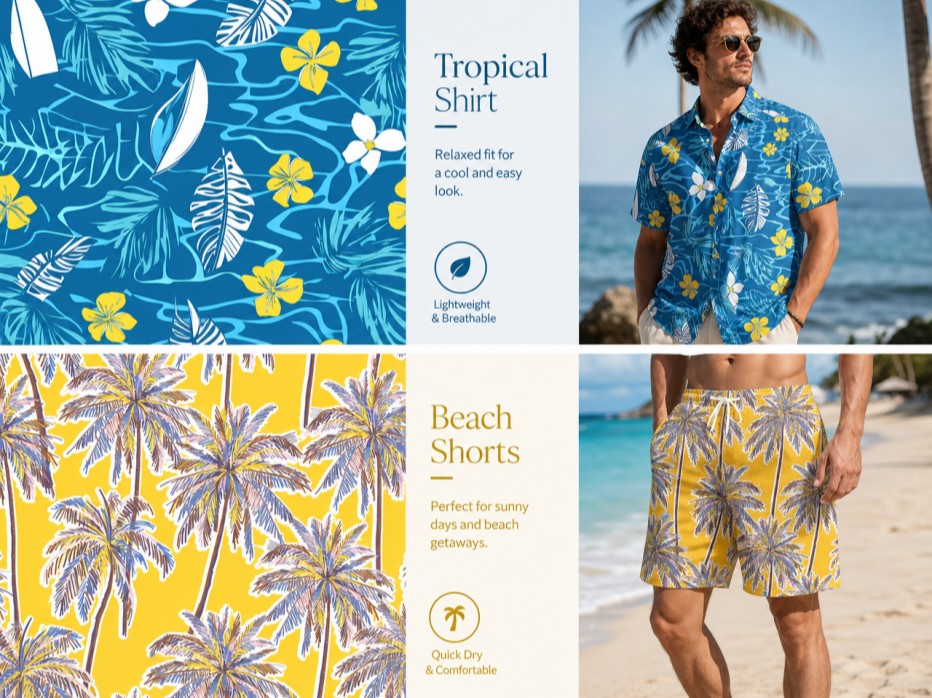
Two print methods — we match the route to your order
We run both mainstream polyester print routes, and we choose between them on the two things that actually decide your cost and your quality: how many metres you need and how complex the pattern is. Send us the artwork and the run length, and we will quote the route that holds the pattern at the lowest cost.
Traditional Rotary Paper Transfer Printing
The pattern is engraved onto copper rollers, printed onto transfer paper through roller pressure, and then thermally transferred onto the polyester base fabric on a continuous calender.
Significant scale economics — the lowest unit cost and the fastest production speed of the two routes, which is why it remains the default for large-batch conventional orders.
High minimum order quantity plus a plate-making fee on every new design. Physical engraving precision also caps fine detail: multi-colour grids and circular dot patterns frequently show pattern misalignment and seam marks.
Digital Paper Transfer Printing
No plate-making step at all. The pattern is printed straight onto transfer paper by a digital printer, then thermally transferred onto the fabric — artwork goes from file to fabric in one pass.
Breaks through the precision ceiling of traditional printing and reproduces high-difficulty patterns such as gradients and precise grids perfectly. No minimum order quantity — custom production is available from as little as 1 metre, provided we hold the complete pattern source file.
Relatively low production efficiency, at roughly 200–300 metres per hour. And by the nature of the sublimation principle it is completely incompatible with nylon fabric.
Pre-Shrunk Base Fabric
Print registration is only as good as the substrate’s dimensional stability. Every printed order runs on base fabric that has already been pre-shrunk and heat-set, so the pattern cannot creep, distort or slip out of alignment after the panel is cut, sewn and washed.
This is what makes precise grids, circular dots and seam-matching all-over prints reliably reproducible in bulk production — not just acceptable on a strike-off.
An Open Pattern Library You Can Order From
We maintain an open library of production-ready designs that customers can select directly: no plate-making fee, no minimum order quantity and no artwork file required. Pick the reference you like, confirm the base spec, and we go straight to printing.
Ideal for new-season refreshes, sample collections and first orders from smaller brands that need printed stretch fabric without committing to a full development cycle.
Common Mill Complaints We Hear About Polyester 4-Way Stretch
We see these complaints from garment factories and brands every season. Each one is paired with the mill-side cause and the control points we use to keep them out of your shipment.
Heat-Logged Hand & Transparency on Thin Lightweights
The complaint60–100 gsm polyester 4-way stretch feels hot and clammy against the skin in summer and shows through when stretched.
Root causePolyester is hydrophobic — it doesn’t absorb sweat the way nylon does, so moisture sits on the skin. Weave density at 60–100 gsm is necessarily open, so transparency on stretch is structural.
Mill fixPair 30D lightweight polyester with a wicking & quick-dry finish so moisture spreads and evaporates instead of pooling. Use a closer weave (twill or dobby) when the buyer needs under-100 gsm without show-through. For sheer-only applications, advise the buyer to consider our nylon 4-way stretch line at the same weight for higher coverage.
Why do some polyester four-way stretch fabrics have particularly poor color fastness?
The complaintPoor washing and rubbing fastness is common. Dark shades may only reach Grade 2~2.5.
Root causePolyester uses disperse dyes that bind via molecular adsorption. Insufficient dye holding time or skipped floating colour removal, paired with high-temperature setting, causes dyes to migrate out.Reaching Grade 4+ fastness on polyester 4-way stretch is harder than nylon, requiring mature production know-how.
Mill fixThorough Soaping: High-temperature soaping post-dyeing removes unfixed surface dye. Sodium hydrosulfite for reduction cleaning converts disperse dyes into soluble leuco forms to boost fastness.
Setting Temperature: Pre-setting: 200–210°C; Final setting: 140–150°C.
Off-Shade Within the Same Dye Lot
The complaintVisible colour shift across rolls from the same production batch — especially on Grey, army green, and coffee.
Root causeLow-cost dye houses push too much fabric through one bath (chasing volume) — fabric in the centre of the rope moves slower than the outside, picks up unevenly. Bigger problem on polyester than nylon because disperse dyes are more sensitive to bath circulation.
Mill fixStrict kg-per-bath limits per colour depth, forced bath circulation, jet-overflow machine with good liquor exchange. Roll-by-roll shade check against reference under D65 light box before packing.
Delamination of Polyester 4-Way Stretch Bonded Polar Fleece After Washing
The complaintPolyester 4-way stretch bonded polar fleece delaminates after 1–2 wash cycles. Bubbling may even appear before washing.
Root causeHot-melt adhesive hasn’t fully cured before next process step (the 12-hour window skipped or shortened); or downstream dryer/iron temperatures exceed 140°C and re-soften the bond layer.
Mill fixEnforce the 12-hour cooling window. AATCC 135 wash test after bond. Label care: cold wash, line dry, no tumble dryer, no hot iron over bonded seams. We provide a care-label spec sheet with every bonded order. Membrane options and base-fabric matching are covered on our laminated fabric page.
Pilling on Hips & Inner Thigh
The complaintAfter several wears, pilling and loose surface fibres appear on high-friction zones of leggings and trousers. This issue is commonly found in downgraded, low-cost 100D 4-way stretch fabric at 110gsm.
Root causeLow weft density creates a loose fabric weave structure. Excessive silicone finishing agents can also reduce fibre cohesion, causing fibres to slip out and form pills.
Mill fixAdopt a tighter weft density to stabilise fabric construction(High-density plain weave, twill, and check/plaid.). Control the dosage of silicone additives to maintain sufficient fibre cohesion.
Nylon vs Polyester 4-Way Stretch — A Sourcing Decision Matrix
Quick comparison for sourcing managers and product developers deciding between the two fibres. Both work, but the right pick depends on hand-feel target, printability, programme size, and end-use conditions.
| Property | Polyester 4-Way Stretch | Nylon 4-Way Stretch |
|---|---|---|
| Moisture regain | 0.4% — fast drying | 4.5% — absorbs sweat, slower to dry |
| Hand feel out of package | Crisper, breaks in after 1 wash | Soft, “premium” drape from day one |
| Stretch recovery (5× wash) | 92–95% | 95–97% |
| UV resistance | Better — 85%+ strength after sun exposure | Good — 70–75% after sun exposure |
| Sublimation print | ✓ Native — disperse dyes bond at 200°C | — Damage hardening above 180°C |
| Wash + light fastness | Grade 3 wash / Grade 4 light (typical) | Grade 3.5 wash / Grade 3.5 light (typical) |
| Price (same weight) | Lower — 15–30% cheaper | Higher — premium positioning |
| Best for recycling / rPET | ✓ Established supply chain for rPET | — Limited rPA supply |
| Typical end use | Workwear, schoolwear, printed beach shorts, sportswear, bonded fleece | Premium activewear, intimate apparel, wind-shell, Yoga wear |
Choose Polyester When …
You need sublimation print, the order is above 5,000 m, the garment is for workwear / schoolwear / uniform, or you’re building a softshell / bonded fleece outer. For spandex-free mechanical stretch in the same polyester family, see our T400 fabric page.
Choose Nylon When …
The buyer prioritizes premium hand feel, the order is for yoga / fashion activewear, or the fabric needs to perform in high-elasticity applications like compression. See our nylon 4-way stretch page for spec details.
rPET Recycled Polyester — Honest Composition Limits
Recycled polyester (rPET) is a clean technical answer for buyers with sustainability mandates — but the ceiling is different for every construction. The engineering constraint is simple: the spandex component of any polyester/spandex blend cannot be sourced in recycled form today, so the maximum rPET share of a given fabric equals its polyester content. A 100D at 92/8 tops out at 92%; a 75D at 88/12 tops out at 88%.
Why each construction has a different rPET ceiling
Spandex is a polyether-polyurea copolymer — chemically and physically distinct from polyester. There is no commercial melt-process route to recycle post-consumer spandex into fibre-grade spandex at any meaningful volume. So the spandex share of every stretch fabric is necessarily virgin, and the rPET ceiling is set by how much polyester the construction carries:
If a supplier quotes a single “recycled content” number for a whole stretch-fabric range without naming the construction, ask which one it refers to — the honest ceiling moves with the spandex ratio.
When rPET makes sense for B2B buyers
The clearest cases are European apparel brands with public recycled-content targets and buyers supplying retailers with the Higg Index or sustainability scorecards. For brands where “recycled” is a marketing differentiator rather than a hard spec, virgin polyester is often the more cost-efficient answer — and we won’t steer a buyer toward rPET purely to inflate the spec sheet.
rPET yarn costs more than virgin polyester (roughly +15–25%) , Recycled yarns feature poorer fiber uniformity compared with virgin yarns, resulting in higher end breakage rates and yarn brittle fracture rates during weaving, which leads to higher production loss, so on a custom colour run the order usually needs larger MOQ. We usually use 50D, 75D, and 100D recycled yarns with regular specifications, since these specs have large market availability and therefore more stable quality.
Certifications available: GRS (Global Recycled Standard), OEKO-TEX Standard 100, RCS. Lead time on rPET orders runs 2–3 weeks longer than virgin equivalent due to yarn supply chain.
Frequently Asked Questions
What is your MOQ for custom colours on polyester 4-way stretch?
Our MOQ for custom dyeing is 1200 meters per colour. For GRS recycled fabric, the MOQ is 3000 meters per colour. Extra charges will be applied if the order quantity falls below the minimum.
What is the lead time from order to delivery?
Colour lab dip takes around 4 days for client approval. Bulk dyeing takes 10–15 days after confirmation. Additional finishing such as lamination or printing adds 3 days. We quote custom lead times for large-volume orders.
Can the fabric be sublimation-printed at our factory?
Yes — we ship pre-treated, pre-shrunk greige specifically prepared for downstream sublimation. We provide the recommended heat-press profile (200°C, 35–45 s, medium pressure). Avoid nylon-blend inks.
What rPET content can you actually deliver?
It depends on the construction, because the spandex portion cannot be recycled: 100D (92/8) tops out at 92%, 30D (91/9) at 91%, and 75D (88/12) at 88%. GRS-certified rPET yarn, OEKO-TEX certified finish. Upcharge +15–25% vs virgin. Lead time +2–3 weeks.
How do you prevent bonded fleece from delaminating?
12-hour hot-melt curing window is enforced. Each lot is tested to AATCC 135 wash cycles. We publish the full bonding spec on request.
What fastness grades does your polyester 4-way stretch reach?
Standard run delivers wash fastness Grade 3, light fastness Grade 3.5, perspiration fastness Grade 3. Our high-fastness dyeing process upgrades select orders to wash Grade 4 / light Grade 4.
Can you supply UPF 50+ sun-protection finish?
Yes. UPF 50+ is our standard finish on outdoor-weight 50D 100gsm and is available as an add-on for other constructions. Test report (AATCC 183 / AS/NZS 4399) supplied per order.
Do you offer custom constructions (weave, weight, finish)?
Yes — for orders above 5000 m we can adjust yarn count, weave pattern, spandex ratio, and finish to your spec. Development lead time is 4–6 weeks. Contact us with your target spec sheet for a feasibility review.