

1. Order Basic Information
This order is a recurring down jacket fabric order from a long-term customer with stable annual cooperation. The core production parameters are as follows:
- Fabric Material: 420T High-density Polyester Pongee
- Quality Requirement: Custom high color fastness fabric that meets high-standard garment quality inspection specifications for end customers
- Original Process: Traditional down-proof coating process
- Order Colors: White, Black, Red, Pink
2. Order Update & Production Risk Prediction
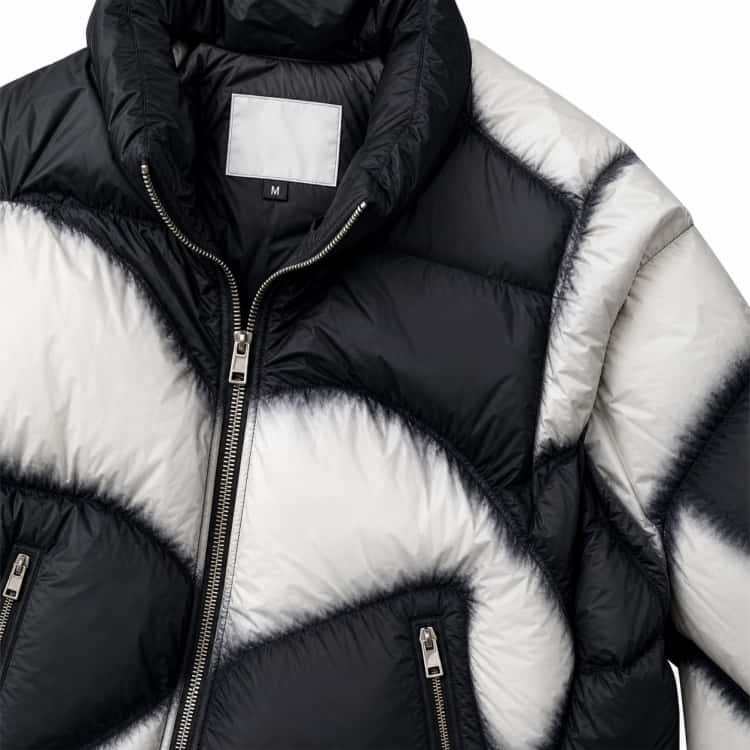
This down jacket style is a perennial bestseller for the customer. In previous years, each garment was designed with a single colorway, featuring mature production processes and stable fabric quality. For the current year, the end customer upgraded the product design and added multiple spliced styles, including three mainstream combinations: black-white splice, red-white splice, and pink-white splice.
Meanwhile, the end brand raised the overall fabric quality standards, with stricter requirements for high color fastness. Zero tolerance is implemented for common defects such as color staining at splicing seams, water washing color fading, and dry & wet rubbing staining.
Based on rich fabric production experience, our technical team identified a critical potential risk: the high color fastness performance of 420T high-density polyester pongee would degrade significantly after traditional down-proof coating treatment. For multi-color spliced garments, inter-fabric color staining and color migration are highly likely to occur, resulting in unqualified finished products.
We promptly informed the customer of the inherent defects of the traditional coating process and potential quality risks of spliced styles, and clearly warned of possible consequences including sharp decline in color fastness and splicing position staining. However, the customer lacked professional understanding of the impact of coating on fabric color fastness and insisted on adopting the original traditional down-proof coating process.
To avoid batch quality accidents and minimize losses for both parties after repeated ineffective dissuasion, we adopted a compromise production solution: only supply pure dyed semi-finished fabrics without coating treatment. The customer independently arranged downstream down-proof coating processing through a third-party factory to effectively evade production risks on our side.
3. Finished Fabric Quality Inspection (Uncoated Original State)
We completed the full procedures of dyeing, color fixing and soaping in strict accordance with the production standards forhigh color fastness fabrics. Before delivery from the dyeing factory, professional inspectors conducted comprehensive tests on the first batch of fabrics of each color, with a single batch length of approximately 1,200 meters per color.
The original dyed fabrics delivered excellent test results: the soaping color fastness and six-fiber staining fastness both reached Grade 4.5, fully complying with the end customer’s standards for high color fastness fabrics. The customer confirmed the qualified test data and accepted all semi-finished fabrics.
4. Quality Accident Occurrence (After Coating Processing)
After receiving the semi-finished fabrics, the customer sent them to a third-party processing factory for traditional down-proof coating. One week after the coating treatment, the customer produced sample garments and conducted finished product tests including water washing deformation and color fastness simulation tests, where severe quality problems were detected.
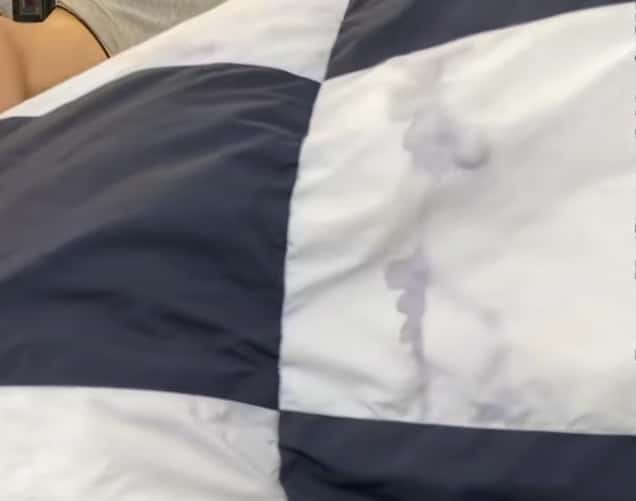
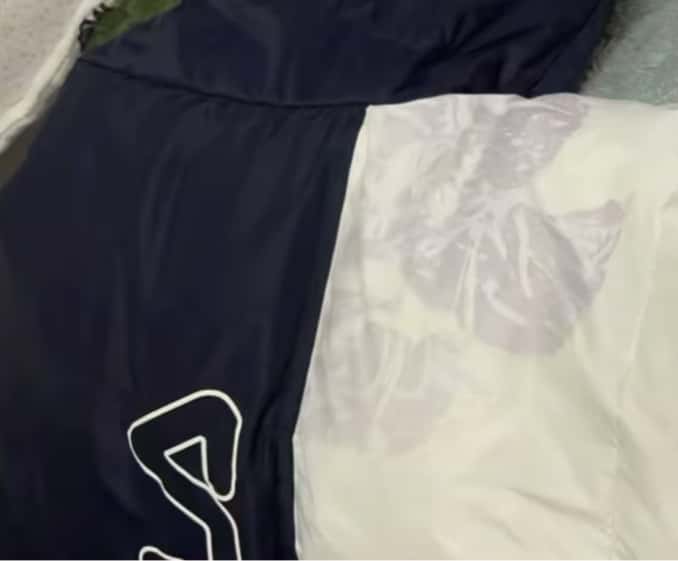
All spliced sample garments suffered from severe white fabric staining and color migration at sewing splicing seams. Pigments from dark-colored fabrics migrated to white fabric areas, causing obvious color difference defects. The finished samples failed to meet the end brand’s quality inspection standards, could not be submitted for final confirmation, and the entire order progress was suspended.
After the accident, we immediately retrieved the defective sample garments for re-inspection. The test data verified the root cause: after down-proof coating, the original Grade 4.5 high color fastness of the fabric dropped sharply to Grade 2.5, and the core performance of the high color fastness fabric completely failed.
5. Root Cause Analysis: Why Coating Process Reduces Color Fastness of High Color Fastness Fabrics
Traditional PU (Polyurethane) and PA (Acrylic) down-proof coatings are the core causes of sharp color fastness decline and discoloration of high color fastness fabrics. The specific principles are divided into two dimensions:
5.1 High Temperature & Chemical Additives Damage Dye Chromogenic System
The down-proof coating process includes drying, curing and hot pressing at a high temperature range of 150~180℃. High temperature accelerates the volatilization and migration of unfixed floating dyes on the fabric surface. In addition, PU and PA coating adhesives contain active substances such as free acids, organic amines and residual monomers. Acidic components destroy the chromogenic groups of reactive dyes and acid dyes, while alkaline components decompose disperse dyes and vat dyes. This directly leads to fabric dullness, discoloration and shade deviation, thoroughly damaging the chromogenic stability of high color fastness fabrics.
5.2 Adhesive Penetration Weakens Binding Force Between Dyes and Fibers
Macromolecules in coating adhesives penetrate into the gaps of polyester pongee fibers and expand the fiber structure, which greatly reduces the adsorption and compatibility between dyes and fibers. The adhesion of originally stable fixed dyes decreases significantly. Dyes are prone to fall off and precipitate during water washing and friction tests, resulting in severe color fading, staining and color migration, and a sharp drop in color fastness indicators.
6. Rectification Solutions & Implementation Results
Targeting this quality accident, our technical team formulated a professional process optimization scheme based on the performance characteristics of high color fastness fabrics. We strongly recommended abandoning the traditional down-proof coating process and adopting a new environmentally friendly lamination process, which was fully approved by the customer.
We assisted the customer in sample testing and process upgrading, replacing the traditional coating with a hot-melt adhesive laminated 0.05TPU film process. This process delivers outstanding comprehensive performance: the hand feel, fluffiness, wind resistance and down-proof properties are completely consistent with the original coating process without hard or stuffy hand feel. Meanwhile, it completely avoids the defects of high-temperature chemical coating, maintaining the original fabric color fastness stably at Grade 4.5 and fully meeting the core quality requirements of high-standard garments.
The revised sample garments successfully passed the end brand’s quality inspection and final confirmation. To minimize the customer’s losses, we assisted in negotiating a reasonable solution for the already coated defective fabrics: these fabrics were applied to single-color down jacket styles to avoid splicing staining risks, resulting in no mass scrap loss.
Ultimately, all subsequent spliced and new-style fabrics of this order adopted the upgraded hot-melt adhesive TPU film lamination process. The entire down jacket order was successfully delivered with almost zero loss.
7. Case Summary
In the garment and fabric production industry, process adaptability and matching degree with fabric characteristics are the key determinants of finished product quality. Conventional fabric and process combinations may trigger hidden quality risks due to style structure and process changes. In particular, high color fastness fabrics are extremely sensitive to downstream processing temperature and chemical additives. Blindly adopting traditional processes will easily cause batch quality accidents.
A professional fabric supplier with an experienced technical team can predict process risks in advance and accurately match fabrics and production processes. It effectively avoids defects such as color fading, staining and substandard color fastness from the source, helping customers stabilize product quality, reduce production losses and ensure smooth order delivery.