Two fabrics can both be sold to you as “waterproof” and behave nothing alike. One sheds a light shower and soaks through in ten minutes of steady rain. The other holds a 10,000 mm column of water and still breathes. The difference is not quality control – it is which of three production routes the mill used, and whether the word on the tech pack matches the test the fabric was actually built to pass.
This article covers all three routes and where each one lands, then goes deep on the finish used on the largest share of waterproof stretch fabric: the durable water-repellent (DWR) finish – its chemistry, what it can and cannot do, and how to specify it so that what you order is what arrives.
1. Water-Repellent vs Waterproof: What Each Claim Actually Promises
In everyday English the two words are interchangeable. On a tech pack they are two different tests with two different pass criteria, and confusing them is one of the most expensive mistakes a buyer can make – not because either word is wrong, but because a supplier can satisfy one of them while you were expecting the other.
1.1 Water-Repellent (DWR): A Surface Effect, Measured by Spray Rating
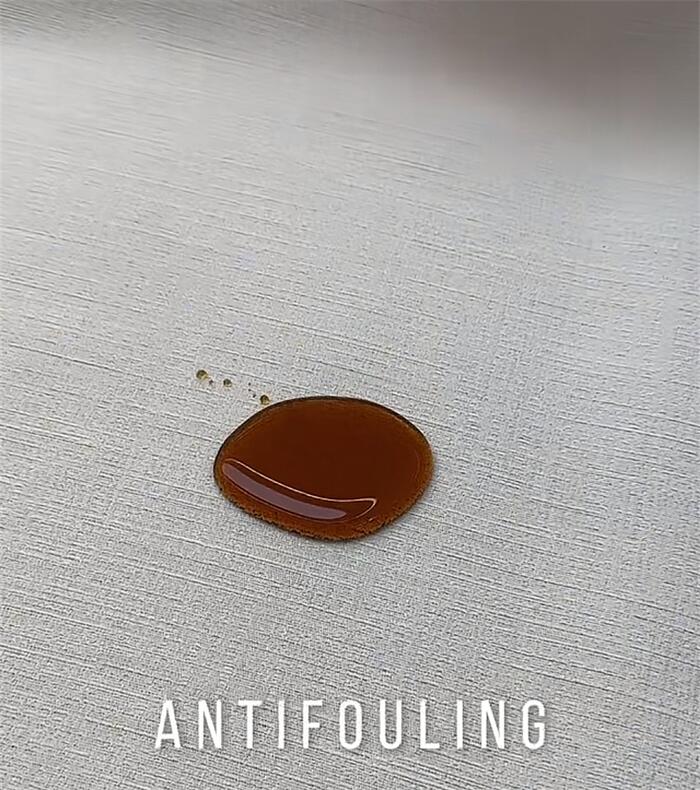
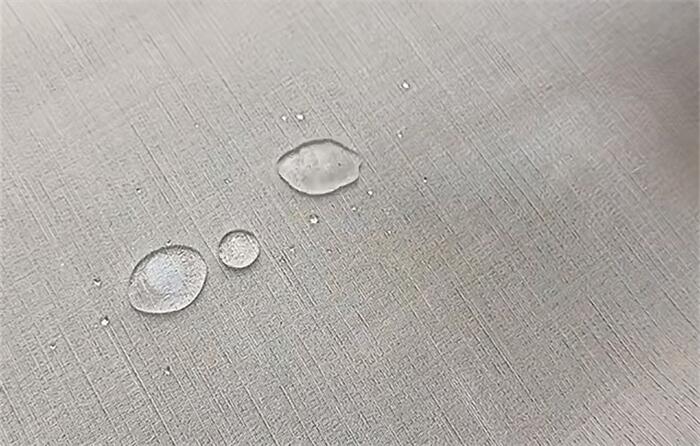
A DWR finish changes the surface energy of the yarn so that water beads up and rolls off instead of spreading and soaking in. It is measured with a spray test: a fixed volume of water is sprayed onto the fabric from a fixed height and angle, and the wetting pattern is compared against a rating card (AATCC 22 in the US, ISO 4920 in the EU, GB/T 4745 in China).
What it cannot do is resist pressure. A DWR-treated fabric is still a woven fabric with gaps between the yarns: kneel on it, lean on it, or let rain pool on it, and water passes. DWR also does not seal seams. What it is genuinely for is keeping the face fabric from wetting out – and on a laminated shell that matters more than most buyers expect, because a saturated face fabric blocks the membrane’s vapour path and the garment stops breathing. A tired DWR does not make a jacket leak. It makes it clammy.
1.2 Waterproof: A Barrier Effect, Measured by Hydrostatic Head
Waterproof means the fabric resists water under pressure. The fabric is clamped over a column of water and the pressure is raised until water penetrates – AATCC 127 or ISO 811 – and the result is expressed as a head of water in millimetres. Only a continuous barrier produces a meaningful number, which in practice means a coating or a membrane.
Two things get lost in the shorthand. First, the barrier belongs to the fabric, not to the garment: a 20,000 mm fabric with unsealed seams is not a waterproof jacket. Second, the number only means something with its method attached – which is the subject of section 6.
1.3 The Four Claims You Will See on a Tech Pack
| Claim on the tech pack | What it actually promises | Test method | Typical value |
| Water-repellent / DWR | Surface sheds water; no resistance to pressure | AATCC 22 / ISO 4920 / GB/T 4745 | Grade 4-5 initial; grade 3-4 after 5 washes |
| Water-resistant | Resists light rain and splash at low pressure | AATCC 127 / ISO 811 | 500-1,500 mm |
| Waterproof | Resists water penetration under sustained pressure | AATCC 127 / ISO 811 | 5,000-20,000 mm and above with a membrane; 1,000-10,000 mm with a coating |
| Rain / shower test | Behaviour under simulated rainfall, including absorption | ISO 9865 (Bundesmann) | Water penetration and percentage absorption |
The most common failure we see is a tech pack that says waterproof, a mill that quotes a DWR finish, and 5,000 metres that are neither. Both sides used the same word for different things. If your tech pack carries a hydrostatic number, it must also carry the method, the face-up or face-down orientation, and whether the number is before or after laundering.
2. The Three Production Methods and Where Each One Lands
Water repellency and waterproofing are not achieved one way. There are three routes in commercial production: a DWR finish on its own, a coating, and lamination with a membrane. They differ in whether they produce a barrier at all – and in what they cost you in breathability and stretch.
| Route | Barrier | Hydrostatic head | Breathability | Effect on stretch | Wash durability | Relative cost |
| DWR finish | No – surface effect only | Not applicable; rated by spray grade instead | Unchanged | None – the base fabric keeps all of its elasticity | Low: roughly 5-30 washes depending on chemistry | Lowest |
| Coating | Yes – continuous film | 1,000-10,000 mm | Poor to moderate; falls further as the film thickens | Compromised – see 2.2 | Moderate; the film can crack and separate | Low to moderate |
| Lamination | Yes – membrane | 5,000-20,000 mm and above | Good – microporous or hydrophilic membrane | Preserved when the membrane and the bonding are elastic | High with a PUR hot-melt bond | Highest |
Values above are indicative ranges; the figure you can actually claim depends on the membrane or coating weight, the base fabric construction and the agreed test conditions.
2.1 DWR Finish: Water-Repellent Only
The finish is applied by padding on the stenter line and creates no barrier at all. The base fabric keeps its full stretch, hand feel and drape, which is why DWR is the right answer for softshells, stretch pants and workwear that need stain resistance and light rain protection – and why it is the standard outer treatment on top of any laminated shell. Being a surface treatment, it is also the one route that never interferes with four-way stretch.
DWR is usually specified alongside moisture-wicking and quick-dry finishes on the same base fabric, because the two answer different halves of the same comfort question: one keeps rain out, the other moves sweat away from the skin.
2.2 Coating: Waterproof, but It Fights Warp Stretch
A coating paste, usually PU or PVC, is spread onto the fabric surface with a blade or roller and then dried and cured. Because it is applied as a liquid, it also penetrates the yarn structure, and the film that forms is continuous – which is exactly why hydrostatic head is easy to reach and breathability is the price. Thick coatings also make fabric stiff, heavy and noisy.
The problem specific to stretch fabric is how the film sets. The coating is applied and cured while the fabric is held out to width and under warp tension on the line, so the film fixes in that extended state. On the finished fabric the warp direction is then largely locked: it can no longer extend and recover the way the greige did, and a four-way stretch fabric ends up behaving like a two-way stretch one. You feel it as a cloth that kept its weft stretch but lost its warp-way give. Repeated stretch and relaxation also work the film itself, and fold lines and stress points are where coatings chalk, crack and eventually lift away from the base fabric.
Coating remains the correct, cheapest legitimate route for articles that do not need to stretch and do not need to breathe: rainwear, tarpaulins, tents, bags and industrial covers. For the mechanism behind it in detail, see how coating builds its water barrier.
There is a second limit worth writing down before it reaches a spec sheet: a thin coating can only carry so much water column. Mini-wet and lightweight coatings are chosen precisely for hand feel and air permeability, and those same choices cap the hydrostatic head. A 30D nylon four-way stretch with a light wet coating will not hold 2,000 mm after four home washes, however the line is adjusted; forcing it there means giving up the lightweight build and moving to a high-density PU coating with multiple washing and setting passes, which changes the hand, the stretch and the weight of the finished cloth. We went through that trade-off with a customer who wanted both: why we declined a 30D nylon four-way stretch coating order.
2.3 Lamination: Waterproof, Breathable and Elastic
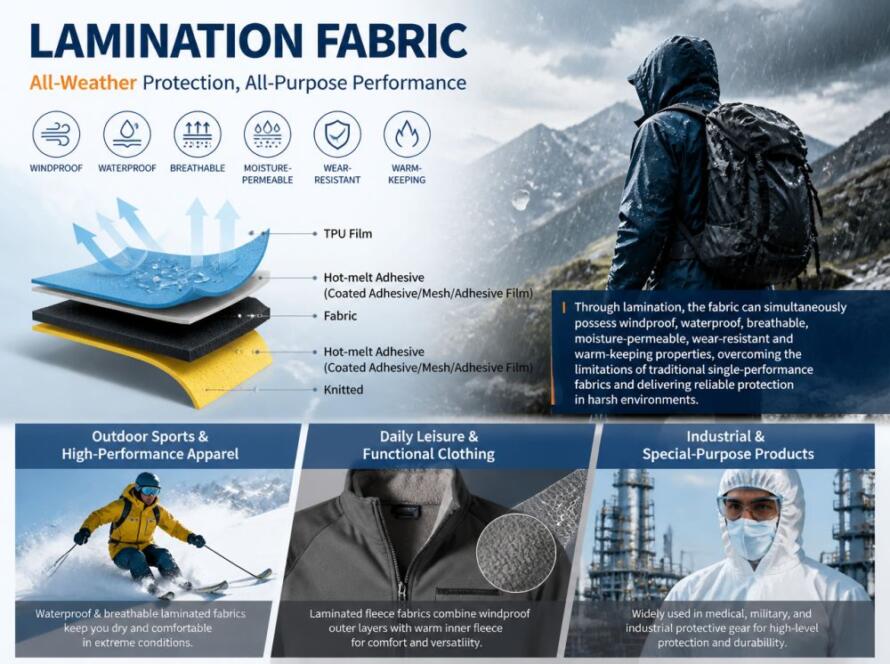
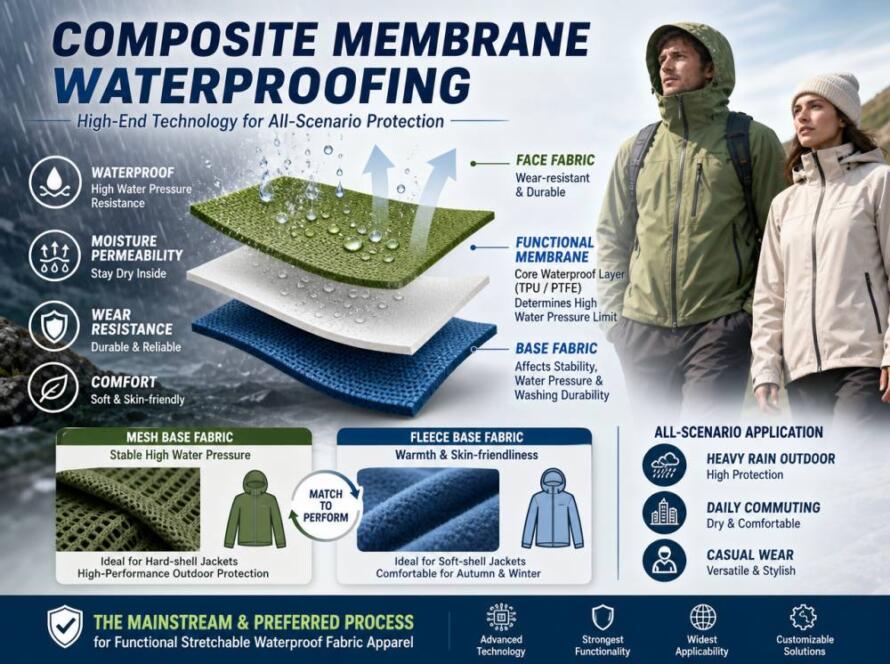
In lamination a pre-formed membrane is bonded to the fabric, typically with a PUR hot-melt adhesive. Because the membrane is manufactured separately rather than cast onto the cloth, it can be elastic – so the finished fabric keeps its stretch while gaining a real barrier. Microporous membranes block liquid water while passing vapour through pores far smaller than a raindrop; hydrophilic membranes move vapour along molecular pathways instead.
This is the route for waterproof stretch fabric that still has to move: ski and snowboard shells, cycling, climbing, motorcycle and technical workwear. What decides whether it survives is rarely the membrane brand and almost always the bonding – adhesive weight, dot coverage, curing, and whether residual stress in the base fabric pulls on the membrane over time. For what laminated fabric actually is, the failure modes and the numbers to write into a specification, that article covers it in depth. We run our own lamination line and test peel strength, hydrostatic head and MVTR in house – details on our lamination service.
2.4 Which Route Fits a Four-Way Stretch Fabric
- Needs to stretch, needs stain resistance and light rain only – DWR finish. Nothing else gives you the same result without touching the hand or the stretch.
- Needs to stretch and needs to be waterproof – laminate with an elastic membrane. This is the only route that delivers both a hydrostatic number and four-way stretch. For the finished article, stretchable waterproof composite fabric covers how the layers are put together.
- Needs to stretch, waterproof, and must not lose elasticity to spandex ageing – build the base fabric on T400 spandex-free mechanical stretch rather than elastane, then laminate it.
- Does not need to stretch – coating is the cheapest legitimate answer, and the correct one for rainwear, covers and tents.
3. Inside a DWR Finish: Chemistry and Line Control
DWR is the finish used on the largest share of waterproof stretch fabric, and the one buyers most often specify loosely. Two things are worth understanding: what is actually being applied, and which line stages decide whether it survives a wash.
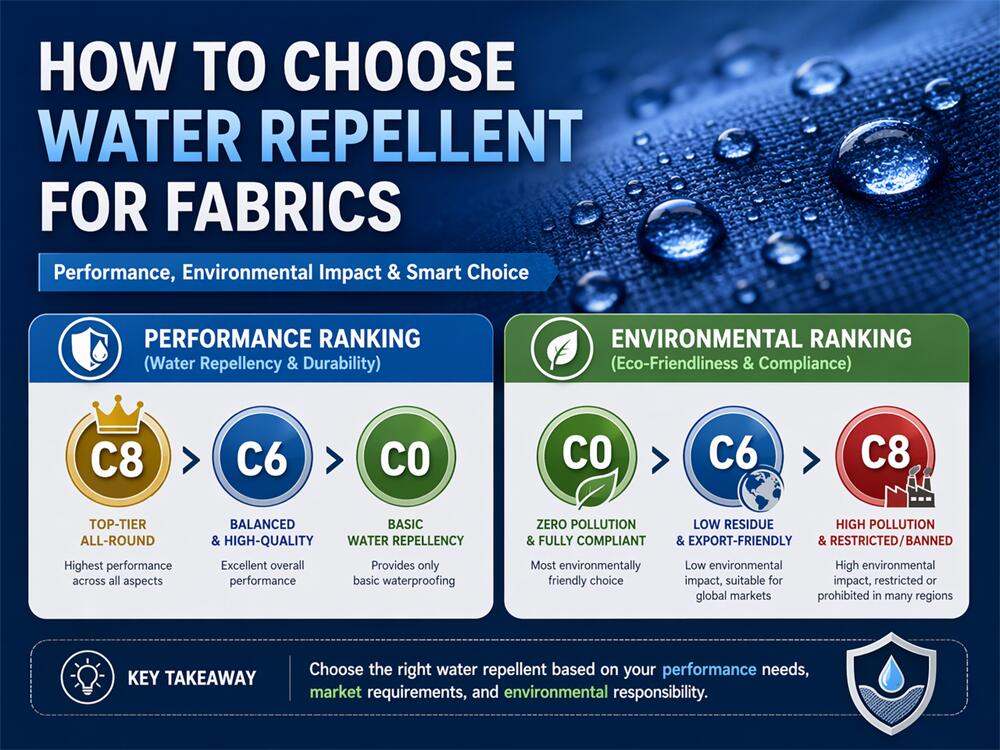
3.1 C8, C6 and C0: Three Generations of Chemistry
C8 long-chain fluorinated. Perfluorinated long-chain hydrocarbon compounds are polymerised into high-molecular fluorinated polymers, and the long chains form a dense, highly ordered film on the fibre surface. Water and oil repellency are both excellent and stable. The cost is in the by-products: the process generates the persistent organic pollutants PFOA and PFOS, which are non-biodegradable and bioaccumulative, and are restricted or prohibited across export markets.
C6 short-chain fluorinated. The carbon chain structure is rebuilt around shorter, safer perfluorohexyl molecules with modified branching, which cuts off the formation route for PFOA and PFOS at the raw-material end. Water and oil repellency stay high and residues in the finished fabric are undetectable against the regulated compound lists. It is still a fluorinated chemistry, however – see section 5.
C0 fluorine-free. Acrylic ester, polyurethane, silicone and bio-based wax emulsions, synthesised by emulsion polymerisation. Repellency comes from film-forming behaviour and the accumulation of hydrophobic groups rather than from fluorine. Water repellency can be good; oil and stain repellency are where it falls short, and that is the functional price of going fluorine-free.
3.2 The Four-Stage Finishing Line, and the Two Stages Buyers Underestimate
All three chemistries run the same sequence – pre-treatment, padding, pre-drying, setting – and differ only in formulation, baking temperature and parameters.
- Pre-treatment. Desizing, scouring, full washing and pre-setting, with no size residue or oil contamination left on the surface and pH held in the neutral range of 5-7. Residual impurities and a drifting pH damage the cross-linking and film formation: performance looks fine on a hand sample and then fails unevenly in the bulk. This is the most common process defect in mass production.
- Padding. One-dip-one-pad or two-dip-two-pad, with the pick-up rate held at 15-25% on synthetic fabrics so that the chemistry penetrates evenly and both faces of the cloth behave the same.
- Pre-drying. Slow drying at 80-110 degrees C. It costs line time, so it is the stage most often skipped on cheap programmes – and skipping it means the surface films over before the chemistry has penetrated, producing surface whitening, peeling and poor after-wash numbers.
- High-temperature setting. Matched to the fibre – nylon, polyester or blends – this both cures the finish and fixes width and texture. Two cautions: the setting temperature that maximises DWR durability is not always the one that protects shade and hand on every substrate, and running the line hot and fast to gain width sets up shrinkage and lost stretch later. The relationship between setting, width control and dimensional stability is covered in how heat and washing decide shrinkage.
3.3 How Repellency Is Measured: Spray Rating and After-Wash Rating
The spray test is run by spraying 250 ml of distilled water onto the fabric from a fixed height and angle for 25-30 seconds, then comparing the wetting pattern against a standard rating card. It is the key acceptance test for a water-repellent finish.
| AATCC 22 (US) | ISO 4920 / GB/T 4745 (EU / CN) | Surface wetting description |
| 100 points | Grade 5 (best) | No staining or wetting of the surface; water rolls off |
| 90 points | Grade 4 | A few sparse, irregular droplets; no large wet areas |
| 80 points | Grade 3 | Visible wetting at the sprayed points |
| 70 points | Grade 2 | Most of the surface is wet |
| 50 points | Grade 1 | The whole surface is wet |
| 0 points | Grade 0 | Fully wetted, with water penetrating through the fabric |
A fabric at grade 4 / 90 points sheds light rain and temporary splash, with droplets rolling off rather than spreading. It is still not waterproof – it has no barrier and no hydrostatic head. And the rating describes initial performance only: for outdoor programmes the number that decides whether a garment is still working in month twelve is the after-wash spray grade, which is why the laundering procedure has to be named next to it.
4. C0 vs C6 vs C8: The Comparison Buyers Actually Need
4.1 Performance
| Property | C8 long-chain | C6 short-chain | C0 fluorine-free |
| Water repellency | Top grade, lotus-leaf effect, grade 5 | Close to C8; high-end modified grades are comparable | Basic to good; droplets roll off, no resistance to pressure |
| Oil and stain repellency | Full three-proof: water, oil and stain | Full three-proof; maximum oil grade slightly below C8 | Little or none; oily liquids can penetrate the fabric |
| Wash durability | Roughly 30-50 washes | Roughly 20-30 washes; modified grades close to C8 | Roughly 5-10 washes without reactivation |
| Hand feel and appearance | Heavier film; can feel dry and slightly stiff over time | Thin, uniform film; soft hand, no whitening, retains drape and elasticity | Needs higher add-on; harder to keep soft, risk of stiffness and whitening |
4.2 Compliance and Environmental Grade
| Question | C8 long-chain | C6 short-chain | C0 fluorine-free |
| Is the chemistry fluorinated? | Yes | Yes | No |
| PFOA / PFOS by-products | Generated in production; high residue risk | Formation route cut off at raw-material level; residue undetectable against regulated lists | Zero fluorine, zero PFOA/PFOS, zero APEO |
| Passes a total-fluorine screen on the finished article | No | No – fluorine is present by definition | Yes |
| Market status | Prohibited for export apparel, mother-and-baby and close-to-skin categories | Accepted on some programmes, restricted or excluded on others – depends on the customer’s RSL | Compliant with current EU and US requirements, and with bluesign and ZDHC approved lists |
| Typical application | Low-end domestic articles with no environmental audit | Export programmes where the customer accepts fluorinated chemistry | All markets where a fluorine-free finish is required |
4.3 The Real Divide Is Oil, Not Water
On water alone, a good C0 finish sits closer to C6 than most buyers expect. The gap opens on oil: hydrocarbon resistance, measured on the AATCC 118 scale. If your product needs rain protection and stain resistance against water-borne dirt, C0 is often sufficient and is the safer choice commercially. If it genuinely needs oil repellency – workwear and uniforms exposed to oils, automotive, some industrial categories – that performance is not available without fluorine, and the decision belongs at the tech-pack stage rather than at a failed test report three weeks before delivery.
5. PFAS: Why “Fluorine-Free” Is Not a One-Line Answer
5.1 Regulation Moves in Families, Not in Single Substances
PFOA and PFOS were the first targets, with limits set at very low levels: under the EU POPs Regulation, PFOA and its salts are limited to 0.025 mg/kg and PFOS to 0.1% by mass. C9-C14 perfluorocarboxylic acids were then restricted under REACH Annex XVII. The scope has since widened from individual substances to the PFAS family as a whole – several EU member states have introduced textile-specific restrictions, US states including California have moved against intentionally added PFAS in textile articles, and the broader EU restriction continues to progress.
The practical consequence: do not treat “PFAS” as shorthand for the two or three substances that were tested last season. Confirm the current version and the exact scope of your customer’s restricted substances list before you quote, because that document – not the news cycle – defines what passes.
5.2 Targeted PFAS Tests and Total Fluorine Screening Are Different Gates
EN 17681-1 and EN 17681-2 are the textile methods: liquid chromatography with tandem mass spectrometry for the non-volatile compounds, gas chromatography with mass spectrometry for the volatile ones, run against a defined list of regulated and monitored substances. They tell you whether specific compounds are present and at what level.
A total fluorine or total organic fluorine screen on the finished article measures fluorine as an element instead. It does not care which molecule the fluorine sits in. Brands use it as a fast pass-or-fail gate, with the threshold written into their own RSL – which is why the same fabric can be “compliant” in one programme and rejected in another without a single test being wrong.
5.3 Why a C6 Finish Can Pass One Gate and Fail the Other
C6 chemistry is fluorinated by definition. It can be clean against a targeted compound list and still register fluorine in a total-fluorine screen. So “is C6 compliant?” has no general answer: it depends entirely on which test your customer runs, what threshold their RSL sets, and on which articles. Ask in writing, before the quote, and put the answer in the order confirmation.
5.4 Where Fluorine Hides in a Garment
The finish is only one source. Fluorine also arrives with membranes and seam tape, zippers, drawcords and elastics, sewing thread and labels, fluorinated oils and lubricants used in knitting, weaving and machine maintenance, and cross-contamination on shared lines and tenter frames. A finish swap alone does not guarantee a passing result on the finished garment: the whole bill of materials and the production line have to be screened, and that is a programme decision rather than a purchasing one. We cover the sourcing side, the evidence to request and how to plan a transition in PFAS-free fabrics.
6. What to Write in Your Spec Sheet: Numbers Without Methods Are Worthless
A hydrostatic figure with no test method attached is not a specification, it is an invitation. Any supplier can select the method that flatters the fabric, or quote a conditioning routine the cloth will never see again. Write the method next to every number, and write what state the sample has to be in.
| Property | Test method | What to add |
| Water repellency (spray) | AATCC 22 / ISO 4920 / GB/T 4745 | Initial grade AND grade after 5 washes, with the laundering procedure named |
| Hydrostatic head | AATCC 127 / ISO 811 | Face-up or face-down; before or after laundering; pressure rise rate if agreed |
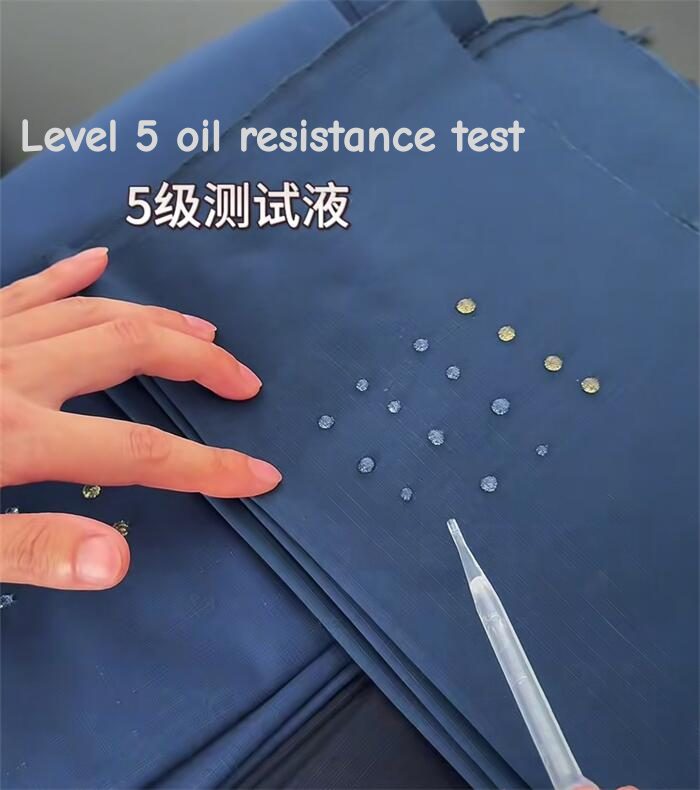
| Oil repellency | AATCC 118 / ISO 14419 | Required grade, and whether it must survive washing |
| Aqueous liquid repellency | AATCC 193 | Alcohol/water rating where the end use involves liquids other than water |
| Rain shower behaviour | ISO 9865 | Penetration and absorption limits for garments exposed to sustained rain |
| Breathability | ISO 11092 (Ret) or ASTM E96 BW | Method, and whether measured on the laminate alone or the finished assembly |
| Air permeability | ISO 9237 | Meaningful for coatings and uncoated fabric; not the right measure for a membrane laminate |
| Laundering procedure | AATCC 135 / ISO 6330 | The exact cycle, temperature and drying method used to generate the after-wash figure |
| Conditioning | ISO 139 | 21 +/- 1 degrees C and 65 +/- 4% relative humidity before testing |
| Seam sealing | Tape type and width | The barrier in a garment is only as good as its seams |
The line most buyers miss: does the after-wash result allow heat reactivation? Many DWR finishes recover a grade when the sample is tumble-dried or pressed, because heat re-orients the hydrophobic groups. That is legitimate and normal behaviour – but it is not the same claim as a finish that holds its grade without reactivation. If the report does not say which one was applied, you do not know which one you bought. Put the answer in the specification, and you will get it. The same discipline applies when you write the RFQ.
7. Sourcing Checklist: What to Verify Before You Place the Order
- Match the word to the test. If the garment has to be waterproof, ask for a hydrostatic number and its method. If the requirement is stain resistance and light rain, a spray grade is the right number – and asking for the wrong one will get you a fabric that passes on paper and disappoints in the field.
- Ask which route produces the number. DWR, coating or laminate – and confirm that the sample you approved came from the same route as the bulk.
- Ask for the after-wash figure with the procedure. Initial ratings are easy to reach. The wash cycle is where programmes fail.
- Ask whether the after-wash figure allows heat reactivation (see section 6). This single line separates two very different products.
- Check stretch retention in both directions, after finishing. Stretch is not one number: if the article has to keep four-way stretch, have warp and weft measured separately on finished cloth. How to read those numbers is set out in what actually decides fabric elasticity.
- Confirm the base fabric as well as the finish. Nylon brings abrasion resistance and strength, polyester brings UV and shade stability, and the base construction sets the ceiling for both stretch and hand feel – see nylon four-way stretch base fabrics. The best finish on the wrong base fabric is still the wrong fabric.
- Get the PFAS position in writing: which chemistry, which test, and which RSL version, before quoting.
- Wash five to ten metres yourself. Three domestic washes, then look at beading, hand feel and whether the face fabric is wetting out at the fold lines.
- Do not forget the seams. Specify the tape and the sealing method in the same document as the fabric.
8. How We Run Water-Repellent and Waterproof Programmes at Mifu
We do not carry a house default finish and apply it to every order. The finish follows your requirement: you tell us the market, the version of the restricted substances list you are working to, the rating you need and whether it has to hold after washing – and we select the chemistry and run the line to hit it.
We test before we ship. The finish is checked on the finished fabric, initial and after-wash, and the reports travel with the goods. Your nominated third-party laboratory remains the final word; if the result does not match the specification, we do not ship the lot. In practice this is the arrangement our customers ask for, and it is the one that keeps both sides out of arguments after the container has left.
Where a fabric has to be waterproof and stay elastic, we laminate it on our own lamination line rather than coat it – and we will also tell you when coating is the cheaper and correct answer instead, which it is for rainwear and covers. If you are specifying a waterproof stretch fabric for a coming season, send us the requirement and we will tell you which route delivers it and what the numbers will be.
9. Conclusion: Match the Claim to the Test, Then the Route to the Cloth
- Water-repellent and waterproof are two different tests. A DWR finish is measured by spray rating and provides no barrier; waterproof means hydrostatic head, which requires a coating or a membrane.
- For four-way stretch, coating is usually the wrong route – the film sets under warp tension and restricts elasticity, then cracks at the stress points. Laminate with an elastic membrane instead.
- Write methods next to numbers, and state the wash procedure and the reactivation rule. A performance figure without its method is not a specification.
- Treat “fluorine-free” as a programme requirement, not a finish choice. Confirm the test your customer runs and the scope of their RSL, and screen the whole bill of materials rather than the finish alone.