What is PFAS‑Free Fabric & Why is the EU enforcing related regulations in 2026?
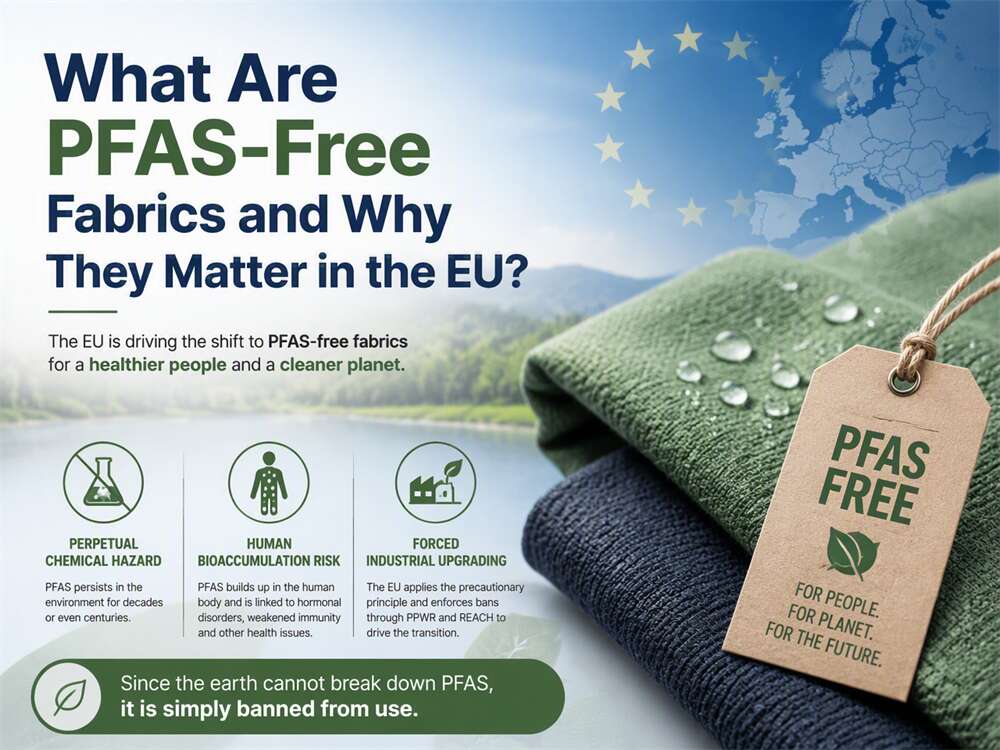
The core reason why the EU is pushing for PFAS-free fabrics is simple: PFAS, the oil and water repellent chemical, is extremely toxic and virtually non-degradable in nature.
To put it plainly, gaining fabric functionality at the cost of human health is never a worthwhile trade-off, and the promotion of qualified PFAS-Free Fabrics has become an inevitable trend in textile foreign trade. Here are three key reasons behind the policy shift:
- Perpetual chemical hazard: PFAS hardly breaks down in the natural environment. It seeps into soil and groundwater through rainfall and remains intact for decades or even centuries, earning it the name “forever chemical”.
- Human bioaccumulation risk: PFAS enters the human body via drinking water and the food chain and builds up over time. Long-term exposure is proven to be linked to hormonal disorders, weakened immunity and other health issues.
- Forced industrial upgrading: The EU adopts the precautionary principle. Even if the full extent of PFAS harm is not fully quantified, safe alternatives like PFAS-free repellents are already available. Therefore, the EU enforces bans via regulations including PPWR and REACH to drive brands and factories to upgrade.
In short, since the earth cannot break down PFAS, it is simply banned from use.
1. How Strict Is The New EU Standard For PFAS-Free Fabrics?
The new EU testing standard EN 17681-1:2025 took effect on October 31, 2025, replacing the old version EN 17681-1:2022 which adopted the alkaline hydrolysis method. This updated standard significantly tightens testing requirements and completely rules out loopholes for hidden PFAS violations, effectively standardizing the production and export of PFAS-Free Fabrics.
The old standard only used formaldehyde extraction to detect free PFAS residues on the fabric surface. In contrast, the new standard applies alkaline hydrolysis with methanol and sodium hydroxide, which can fully break down and detect bonded PFAS hidden inside fabric fibers and polymer structures.
The testing coverage is greatly expanded. Instead of only detecting a few common PFAS monomers, it now identifies thousands of related substances and their degradation products. The limit values are extremely strict: single PFAS substance ≤25ppb, total PFAS content ≤250ppb, and fluorinated polymer content ≤50ppm. Most fabrics qualified under the old standard will fail the new test, as all hidden and residual PFAS can be accurately detected now, raising higher requirements for the production of genuine PFAS-Free Fabrics.
- Testing upgrade: Old standard only detects surface free PFAS; new alkaline hydrolysis method captures internal fiber-bonded PFAS and covers thousands of substances and degradation products.
- Strict limit values
- Single PFAS ≤25ppb
- Total PFAS ≤250ppb
- Fluorinated polymer ≤50ppm
- Fabrics passing the old standard are highly likely to fail the new standard; hidden PFAS can no longer escape detection.
2. Why are quotations for PFAS‑free fabrics higher? Where exactly do the extra costs come from?
Currently, the textile foreign trade market is in urgent need of PFAS-free dyeing factories and grey fabrics. EU orders are fully shifting to fluorine-free and eco-friendly production, and high-quality PFAS-Free Fabrics have become the core demand of European buyers. Qualified PFAS-Free Fabrics require strict full-process control across three core links: grey fabric production, dyeing, and finishing.
2.1 PFAS-Free Grey Fabric
- The strictest requirement is pure tap water production. Most Chinese water-jet looms use recycled purified water, and only about 10% of domestic factories adopt tap water production. Meanwhile, strict checks must be conducted on equipment residual pollution, production auxiliaries and sizing agents.
- Two compliant solutions: customize production from qualified tap-water factories, or adopt air-jet weaving technology for fluorine-free production, which increases production cost by approximately 1.2 times.
- Industry status: Full-process PFAS-free production is complicated and highly standardized, leading to much longer lead times, up to 100 days in extreme cases.
2.2 PFAS-Free Dyeing Factories
Dyeing factories must confirm all incoming grey fabrics are 100% PFAS-free. All pre-treatment procedures, dye vats and setting machines need full PFAS-free renovation, with complete supporting PFAS testing procedures. This has become a major industrial upgrading trend, with numerous factories upgrading their equipment, products and testing systems comprehensively to produce compliant PFAS-Free Fabrics.
2.3 PFAS-Free Finishing Factories
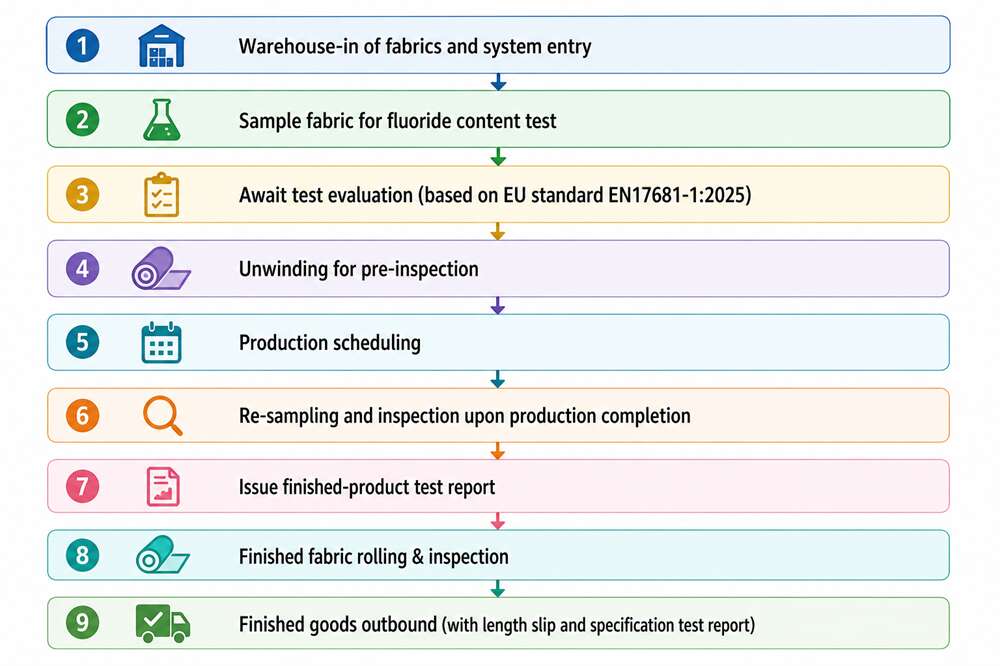
- Incoming material inspection: Every batch of incoming fabric must undergo laboratory PFAS testing. Unqualified fabrics are rejected directly to avoid source pollution and cross-contamination.
- Finished product testing: All finished fabrics must be verified by professional testing equipment to ensure PFAS compliance before delivery and guarantee qualified PFAS-Free Fabrics for export.
2.4 How much does a single PFAS‑free fabric test cost? Costs are added up at every stage.
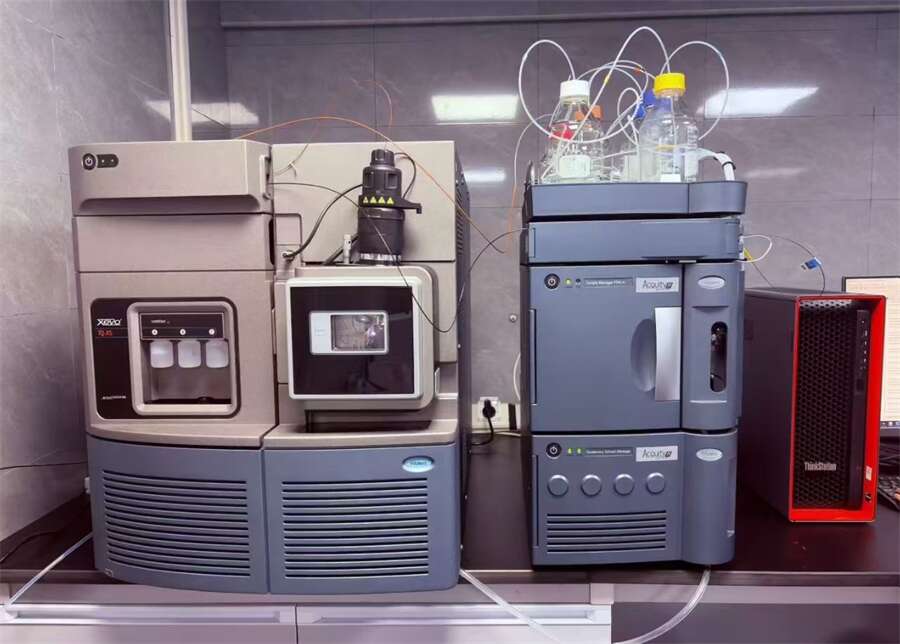
- The core testing device is ultra-high performance liquid chromatography coupled with a triple quadrupole mass spectrometer, costing around 3 million RMB per unit. It can accurately detect all restricted PFAS substances and issue official test reports for full traceability of every fabric roll, supporting the compliant delivery of PFAS-Free Fabrics.
- To stably pass EU new standards, factories need two key precision devices: UHPLC-DAD (ultra-high performance liquid chromatography with diode array detector) and LC/MS/MS (ultra-high performance liquid chromatography triple quadrupole mass spectrometer), with a total investment of about 5 million RMB.
- Supporting hardware: Dedicated PFAS-free dyeing machines, setting machines, mixing barrels and delivery pipelines. All fluorine-free equipment is physically isolated from fluorine-containing production lines to eliminate cross-contamination.
- Third-party testing cost: A single standard PFAS test via SGS costs around 3000 RMB.
3. How to ensure your PFAS‑free fabric orders comply with the new EU standards?
To improve the pass rate of EU-bound fabrics under strict new PFAS regulations and stabilize the export quality of PFAS-Free Fabrics, trading companies need to implement standardized management across all departments as follows:
- Production department: Verify all cooperative dyeing factories to confirm complete PFAS-free workshop and production line upgrades.
- Finishing department: Audit external coating and lamination factories to ensure they have fully upgraded to PFAS-free production systems.
- Quality inspection department: Inspect all inspection and winding equipment and paper tubes to eliminate PFAS-containing accessories.
- Setting process: Replace all traditional fluorine-containing chain oil with PFAS-free chain oil for setting machines.
- Warehouse overall upgrade: Replace all fluorine-containing tools and supplies including inspection tools, looms, scissors, paper tubes and plastic packaging with fully PFAS-free compliant alternatives.
4. Q&A: Common Misunderstandings & Five Hidden PFAS Contamination Risks
A widespread industry misunderstanding: Fabrics produced in PFAS-free workshops or dedicated lines can definitely pass the new EU standard. In fact, PFAS-free production lines cannot guarantee a 100% pass rate, due to multiple hidden contamination risks that affect the compliance of final PFAS-Free Fabrics.
4.1 Core Differences Between PFAS-Free Production Line & PFAS-Free Workshop
- PFAS-Free Dedicated Line: One or multiple independent production lines inside the factory, with full prohibition of all PFAS-containing materials to avoid direct cross-contamination.
- PFAS-Free Workshop: Fully closed and independently controlled workshop. All equipment and processes ban PFAS usage completely, with physical isolation from all fluorine-containing production areas, achieving stricter control than dedicated lines.
4.2 Five Hidden Pitfalls Causing PFAS Failure
- Hidden PFAS in raw materials: Grey fabrics, yarns and chemical auxiliaries carry trace hidden PFAS. Most factories skip incoming PFAS screening and start production directly, causing source violations.
- Factory environmental cross-contamination: High-temperature setting volatilizes residual fluorine auxiliaries into gas. Shared ventilation and water circulation systems cause air and water cross-contamination, which adheres to fabrics.
- Tool cross-contamination: Shared mixing barrels, trolleys and filter screens retain trace fluorine residues, which transfer to fabrics during processing.
- Historical equipment residues: Most production lines previously produced C6/C8 fluorinated products. Machine gaps, winders, padder machines, ovens and tanks retain stubborn fluorine scale that cannot be removed by simple water washing, causing continuous contamination.
- Outsourcing finishing contamination: External factories for printing, coating, lamination and washing still use fluorine-containing equipment and auxiliaries, leading to final product PFAS failure.
5. Industry Warning Case: Severe Penalty For PFAS Non-Compliance
A recent serious foreign trade accident occurred in the textile industry: A fabric trading company exported 20,000 finished garments to the EU, which were fully destroyed by EU customs due to PFAS non-compliance. The fabric supplier was fined 4 million RMB, causing huge economic losses.
This case proves that EU PFAS environmental regulations are fully enforced now. Strict full-chain PFAS control is required from weaving, dyeing and finishing to coating. Especially for functional fabrics like outdoor jackets and down jacket materials, long-term fluorine accumulation harms human health. All textile foreign trade practitioners and upstream/downstream factories must prioritize PFAS-free standards and strict quality control to produce qualified PFAS-Free Fabrics and avoid compliance risks and huge losses.
6. Industry Involution: PFAS Testing Equipment Boom & Price War
The textile industry’s fierce involution is fully reflected in the PFAS testing field, with drastic market changes within half a year.
- Early stage: Last October, only professional institutions like Heinstein and CNTAC provided PFAS testing, charging 2000–3000 RMB per test with high profit margins.
- Mid-stage upgrade: Forward-looking factories purchased high-performance liquid chromatography instruments for self-testing, cutting the cost to 800 RMB per test and breaking institutional monopoly.
- Full price war: Massive factories followed suit and purchased testing equipment to test and certify PFAS-Free Fabrics, triggering fierce competition. Recharge testing prices dropped gradually from 800 RMB to 600 RMB, 300 RMB, and finally 150 RMB per test.
- Current status: A single high-end testing device costs 3 million RMB. More than ten units were installed locally in a short time. Factories with newly ordered unreceived equipment are facing huge operational pressure.
7. EU PPWR Packaging Regulation That Impacts The Textile Industry
7.1 Implementation Timeline
The PPWR regulation is phased in gradually instead of full immediate enforcement. Requirements will be updated step by step until after 2030, with no sudden full ban in August 2026.
7.2 Core EPR Recycling Responsibility
Whoever places packaging materials on the EU market bears the recycling responsibility. In Belgium, transport packaging falls under Valipac and household packaging under Fost Plus. Qualified enterprises must complete registration, declare annual packaging usage and pay corresponding fees.
- Trade mode judgment: Chinese suppliers selling directly to EU end customers may become responsible parties. If selling only to local EU importers, the importer usually takes charge of EPR compliance. Confirm your trade mode when EU clients request EPR documents.
7.3 Packaging Compliance Requirements
The EU strictly prohibits over-packaging. All packaging must be simplified and recyclable. Plastic packaging requires a fixed proportion of recycled materials, and complex multi-layer non-recyclable composite packaging is restricted.
7.4 Preparations For Enterprises
- Clarify your trade model and confirm the EPR responsible party;
- Record and archive accurate weight data of all packaging materials;
- Design new packaging based on EU recyclability standards to avoid over-packaging.
7.5 PFAS Exemptions & Potential Risks
- Official exemption: Non-food contact outer packaging for industrial products and daily goods is exempt from mandatory PFAS testing.
- Potential risk: Brands, supermarkets and e-commerce platforms such as Amazon will voluntarily require suppliers to provide PFAS screening reports for risk control. Confirm specific requirements with clients in advance to ensure your supplied PFAS-Free Fabrics meet brand standards.
7.6 PFAS Testing Rules & Limit Values For Packaging
- Screening process: Test total fluorine (TF) first. Products with TF <50ppm are directly judged compliant. If exceeding the limit, further tests distinguish organic and inorganic fluorine to confirm regulated PFAS content.
- Limit standard
| Testing Item | Limit Value |
| Single non-polymer PFAS substance | ≤25ppb |
| Total non-polymer PFAS (including degradation products) | ≤250ppb |
| Total organic fluorine (polymer PFAS screening index) | ≤50ppm |