1. Why Waterproof Stretch Fabric Is Hard to Make — and Which Route to Use
Waterproof and stretchable are two properties that fight each other. Waterproofing wants a continuous barrier; stretch wants the material to move. Everything difficult about waterproof stretch fabric comes from that conflict — and every production route solves it in a different way, with a different cost in stretch, breathability and durability. This article covers the route that keeps the most stretch, membrane lamination, in the depth a buyer needs before placing an order: which layer construction to specify, which membrane, which base fabric, and which numbers actually decide whether the goods will still be waterproof after five washes.
1.1 Waterproof and Stretch Pull in Opposite Directions
A woven stretch fabric gets its elasticity from spandex or from a spandex-free elastic yarn such as T400, and both need freedom to extend and recover. Any waterproof layer applied to the back of that fabric restricts that movement to some degree. The engineering question is not “how do I avoid the restriction” — it is “which route restricts it least, and what do I have to control in production to keep it”.
There is also a common misunderstanding to clear up first: water-repellent is not waterproof. A DWR finish makes water bead on the surface, but it carries no hydrostatic head at all. Repellency keeps the face fabric from wetting out; the actual water column comes from a membrane or a coating. For the full comparison of repellency versus waterproofing, see our guide to the three waterproofing routes and the DWR finish behind them.
1.2 The Three Production Routes for Waterproof Stretch Fabric
- Water-repellent finish (DWR) — a repellent applied to the face fabric at the mill. It changes surface tension, not structure, so it adds no water column. It is the finishing step on top of the other two routes, not a substitute for them.
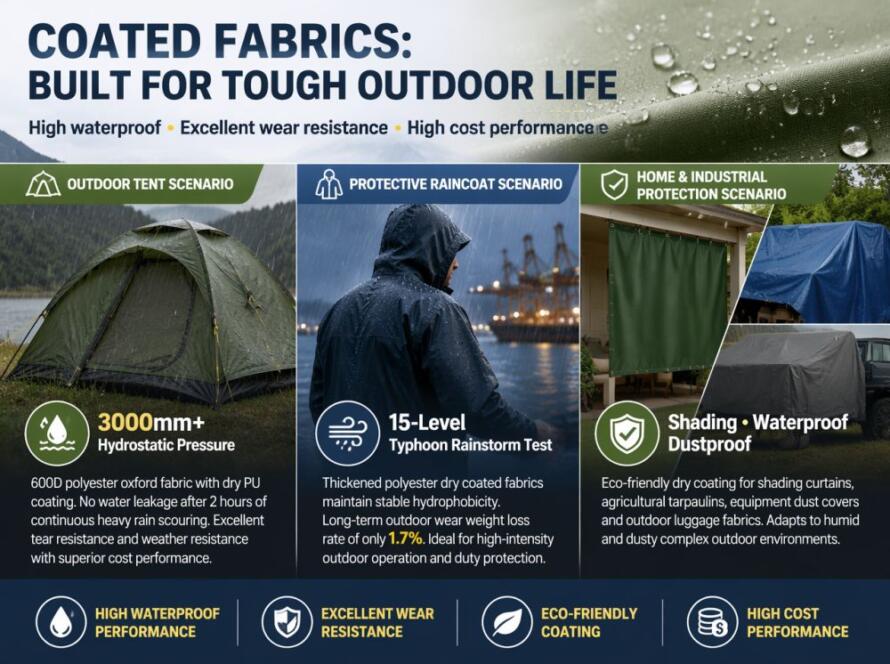
- Coating — a PU or PVC paste knife-coated onto the back of the fabric. We cover how this works separately in why coated fabrics are waterproof.
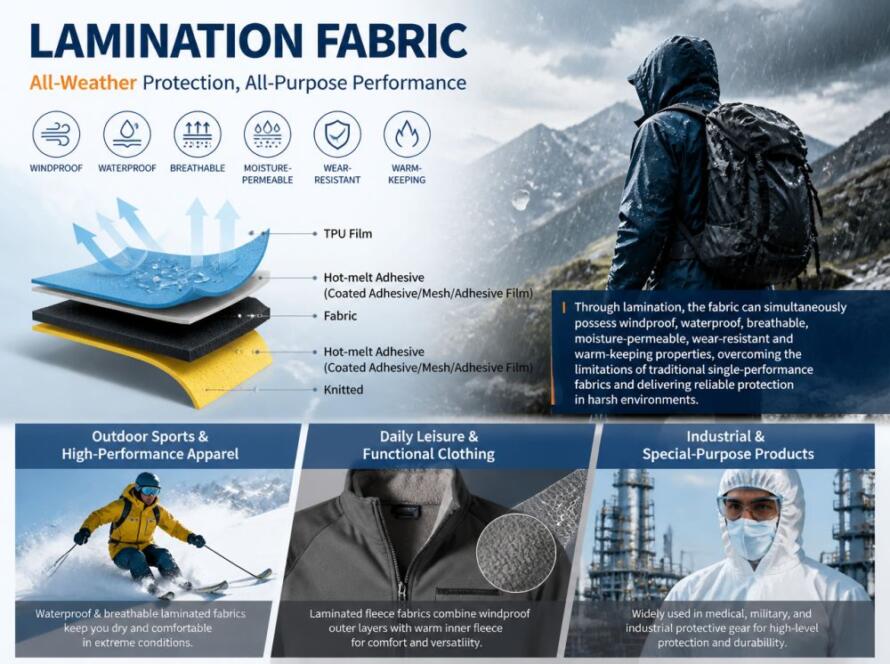
- Lamination — a functional membrane bonded to the back of the fabric with a dot-pattern hot-melt adhesive. This is the route that holds the highest water column while preserving the most stretch and the most breathability, and it is the subject of this article.
1.3 Route Comparison: Where Each One Wins and Fails
| Route | How it works | Stretch after finishing | Breathability | Typical hydrostatic head | Best for |
| DWR finish only | Repellent applied to the face fabric | Unaffected | Unchanged | None — repellency carries no water column | Keeping a stretch fabric from wetting out; wind shirts; light drizzle |
| Coating | PU or PVC paste knife-coated onto the back | Warp stretch is largely lost — the film is set while the fabric is held under warp tension | Low, unless a microporous coating is used | 3,000–10,000 mm | Budget rainwear, non-stretch or weft-stretch items |
| Lamination | Membrane bonded with dot-pattern hot-melt adhesive | Preserved when bonding tension is controlled | Highest — up to the membrane’s own breathability | 10,000–20,000 mm and above | Stretch softshell and hardshell, ski, workwear, cycling |
That third row is the reason this article exists. If a garment needs to keep four-way stretch and hold a real water column, lamination is the only route that can deliver both — but only if the mill controls tension during bonding instead of stretching the goods to run more meters. Section 5 covers that in detail.
2. Hydrostatic Head and Breathability: The Two Numbers Buyers Get Wrong
2.1 Hydrostatic Head (mm): What the Numbers Actually Mean
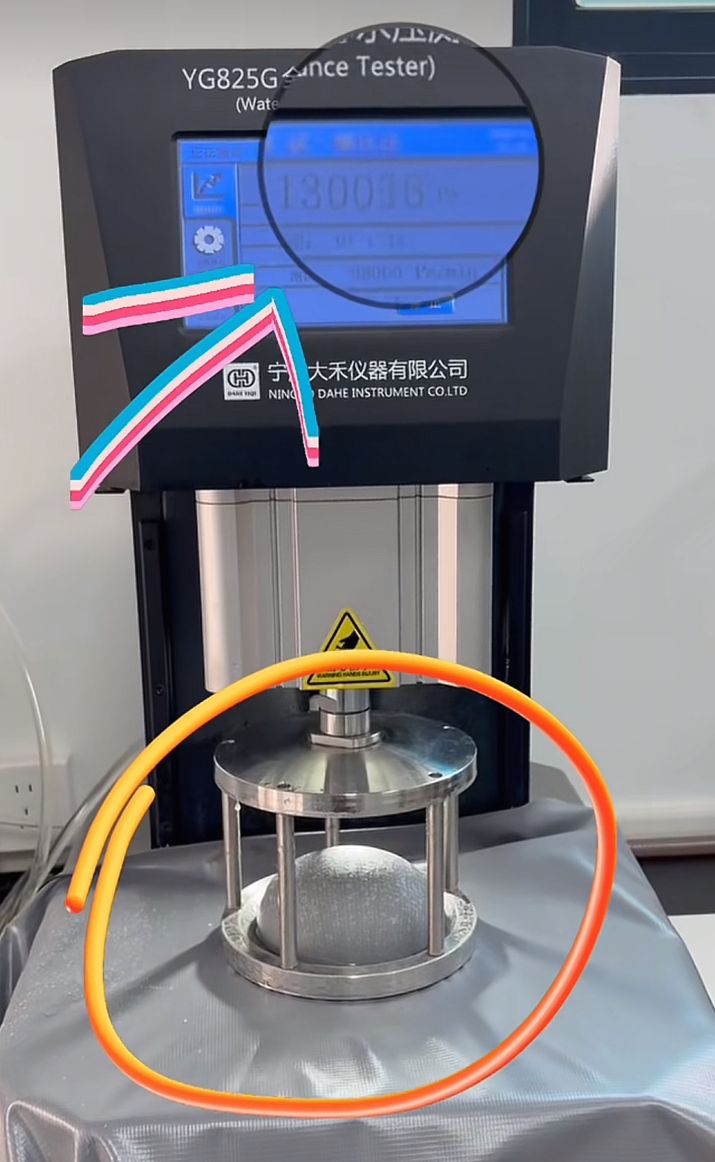
Hydrostatic head is the height of a water column the fabric resists before water penetrates, measured in millimetres. It is the only number that legitimately supports a “waterproof” claim. The usual market tiers are:
| Hydrostatic head | What it handles | Typical garment |
| 1,500–3,000 mm | Drizzle, snow, brief exposure only | Water-resistant softshell, fashion outerwear |
| 3,000–5,000 mm | Light to moderate rain | Commuter jackets, team uniforms |
| 8,000–10,000 mm | Steady rain, hiking in wet weather | General outdoor shells |
| 15,000–20,000 mm | Sustained heavy rain, and pressure points such as pack straps, kneeling and sitting | Hardshell jackets, workwear, ski |
| 20,000 mm and above | Prolonged storm exposure | Alpine, expedition, marine |
Two cautions matter more than the tiers themselves. First, the same fabric can be reported at different figures depending on the test method — ISO 811 (rising water column) and AATCC 127 (hydrostatic pressure) do not produce identical numbers, and a laboratory may report the first drop or the third. Second, a single figure hides whether it is the initial value or the value after washing. A laminate that reads 10,000 mm new and 5,000 mm after five washes is a different product from one that holds 8,000 mm, even though both may be quoted as “10,000 mm” on a spec sheet.
2.2 Breathability: MVTR, RET and Air Permeability Are Three Different Things
Buyers routinely treat “breathability” as one number. It is at least two, and on a stretch laminate there is a third that decides whether the jacket feels windproof:
| Metric | Unit | Better direction | Common methods | Rough reading |
| MVTR (moisture vapour transmission rate) | g/m²/24h | Higher is better | ISO 15496, ASTM E96 BW, JIS L1099 B1 | 3,000 g/m²/24h is adequate for moderate activity; 5,000–10,000 g/m²/24h is what high-output sports and ski wear expect |
| RET (resistance to evaporative heat transfer) | Dimensionless | Lower is better | ISO 11092 | Below 6 is very breathable, 6–13 is good, 13–20 is only satisfactory, above 20 is poor |
| Air permeability | mm/s or CFM | Lower is more windproof | ISO 9237 | Around 1 CFM or below is effectively windproof; this is a wind metric, not a breathability metric |
The three are not interchangeable and cannot be converted. MVTR and RET both describe moisture vapour, but one is a transmission rate and the other is a resistance, so a quotation that mixes them across suppliers cannot be compared directly. Air permeability is a separate property again, and it is the one that most clearly separates the two membrane families in section 4.
2.3 A Number Without a Test Method Is Not a Specification
If a purchase specification says “waterproof 10,000 mm” and nothing else, it has effectively authorised the supplier to deliver the weakest result that can be made to fit that wording — any method, any sample conditioning, initial value only. The workable form is the number plus the method plus the condition, for example “hydrostatic head ≥ 10,000 mm per ISO 811, initial and after 5 washes per ISO 6330”. We set out the full specification syntax, item by item, in our guide to laminated fabric and how to specify it.
3. 2-Layer, 2.5-Layer and 3-Layer: What Changes on a Stretch Fabric
Layer count is the buyer’s most consequential choice, and it is the first thing any technical outerwear team asks about. The industry convention is two-layer (2L), two-and-a-half layer (2.5L) and three-layer (3L); “two-layer” in this context never means “two pieces of fabric”.
3.1 Two-Layer (2L): Face Fabric Plus Membrane
The membrane is bonded to the face fabric only, and the membrane side faces the inside of the garment. Because the membrane is exposed, a 2L garment needs a separate hanging liner — mesh, taffeta or tricot — to stop body oils and abrasion from attacking it. This adds weight and sewing complexity. The structure is light on the fabric side and has the softest drape, which is why it is common in casual rainwear and lifestyle jackets, but on a stretch fabric the exposed membrane is the first thing to suffer: it is also the construction where stretch recovery feels least controlled, because the membrane carries the full load of every movement with nothing behind it to stabilise it.
3.2 Two-and-a-Half Layer (2.5L): A Printed Protective Layer Instead of a Liner
2.5L adds a printed or sprayed protective pattern on the inside of the membrane rather than a full fabric backer. It is the lightest and most packable of the three, popular for cycling and lightweight shells. The trade-off is feel: the printed surface can feel slightly clammy or “plastic” against bare skin, and because the print is not a fabric, it does not add structural stability. On a stretch laminate the print layer can also restrict stretch slightly more than buyers expect for the weight saved.
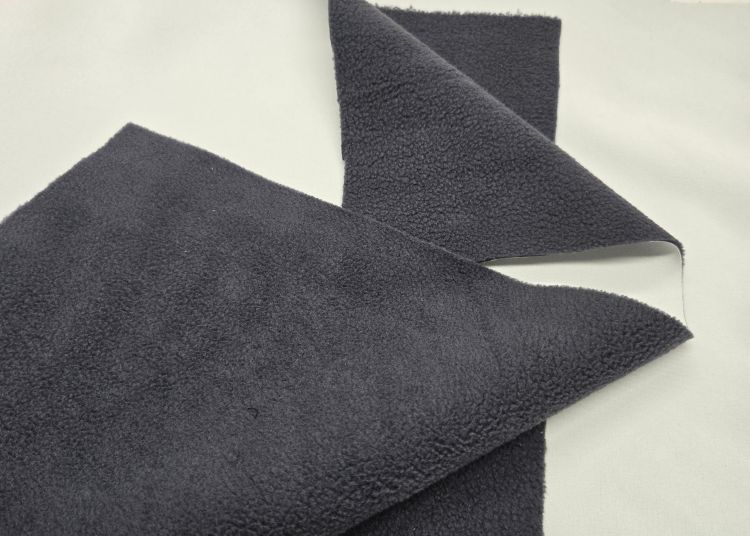
3.3 Three-Layer (3L): Face Fabric, Membrane and Backer
The membrane is sandwiched between the face fabric and an integrated backer — usually a fine knit, tricot or scrim. The result is a single self-contained piece of fabric needing no separate lining. This is the mainstream structure for outdoor functional fabric and the one that performs best on stretch goods, for a specific reason: the backer distributes the load when the fabric extends, so the membrane is not being pulled locally at every movement. It is also the structure most compatible with seam taping and with laser cutting. Typical weights run heavier than 2L, which is the price of that stability.
3.4 Construction Comparison for Stretch Laminates
| 2-Layer (2L) | 2.5-Layer (2.5L) | 3-Layer (3L) | |
| Structure | Face fabric + membrane | Face fabric + membrane + printed protective layer | Face fabric + membrane + knit or scrim backer |
| Separate lining required | Yes — hanging mesh or taffeta | No | No |
| Relative weight | Light fabric, heavier finished garment | Lightest and most packable | Heaviest |
| Hand feel and drape | Softest | Stiffer, can feel clammy on skin | Substantial, holds shape |
| Membrane protection when the fabric stretches | Low — membrane takes the load directly | Medium | High — backer distributes the load |
| Seam taping compatibility | Good | Moderate | Best |
| Typical use | Casual rainwear, lifestyle jackets | Lightweight packable shells, cycling | Stretch softshell, ski, workwear, technical shells |
Practical rule for stretch goods: if the garment has to keep four-way stretch and be worn hard, specify 3L. If it is a lightweight packable piece where stretch is a comfort feature rather than a performance requirement, 2.5L is the economical choice. 2L only makes sense where the design already includes a hanging liner for styling reasons.
4. PTFE vs TPU Membrane: Air Permeability or Moisture Permeability
Two membrane families cover almost all waterproof stretch fabric on the market, and the difference between them is mechanistic, not just a price difference.
4.1 Microporous PTFE: Air Can Pass Through
Expanded PTFE (ePTFE) is made microporous by biaxial stretching. The pores are roughly 0.1–0.5 micrometres across. For scale: a water droplet is around 100 micrometres, and a water vapour molecule is around 0.0004 micrometres. Liquid water cannot enter a pore two or three orders of magnitude smaller than a droplet, while vapour passes freely. Because the pores are open to the air, PTFE membranes are permeable to air as well as to moisture vapour — a genuine difference from TPU, and the reason some wearers find a PTFE shell less clammy in cold conditions.
The known weakness is contamination. Sweat oils, sunscreen and detergent residue can progressively block the pores, and performance fades as they do. The standard fix is a two-component construction with a thin PU protective layer over the PTFE, which keeps oils out at the cost of a small reduction in breathability.
4.2 Non-Porous TPU: Moisture Vapour Only
Thermoplastic polyurethane membranes are monolithic — there are no pores at all. Water is blocked physically. Moisture vapour is transported by hydrophilic groups in the polymer through a cycle of adsorption, diffusion and desorption, driven by the humidity difference between inside and outside. Because there is no open pore, a TPU membrane does not let air through: it is inherently windproof, which suits softshell and winter garments, but it also means the material is only moisture-permeable, not air-permeable. It is the cheaper of the two families and the more widely used one in civilian stretch laminates.
4.3 Membrane Comparison
| Property | Microporous PTFE (ePTFE) | Non-porous TPU |
| Structure | Microporous, pores around 0.1–0.5 μm | Monolithic, no pores |
| How it blocks liquid water | Pores far smaller than a water droplet (around 100 μm) | Dense film physically blocks water |
| How moisture vapour passes | Vapour diffuses through the open pores | Adsorption–diffusion–desorption through hydrophilic groups |
| Air permeability | Yes — air passes, so lower windproofness on its own | No — inherently windproof |
| Breathability | Higher | Lower; grading from about 1,000 g/m²/24h (low) through 3,000 (medium) to 5,000+ (high) |
| Elastic behaviour in a laminate | Broadly comparable to TPU | Broadly comparable to PTFE |
| Cost | Higher | Lower |
| Main weakness | Pores clog with sweat oils and detergent residue; usually needs a PU protective layer | Lower breathability, and no air permeability |
| Best fit | High-end hardshell, high hydrostatic head, cold dry conditions | Stretch softshell, workwear, cycling, cost-controlled programmes |
One point worth stating plainly, because it is widely assumed otherwise: the two membrane families do not differ much in elasticity. Buyers often expect PTFE to be “the stiff one” and TPU to be “the stretchy one”. In practice, what happens to a laminate’s stretch is decided far more by how the bonding line runs the goods than by which of these two membranes is inside. That is the subject of the next section.
4.4 Both Membranes Still Need a Working DWR on the Face Fabric
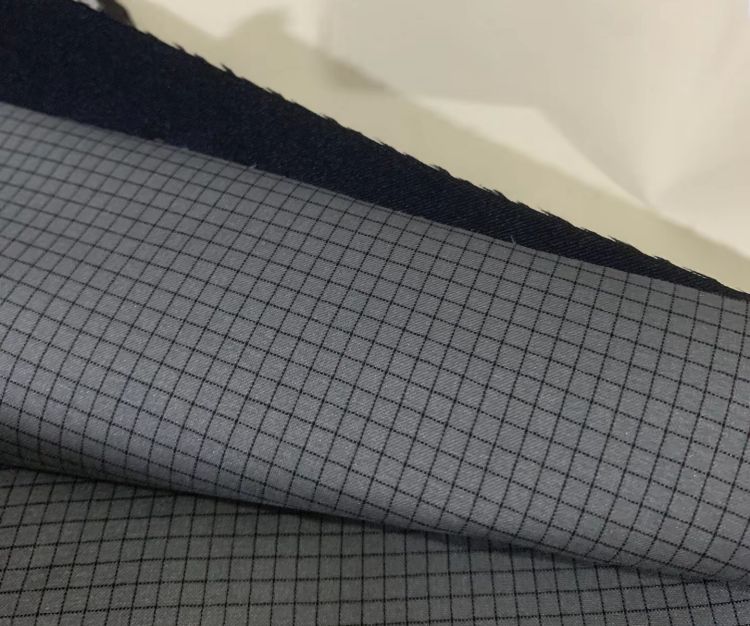
A membrane keeps water out, but it cannot stop the face fabric from soaking. When the outer surface wets out, the fabric feels colder, weighs more, and breathability drops sharply because vapour now has to cross a film of water before it reaches the membrane. That is why every waterproof laminate needs a durable water repellent on the face fabric, and why its wash durability is worth specifying separately. With PFAS restrictions now in force or phasing in across several markets, it is also worth knowing that compliance is judged on the finished article, not just on the repellent — see what PFAS-free actually requires in a finished textile.
5. Why a Laminate Loses Its Stretch — and What We Do About It
5.1 It Is Rarely the Membrane
When a buyer finds that a four-way stretch face fabric has turned into a two-way stretch laminate, the instinct is to blame the membrane. As section 4.3 notes, that is usually the wrong diagnosis. Membranes of both families behave similarly under extension. If warp stretch has disappeared from a laminate, the cause is almost always mechanical: the goods were held under warp tension during bonding, and the fabric was stretched out while the adhesive cured and the membrane was set.
5.2 Over-Tensioning for Yield: The Hidden Cost
There is a commercial incentive behind that mistake. Stretching the goods during lamination makes the roll longer, so the same input produces more meters and the price per meter looks better. The buyer pays for it twice:
- Stretch is locked in. The fabric has already been extended to its limit during bonding, so what arrives has little extension left. The garment then fails exactly where stretch matters — shoulders, elbows, knees.
- The goods curl. The stretched layer and the unstretched layer carry different residual stress, and the laminate responds by curling at the edges and at cut panels. That is one of the most common causes of the curling problem on laminated goods, and it shows up as a cutting and sewing defect several weeks downstream.
This is the same mechanism that damages stretch fabric earlier in the chain: over-stretching to gain length in dyeing and finishing causes permanent deformation of the elastic yarn. We cover the finishing side of it in why the same specification can end up with different elasticity.
5.3 Heat During Bonding Acts as a Pre-Shrink Pass
Lamination runs at temperature, and that heat does something useful for a stretch fabric: it relaxes and stabilises the base fabric in much the same way a pre-setting or pre-shrinking pass would. By the time the laminate is finished, the dimensional change that would otherwise show up in the finished garment has largely already happened.
Two practical conclusions follow. First, the laminate’s dimensions are essentially fixed at bonding — so the pre-lamination state of the base fabric and the tension used at the bonding line are the two variables that decide the final result, and neither can be corrected afterwards. Second, later heat still matters: a garment heat press, a heat-transfer print or a lamination press for seam sealing all apply temperature to a stretched fabric again, and it is worth checking dimensional stability after those steps rather than only on the fabric roll.
5.4 How We Control Stretch Loss on Waterproof Stretch Laminates
Our approach on waterproof stretch fabric is deliberately conservative on tension. We run the bonding line as close to tension-free as the process allows — not literally zero tension, because the membrane still has to lie flat and wrinkle-free across the full width, but only the minimum needed to lay it down evenly. We do not add tension to gain meters, which means we accept a shorter roll than a mill that stretches the goods. The trade is straightforward: the customer gets the warp stretch they specified, and the goods do not arrive curled.
Two other controls matter as much as tension. The base fabric is pre-set before lamination so that the elastic yarn has already relaxed into its stable state before it goes onto the bonding line. And the adhesive is applied in a dot pattern that leaves the bulk of the surface free to move, rather than a continuous film that would stiffen the hand and reduce moisture permeability at the same time. Adhesive coverage is set per article and checked against peel strength and breathability rather than assumed.
For programmes that need stretch and dimensional stability without relying on spandex at all, a spandex-free elastic yarn such as T400 is often the cleaner base, because relaxation behaviour is more predictable through finishing and bonding. Face fabric selection is the other half of the job — high-density nylon is the usual choice where the garment needs abrasion resistance as well as stretch, and we cover those options under nylon four-way stretch fabric.
6. Base Fabric: What Actually Decides the Measured Water Pressure
6.1 The Membrane Sets the Ceiling, the Base Fabric Sets the Result
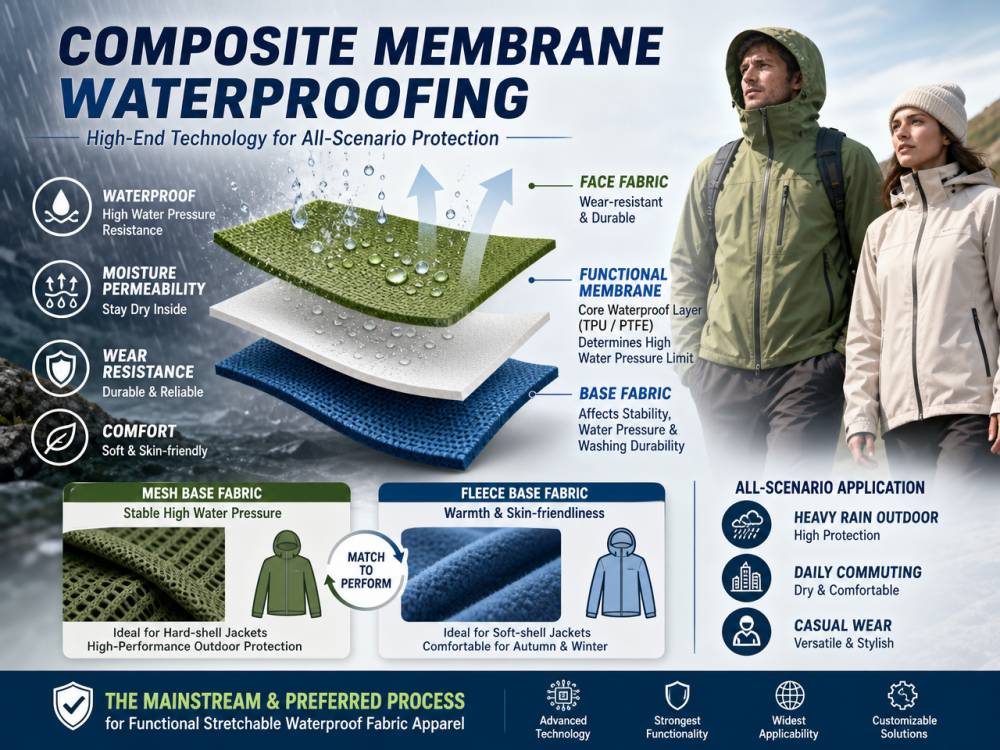
Two laminates made from the same face fabric and the same TPU or PTFE membrane have the same theoretical maximum hydrostatic head — typically 10,000–20,000 mm for the film itself. What differs is the value actually measured, and how much of it survives washing. That difference comes almost entirely from the base fabric bonded behind the membrane, because the base fabric is what supports the membrane against pressure.
6.2 Warp-Knitted Mesh and Bird-Eye Mesh
- Structure: Lightweight, breathable, high support with minimal deformation.
- Behaviour under pressure: Supports the membrane evenly across the test area, so the membrane does not stretch, bulge or seep locally.
- Performance: Measured hydrostatic head lands close to the membrane’s theoretical value, and retention after washing is high — 10,000 mm commonly holds around 8,000 mm.
- Best fit: High-specification waterproof stretch fabric for hardshell jackets and heavy-rain outerwear where both water column and wash durability are specified.
6.3 Polar Fleece, Short Plush and Coral Fleece
- Structure: Thick and lofty, with loose fibres that compress easily.
- Behaviour under pressure: The fleece layer collapses under load and pulls the membrane with it, opening pores locally and allowing seepage.
- Performance: Measured hydrostatic head typically 10–30% below a mesh-based equivalent, with a larger drop after repeated washing — a nominal 10,000 mm can read 5,000–6,000 mm after washing.
- Best fit: Warm softshell for autumn and winter, commuter and lifestyle garments, where a moderate reduction in water column is acceptable in exchange for warmth and skin comfort.
6.4 Base Fabric Comparison
| Base fabric | Measured hydrostatic head | Retention after washing | Comfort and warmth | Suits |
| Warp-knitted mesh / bird-eye mesh | Close to the membrane’s theoretical value | High — around 8,000 mm retained from 10,000 mm | Light, breathable, minimal deformation | Hardshell, high-spec outdoor, workwear |
| Polar fleece / short plush / coral fleece | 10–30% below mesh | Lower — 10,000 mm can fall to 5,000–6,000 mm | Warm, soft, bulky | Winter softshell, commuter, lifestyle |
The practical instruction for buyers is simple: specify the base fabric together with the water column, not separately. “10,000 mm” means one thing on a mesh backer and something else on a fleece backer, and the difference will show up in the field rather than on the spec sheet.
7. Five Failure Modes to Check Before You Approve a Sample
7.1 Curling
Curling at the edges and at cut panels is the signature defect of an over-tensioned laminate, and it is often not visible on the roll — it appears after the goods are cut and left to relax, or after the garment is washed. If a sample arrives already curling at the selvedge, that is a warning about how the whole roll was run, not a minor handle issue to be pressed out during cutting.
7.2 Delamination and Bubbling After Washing
Bubbling, blistering and separation between layers is the number one complaint we see on laminated fabric, and the causes are specific: insufficient adhesive coverage, under-cured reactive PU adhesive, and stress stored in the base fabric that pulls the bond apart once the laminate is washed. The check that predicts it is peel strength tested after washing, not peel strength on a fresh sample. We run peel and wash-retention testing on every shipment — see how we test laminates in-house — and the specification items in section 8 are what to hold any supplier to.
7.3 Seam Leaks — a Garment-Factory Step, Not a Mill Step
A fabric can hold 20,000 mm and the garment can still leak at the seams, because every stitch line is a row of needle holes. Seam taping is the standard remedy, and on stretch garments it carries an extra requirement: the tape has to stretch with the seam. A non-elastic tape applied to a four-way stretch shell will crack or delaminate along the seam the moment the garment is worn.
What matters commercially is who performs the step. Seam sealing is not a fabric-mill process — it is carried out at the garment factory on a seam-sealing machine (a hot-air taping machine), and a factory without that equipment cannot produce a genuinely waterproof stretch garment no matter how good the fabric is. So before the fabric specification is fixed, it is worth confirming two things about the nominated garment factory: that it has taping equipment, and that it has experience with outerwear of this type rather than only flat wovens. The tape grade then has to be matched to the fabric’s stretch and surface, not only to its width. We do not supply tape, but we will tell you which tape grades are compatible with a given laminate, because it is the fabric’s stretch behaviour and surface that decide which tape will hold.
7.4 Face Fabric Wet-Out
If the outer surface stops beading and darkens in the rain, the DWR has failed, not the membrane. The garment is not leaking yet, but it will feel cold and clammy because vapour now has to cross a film of water. Spray rating per AATCC 22, quoted initial and after five washes, is the number to hold a supplier to — and the specification should state whether reactivation by tumble drying or ironing is permitted, because fluorine-containing repellents recover a grade that way while fluorine-free systems may not.
7.5 Stretch Loss and Growth on the Laminate
The error here is testing the face fabric and assuming the laminate matches. Specification should be written against the finished laminate, tested per ASTM D3107 for stretch, growth and recovery, because the bonding step, the adhesive pattern and the tension used all sit between the grey fabric and the finished roll. As a rule, growth of more than 5% after repeated extension is a rejection point, and the figures should be given separately for warp and weft — four-way stretch claims are meaningless when only one direction has been measured.
8. Specification Checklist for Waterproof Stretch Fabric
8.1 What to Write in the Spec
| Item | Write it like this | Method | Why it matters |
| Layer construction | 3L (face + membrane + knit backer), no separate lining | — | Decides membrane protection and stretch behaviour |
| Membrane | TPU or ePTFE, stated by name | — | Decides air permeability, breathability and cost |
| Hydrostatic head | ≥10,000 mm, initial and after 5 washes | ISO 811 or AATCC 127; wash per ISO 6330 / AATCC 135 | A single initial figure hides wash loss |
| Breathability | MVTR ≥5,000 g/m²/24h or RET <13 — pick one | ISO 15496 / ASTM E96 BW / JIS L1099 B1, or ISO 11092 | MVTR and RET cannot be converted between suppliers |
| Peel strength | ≥2.5 N/25mm after washing | ISO 2411 / ASTM F904 | The real predictor of delamination and bubbling |
| Stretch and recovery | Warp and weft stretch ≥ the agreed %, growth ≤5% | ASTM D3107 on the finished laminate | Face fabric passing does not mean the laminate passes |
| Dimensional stability | ≤3% both directions | ISO 6330 with ISO 5077 | Lamination heat pre-shrinks; later heat can release it |
| DWR | Spray ≥4 initial, ≥3 after 5 washes; state whether reactivation is allowed | AATCC 22 | Wet-out cuts breathability even when the membrane is intact |
| Base fabric | Mesh or fleece, with weight in g/m² | — | Sets the measured water column and its wash retention |
| Width and weight tolerance | ±3% width, ±5% weight | — | Over-tensioned goods arrive wide and with the stretch gone |
| Seam sealing | Fully taped, using elastic tape matched to the fabric’s stretch | Performed at the garment factory on a seam-sealing machine | A mill cannot perform this step — confirm the nominated garment factory has taping equipment |
8.2 Four Checks You Can Run on a Sample Yourself
- Manual stretch and recovery. Mark 4 inches on the laminate, extend it to its natural limit and hold for ten seconds, then release and measure. Returning to 4.0–4.1 inches indicates good recovery; anything clearly beyond that means the laminate has taken a permanent set and will grow in wear.
- Spray test on the face. Water should bead and roll off. If it darkens and soaks in within seconds, the DWR is not doing its job.
- Curling check. Cut a 30 cm square, lay it flat and leave it for a few hours. Any lift at the corners predicts the same behaviour after cutting in production.
- Five-cycle wash and peel by hand. Wash and dry five times, then try to separate the layers at a cut edge. Any easy lift means the bond is not going to survive the garment’s life.
8.3 How We Run Waterproof Stretch Lamination
- In-house lamination. We bond in our own plant rather than outsourcing, so the tension setting, adhesive coverage and base fabric pairing are ours to control on every run — see the lamination capability page for structures and testing.
- Minimum-tension bonding. We run as close to tension-free as the membrane allows and never stretch the goods for extra meters, which is why our rolls come in at the width and stretch that were ordered rather than looking generous on the meterage.
- Pre-set base fabric. The stretch base is relaxed and stabilised before bonding, so that the heat of lamination finishes the job rather than starting it.
- Base fabric matched to the water column. If the garment needs a high wash-retained hydrostatic head we will say so and recommend a mesh backer, even when a fleece backer would be cheaper to sell.
- Custom development. Face fabric, membrane, base fabric and finish can be combined to a programme’s own numbers under custom woven fabric development.
- Honest scope. We deliver the laminate. Seam sealing and the finished garment depend on the factory you nominate, so we flag the taping requirement at sampling stage rather than leaving it to surface after bulk.

8.4 Next Step
If you are specifying waterproof stretch fabric and want a construction recommendation against your own numbers — layer count, membrane family, base fabric, water column and stretch — send the requirement through. The clearest way to frame it is the RFQ structure in how to write an RFQ for woven stretch fabric, and we will come back with a construction that will still pass after five washes rather than one that merely passes on the bench sample.