Complete Guide & Common Pitfalls for Fabric Sourcing in China
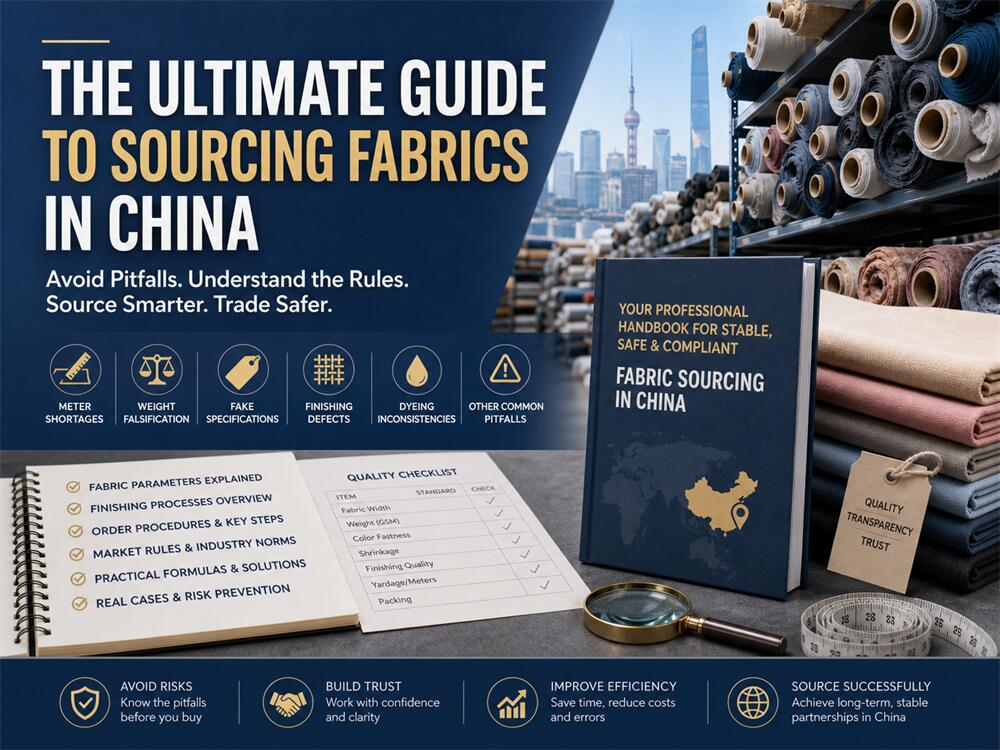
Summary: This guide is specially compiled for overseas buyers to help them understand the local market rules, hidden industry norms, and common pitfalls when sourcing fabrics in China. It systematically covers meter shortages, weight falsification, fake specification labeling, finishing defects, dyeing inconsistencies, and other frequent problems in Chinese textile transactions. Equipped with practical calculation formulas, standardized solutions, and real cases, this document also explains fabric parameters, finishing processes, order procedures, and market conventions. It serves as a professional and practical manual for foreign clients to source fabrics in China stably, safely, and compliantly.
1. Common Fabric Sourcing Pitfalls & Industry Jargon
1.1 Meter Shortage Issues (Mostly for Woven Fabrics)
1. Shortage Tolerance: 98 / 95 / 92 Standard
Core Definition: It is a widespread unspoken rule in the Chinese fabric market that a roll labeled 100 meters actually contains 98m, 95m, or 92m. Different ratios represent different market positioning.
- 98: Market-recognized “full meter” standard, the most common acceptable tolerance
- 95: Moderate shortage with relatively cost-effective pricing
- 92 and below: Low-price trap, commonly seen in printed and bleached fabrics, the actual meter rate can drop to 75–80
Essential Calculation Formula
Actual Meterage = Labeled Meterage × Shortage Coefficient Example: 100m × 0.98 = 98 actual meters
True Unit Price (Full Meter Price) = Quoted Price ÷ Shortage Coefficient Example: Quoted at $1.5/m with 95 shortage, true price = 1.5 ÷ 0.95 ≈ $1.58/m
2. Modified Label / Full Meter
- Modified Label: Suppliers scratch or alter the meter label to cover severe shortages (usually below 90), selling defective rolls as standard full-meter goods, which is a high-risk fraud
- Full Meter (Net Meter): 100% accurate meterage with zero shortage, stable quality, 5%–10% higher in price, widely used for export and high-end brand orders
3. Official Standard vs. Actual Market Chaos
- National Standard: Woven fabric tolerance ±2%, knitted fabric tolerance ±3%
- Market Reality: Most low-priced fabrics have a real shortage of -5%~-10% while charged at full-meter price
Sourcing Solution for Foreign Buyers: When sourcing fabrics in China, never take labeled meterage as actual quantity. Confirm the shortage coefficient in writing before placing orders and clarify full-meter settlement standards. Conduct random meter inspection after delivery and add shortage compensation clauses in the contract to avoid losses.
1.2 Weight Fraud Issues (Severe for Knitted Fabrics)
1. Weight Tolerance (Air Weight Deduction)
A typical hidden rule for knitted fabrics sold by weight. Suppliers add virtual “air weight” during weighing. Common virtual weight ranges: 1kg, 2kg, 2.5kg per roll.
2. Paper Tube Weight-Sourcing Fabrics in China
The middle paper tube of fabric usually weighs 0.5kg~1.5kg. Unethical suppliers use cement-filled tubes over 2kg to falsely increase total weight.
3. Industry Black Talk: 2+2 Weight Fraud
2kg paper tube weight + 2kg virtual air weight = 4kg total fake weight per roll, the most common trap for new overseas buyers.
Practical Case:
- Labeled weight: 28kg/roll, unit price: $12/kg
- Actual net fabric weight: 28kg-4kg fake weight = 24kg
- Total payment: 28 × 12 = $336
- Real unit price: 336 ÷ 24 = $14/kg
Anti-trap Sentence: Request “net fabric price, tube weight excluded, zero virtual weight, full accurate weighing”.
Sourcing Solution for Foreign Buyers: Knitted fabric is the highest-risk category when sourcing fabrics in China. Always ask suppliers for a net weight quotation. Confirm paper tube deduction standards and zero virtual weight settlement in advance. State clearly in the contract that only pure fabric weight is valid for payment to eliminate the 2+2 weight fraud.
1.3 GSM & Sample Inconsistency Tricks
1. False GSM Labeling-Sourcing Fabrics in China
Suppliers falsely mark high GSM while producing lighter fabrics. For example, labeled 150gsm but actual only 130–140gsm. Every 10gsm reduction greatly cuts production cost, resulting in thin, weak, and less durable finished garments.
2. Sample vs. Bulk Discrepancy
Suppliers provide high-density, full-weight, high-quality custom samples, but downgrade density, GSM, and raw materials for bulk production, leading to inconsistent bulk quality, one of the most frequent sourcing problems.
Sourcing Solution for Foreign Buyers: When sourcing fabrics in China, strictly implement “sample equals bulk” standards. Seal and sign confirmed samples, mark exact GSM, density, and hand feel parameters in the contract, and specify return/exchange rights for inconsistent bulk goods. Require pre-production bulk samples before mass production to avoid quality gaps.
1.4 Composition & Raw Material Fraud-Sourcing Fabrics in China
1. False Composition Ratio (High-end Fabric High-risk Area)
- Spandex fraud: Labeled 10% spandex content but actual only 4%, causing poor elasticity, easy loosening, and bad shape retention
- Functional fiber fraud: Cupro / Tencel fabrics blended with cheap viscose, similar in hand feel but much worse in moisture absorption, draping, and skin-friendliness
2. Downgraded Yarn Specification
Suppliers secretly downgrade yarn standards: 40s cotton replaced with 32s, 20D ultra-fine yarn replaced with 30D coarse yarn. Resulting in stiff hand feel, easy pilling and fuzzing, lower cost and poorer quality.
Sourcing Solution for Foreign Buyers: When sourcing fabrics in China, precisely write yarn count, D denier, and fiber proportion into contract parameters without vague descriptions. For high-end and functional fabrics, specify third-party inspection standards and conduct random testing after delivery to prevent raw material downgrade and stabilize garment quality.
1.5 Finishing & Pre-shrinkage Defects
1. Unqualified Pre-shrinkage & Setting
- No pre-shrinkage: Garment water shrinkage reaches 5%–10%, causing size deformation and finished product scrapping
- Unstable setting: Fabrics wrinkle easily, with unstable width and fluctuating GSM, leading to inconsistent batch quality
Sourcing Solution for Foreign Buyers: For export orders sourcing fabrics in China, mandatory full pre-shrinkage and professional setting finishing. Clarify shrinkage rate and width stability standards in contracts and reject unfinished grey fabric delivery. Require finishing reports for high-end orders to avoid deformation and batch inconsistency.
1.6 Dyeing & Surface Defects-Sourcing Fabrics in China
1. Batch Shade Difference (Batch Variation)
Mass fabric is dyed in multiple batches. Different dye batches cause differences in shade, depth, hand feel, and softness, resulting in garment color inconsistency in large orders.
2. Double-sided Color Difference (Yin-Yang Color)
Inconsistent color, luster, and hand feel between fabric front and back, causing obvious color difference during garment splicing and leading to finished product scrap.
3. Roll Head-Tail Difference
The start and end of one fabric roll differ in color and thickness, resulting in partial color difference and texture inconsistency after cutting.
Sourcing Solution for Foreign Buyers: When placing bulk orders while sourcing fabrics in China, prioritize single-batch production to reduce color difference risk. Require suppliers to inspect head and tail of each roll and remove defective sections. Clarify compensation standards for dyeing defects in contracts to ensure uniform export garment quality and zero scrapping loss.
2. Basic Fabric Sourcing Knowledge
2.1 Common Fabric Unit Explanation
- D (Denier): Unit for chemical fiber thickness. The smaller the number, the finer and softer the fabric (20D ultra-fine, 70D standard, 320D heavy-duty)
- S (Count): Cotton yarn exclusive unit. The larger the number, the finer and lighter the cotton fabric
- gsm: Gram per square meter, fabric thickness weight. Higher value means thicker, more wear-resistant, and stiffer fabric
- Width: Effective cutting width, common sizes 145cm, 150cm, 160cm, directly affecting cutting utilization and material cost
2.2 Core Fabric Finishing Processes
1. Functional Finishing
- High Color Fastness: Washable and friction-resistant, anti-fading and anti-staining
- Water Repellent: Surface water resistance, divided into standard waterproof and washable waterproof grades
- Moisture Wicking & Quick Dry: Fast sweat absorption and diffusion, keeps skin dry for sportswear
- UV Protection: Anti-ultraviolet finishing for outdoor garments
- Lamination: Multi-layer bonding to enhance windproof, warm, and thick performance
2. Hand Feel Finishing
- Original Dye Hand Feel: Natural raw texture without chemical additives, no hardening after washing
- Silicone Softening: Temporary smooth hand feel by silicone soaking, will harden and fuzz after repeated washing (key sourcing trap)
3. Pre-shrinkage & Heat Setting
Advanced shrinkage and shape fixation processing to lock fabric size, ensuring no garment deformation after washing, essential for high-end and export orders.
2.3 Fabric Supply Types & Features
- Grey Fabric: Un-dyed and unfinished raw fabric, lowest price, requires external dyeing and finishing, suitable for large customized orders
- Finished Fabric: Fully dyed, set, and finished, ready for cutting and garment making, flexible for small and fast orders
- Stock Fabric: In-stock warehouse goods, fast delivery within 1–2 days, fixed colors and specifications with limited options for urgent orders
- Custom Weave & Dye: Customized composition, GSM, texture, and color with stable uniform quality, disadvantage of higher MOQ and longer lead time
2.4 Basic Sourcing Rules
1. MOQ Standard
Stock fabric: No MOQ; Custom woven & dyed fabric: MOQ from hundreds to thousands of meters, fewer customized colors mean lower MOQ.
2. Custom Dyeing Process
Sample confirmation (hand feel & GSM) → color verification → mass production → pre-shipment inspection
3. Standard Lead Time
- Stock Fabric: 1–2 days delivery
- Finished Dyed Fabric: 5–10 days
- Custom Woven & Dyed Fabric: 15–30 days
4. Industry Payment Terms
- Stock Market Goods: Cash before delivery
- Bulk Custom Orders: 30% deposit, balance paid before shipment
3. Ultimate Anti-risk Principles for Foreigners Sourcing Fabrics in China
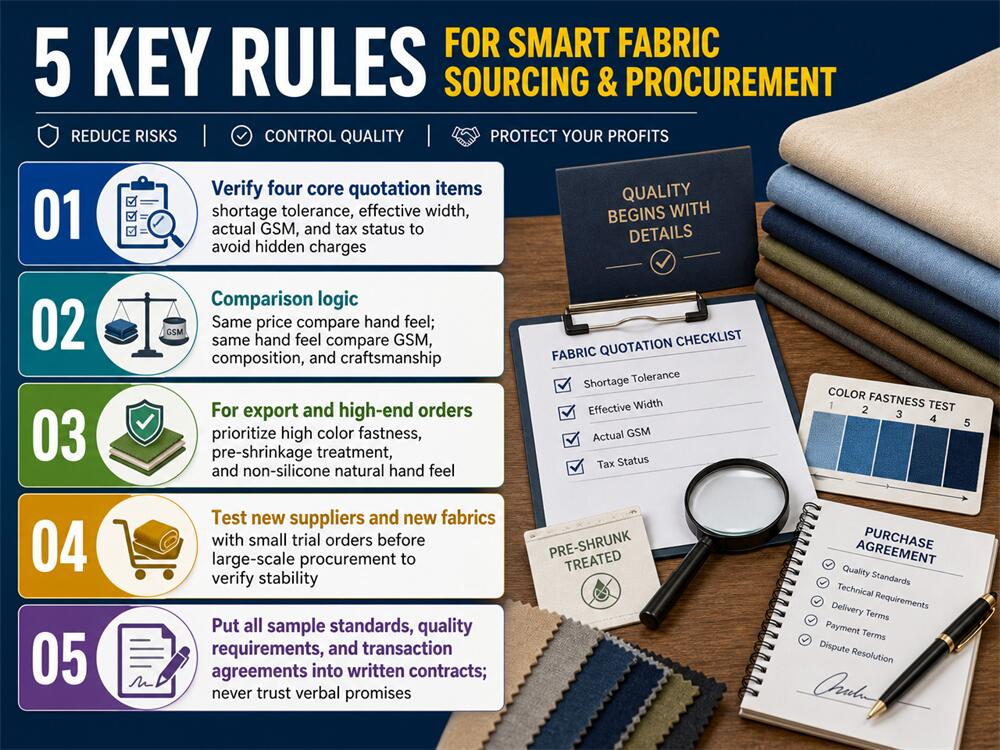
- Verify four core quotation items: shortage tolerance, effective width, actual GSM, and tax status to avoid hidden charges
- Comparison logic: Same price compare hand feel; same hand feel compare GSM, composition, and craftsmanship
- For export and high-end orders, prioritize high color fastness, pre-shrinkage treatment, and non-silicone natural hand feel
- Test new suppliers and new fabrics with small trial orders before large-scale procurement to verify stability
- Put all sample standards, quality requirements, and transaction agreements into written contracts; never trust verbal promises
4.More articles on procurement details