

0-to-1 Iterative Development Case of Workwear Fabric
1. Project Background & Customer Requirements
This project is a typical 0-to-1 customized development case of workwear fabric, as well as a mature R&D and delivery case of Custom Nylon Fabric. The end customer is a large enterprise that plans to customize exclusive high-end workwear for company leaders with extremely strict quality standards. The customer entrusted the garment production order to its cooperative apparel company, who contacted us and clarified four core fabric performance requirements: anti-static, high wear resistance, high tear resistance and elasticity. Besides, the fabric was required to have good stiffness, comfortable wearing experience and high-grade appearance, matching the business workwear scenario for enterprise management staff.
2. Complete Development Timeline & Three Rounds of Sample Optimization
First Sample: Basic Demand Matching & Initial Trial Productions
In accordance with the core performance requirements, we firstly adopted mature fabric suitable for workwear scenarios: 300D weft elastic gabardine with conductive filament (spandex-free). The fabric adopts twill weave with 1cm black spaced vertical stripes on the surface. Built-in conductive filaments realize anti-static function; the twill structure improves wear resistance and tear resistance effectively, and the fabric comes with weft elasticity, covering all basic demands proposed by the customer initially.
We sent fabric samples to the apparel company after sample weaving. The apparel company made finished sample garments and delivered them to the overseas end customer for review.
Customer Feedback: The 300D polyester fabric is too heavy with insufficient elasticity, causing tight and uncomfortable wearing experience. Meanwhile, the common twill structure leads to an ordinary visual effect, failing to meet the high-grade positioning of leadership workwear.
Second Sample: Upgrade of Fabric Texture & Elasticity
Upon receiving customer feedback, we launched optimization iteration immediately and adjusted the fabric structure to square weave. We replaced the original 300D polyester raw material with 70D nylon + 40D spandex to develop exclusive Custom Nylon Fabric, while retaining conductive filaments to guarantee stable anti-static performance. Nylon material upgrades fabric texture and high-end visual performance, and spandex greatly enhances fabric elasticity to solve wearing tightness. We completed and delivered new samples within 3 working days.
The apparel company produced sample garments again and sent them to the overseas end customer for secondary review.
Customer Feedback: The 70D nylon fabric is too thin and soft without sufficient stiffness, unable to support the three-dimensional silhouette of business formal workwear. In addition, the inherent color of conductive filaments cannot be completely covered after dyeing neutral and light colors, resulting in visible black grid patterns on fabric surface and unqualified overall appearance.
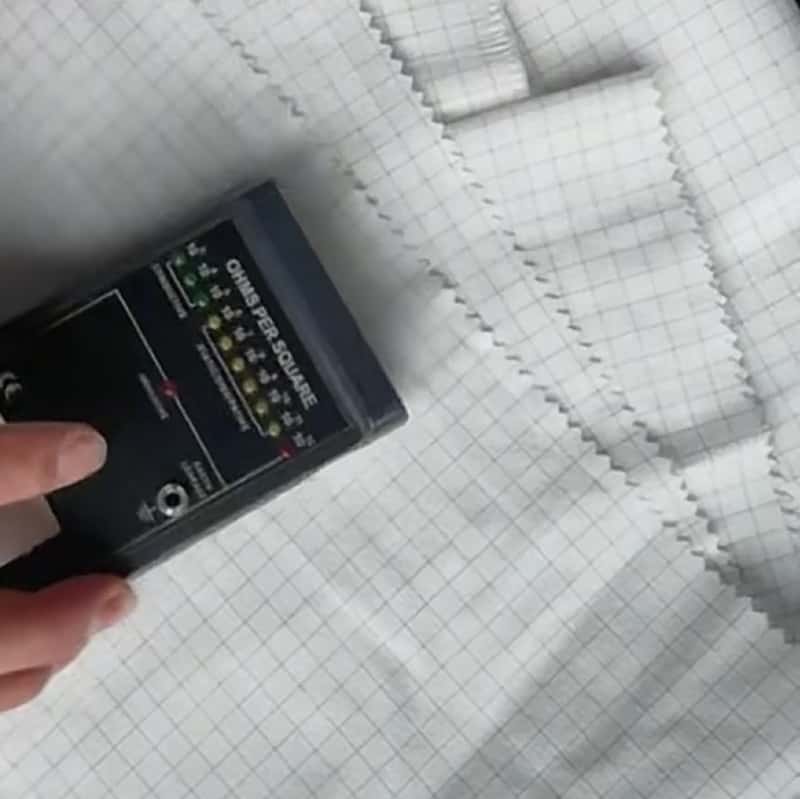
Third Sample: Full Compliance with Performance, Silhouette and Appearance Requirements
Targeting two key defects including insufficient stiffness and exposed conductive filament color, we carried out final fine optimization and finalized the qualified Custom Nylon Fabric. Firstly, we upgraded the yarn specification from 70D nylon to 140D nylon, balancing fabric thickness and softness accurately and improving fabric stiffness to fit workwear silhouette requirements. Secondly, we adopted the new twisted yarn wrapping conductive filament technology, wrapping conductive filaments completely inside yarns to eliminate exposed black grid patterns fundamentally, adapting to full-color dyeing demands.
The final sample satisfies all demands perfectly: it maintains excellent anti-static, wear-resistant, tear-resistant and elastic properties, and features stiff silhouette, comfortable wearing experience and neat high-grade appearance, fully fitting the positioning of high-end workwear for enterprise leaders.
3. Project Delivery Result
After three rounds of sample iteration and precise process optimization, this customized Custom Nylon Fabric was fully recognized by the overseas end customer. We finally received a bulk order for 16,500 sets of men and women high-end workwear fabrics. The whole 0-to-1 customized development project was completed successfully, accumulating rich iterative experience for our subsequent high-end workwear Custom Nylon Fabric development.
4. Process Optimization & Problem Solving in Mass Production
After sample confirmation and entry into mass production, this high-density square-grid Custom Nylon Fabric encountered minor weaving defects during production. Relying on our rich practical experience and professional textile technology, we accurately located root causes and optimized weaving processes rapidly, eliminating production risks and ensuring stable fabric quality and smooth mass delivery.
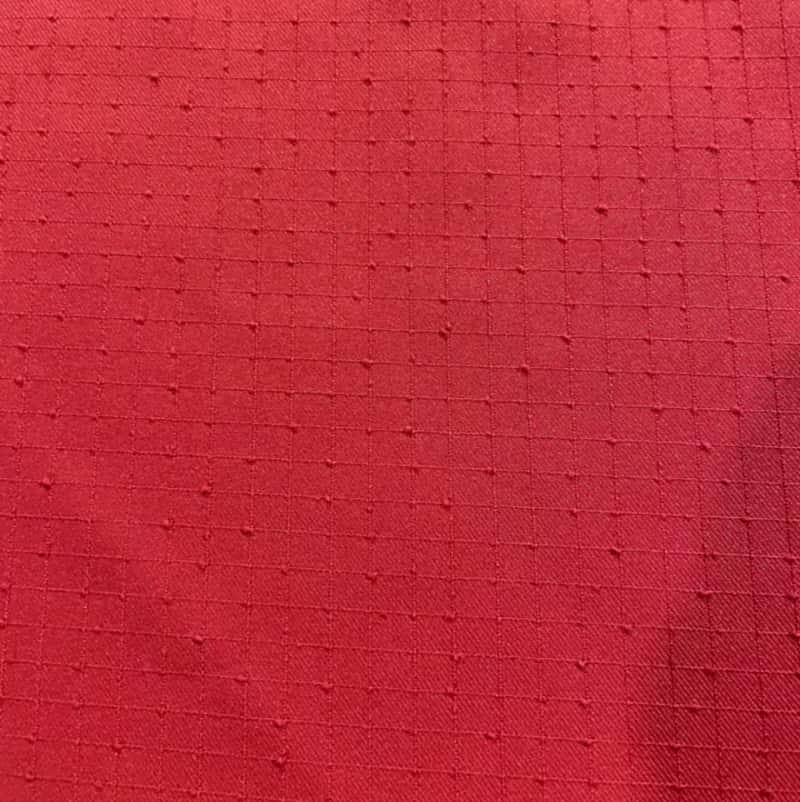
4.1 Initial Weaving Process & Existing Defects
After adjusting this Custom Nylon Fabric to square weave, we adopted the initial production parameters: reed count 16*3, and drafting structure: 1 , (1,2,3,4)×5 + 1,2,3 + 2, (4,1,2,3)×5 + 4,1,2.
Obvious weaving defects occurred after loom loading. Our technical team conducted professional inspection and analyzed the root causes as follows:
An independent single warp yarn of harness 2 was arranged in the middle of the whole drafting structure, forming a weak stress point. Adjacent yarns adopt continuous multi-yarn transition structure, while the sudden single independent harness 2 yarn has a huge difference in movement stroke and lifting rhythm with surrounding yarns during shedding, leading to sudden local tension change and uneven stress distribution.
Besides, the transition yarn quantity at the start and end of the grid circulation is insufficient: only one single harness 1 yarn at the start and three combined yarns of 412 at the end. The large shedding difference at the joint of two weaving circulations further causes disordered fabric stress, easily resulting in fabric defects, warp breakage and skipped ends, which seriously affects the flatness and quality stability of bulk fabrics.
4.2 Optimized Weaving Process Solution
To solve uneven tension and weaving defects thoroughly and support mass production of this high-density double-warp square-grid Custom Nylon Fabric, we upgraded the drafting structure to the optimal scheme:1234×6+4321×6.
The new process adopts a symmetrical circulation structure: the first half follows straight drafting 1234 circulation, while the second half adopts reverse drafting 4321 circulation, forming complete symmetry based on 24 yarns. For the characteristics of this double-warp and double-weft square fabric, left and right warp yarns present mirror movement tracks, which greatly improves the stability of double warp combined yarns and fundamentally avoids yarn twisting, fabric bubbling and partial wrinkling.
Compared with the old process with an isolated single harness 2 yarn, the new process adopts complete 4-harness circulation throughout the weaving process, keeping consistent movement rhythm and stroke of all warp yarns with balanced adjacent yarn tension, removing local sudden tension completely. Moreover, only 4 ground harnesses (1,2,3,4) are applied with constant shedding size, avoiding partial excessive wear of steel reeds and heddles, and reducing warp breakage and skipped ends effectively during high-density double-warp weaving, perfectly adapting to stable large-batch production.
4.3 Core Advantages of Process Optimization
The optimized symmetrical drafting process (1234×6 + 4321×6) completely fixes structural defects of the original process. It features better loom loading stability, fewer weaving defects and simpler equipment debugging with higher production fault tolerance. The upgraded process improves fabric yield rate and weaving capacity, reduces equipment consumable loss and production cost, ensuring high-quality and efficient delivery of 16,500 sets of workwear fabrics.
5. Custom Nylon Fabric & Overall Project Review
The 0-to-1 development of high-end customized workwear fabric is never a simple matching of raw materials and sample weaving, but a systematic project covering demand analysis, formula iteration, appearance optimization, process tackling and mass production delivery. From solving fabric thickness, elasticity, comfort and appearance problems via three rounds of sample iteration in the early stage, to tackling weaving structure, tension balance and equipment adaptation problems in mass production, every link relies on solid professional textile technology and years of on-site production experience.
Fabric development seems to be minor adjustments of parameters and processes, but it comprehensively tests the team’s capability in fabric structure, yarn characteristics, weaving logic and dyeing & finishing adaptation. Tiny process defects will be magnified infinitely in mass production, affecting final fabric quality and order delivery. The smooth delivery of this Custom Nylon Fabric project proves that high-end customized fabric development is far more than simple formula imitation. It requires profound technical accumulation, accurate problem judgment and mature mass production optimization experience to realize the complete delivery from qualified samples to stable bulk fabrics, and provide customers with high-quality and well-matched customized fabric solutions continuously.