In the functional textile market, stretch fabrics are a core staple for apparel, outdoor wear, workwear and foreign trade orders. For decades, stretch fabrics relied heavily on spandex blends, but spandex comes with inherent flaws: loss of elasticity over time, bagging, poor color fastness, low chlorine resistance and difficulty in recycling. As global sustainable fashion advances and international brands tighten eco-friendly sourcing standards, spandex-free stretch fabric powered by mechanical stretch has gradually replaced traditional spandex blends, becoming the go-to option for premium apparel and export orders. This article breaks down the technology behind elastane-free stretch fabrics, the differences between T400 and T800 fibers, performance comparisons with spandex, brand adoption drivers and practical production FAQs.
1. What Is Spandex-Free Stretch Fabric?
Spandex-free stretch fabric, also known as elastane-free stretch fabric, refers to functional textile materials that deliver reliable stretch and recovery performance with zero spandex or elastane fiber content.
Traditional stretch fabrics achieve stretch and rebound entirely through the chemical elasticity of spandex fibers. However, the inherent drawbacks of spandex significantly limit apparel quality and environmental compliance. Spandex-free stretch fabric breaks this long-held dependency: its elasticity does not come from added elastane components, but from the molecular structure of modified polyester fibers and the structural design of the woven fabric itself.
Today’s most mature, mass-produced and brand-recognized spandex-free stretch system is the bicomponent elastic fiber range represented by T400 fabric and T800 fabric. By side-by-side spinning two polyester polymers with different thermal shrinkage rates and setting them under controlled heat treatment, a permanent three-dimensional helical crimp is formed, delivering stable, durable and recyclable mechanical stretch.
2. What Is Mechanical Stretch?
To fully understand fabric stretch without spandex, the core concept to grasp is mechanical stretch. It is a next-generation stretch mechanism fundamentally different from spandex, and it is why mechanical stretch fabrics outperform traditional elastane blends in long-term performance.
2.1 Core Difference: Mechanical Stretch vs Spandex
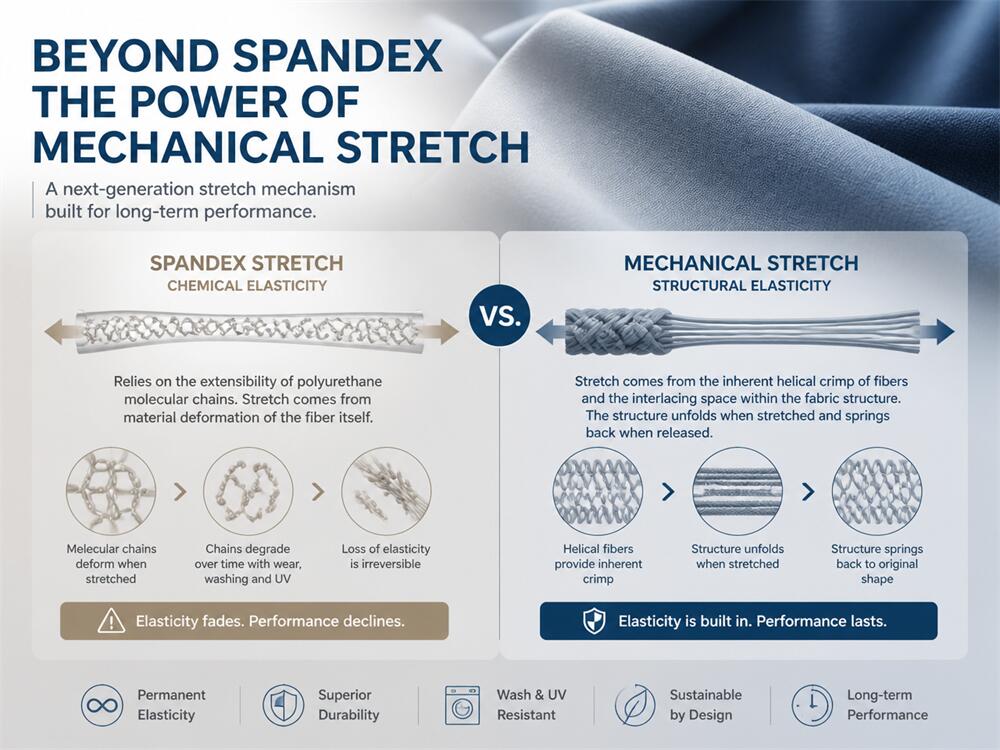
- Spandex stretch (chemical elasticity): Relies on the extensibility of polyurethane molecular chains, working much like a rubber band. Stretch comes from material deformation of the fiber itself. With long-term wear, repeated washing and UV exposure, the molecular chains degrade and break, leading to irreversible loss of elasticity.
- Mechanical stretch (structural elasticity): Stretch comes from the inherent helical crimp of fibers and the interlacing space within the fabric structure. When stretched, the helical fibers straighten and the fabric structure unfolds; when released, the structure springs back to its original shape. Since elasticity is built into the fiber structure rather than added as a separate elastane component, it is permanent and does not degrade over time.
2.2 Three Main Mechanical Stretch Technologies
There are three mature mechanical stretch approaches widely used in the textile industry:
- Structural mechanical stretch from weave design or yarn wrapping techniques
- Crimp elasticity from false-twist textured yarn (DTY) processing
- Permanent crimp elasticity from bicomponent differential-shrinkage fibers (T400/T800 Spandex-free stretch fabric yarn, the industry-leading solution)
3. T400 vs T800: Fiber Differences Explained
3.1 What Is T400 Fabric?
LYCRA T400 fabric is a classic bicomponent side-by-side elastic fiber originally developed by Invista. It is made of PET (standard polyester) and PTT (Sorona®), two polyester polymers with different shrinkage rates, spun together in a side-by-side configuration. Most commercial T400 polyester fabric is produced from FDY (fully drawn yarn).
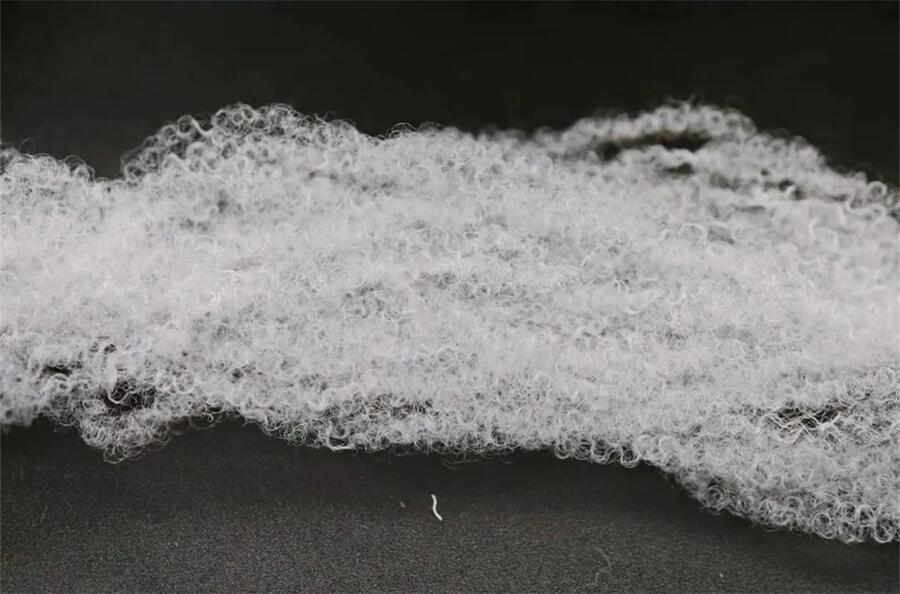
Stretch mechanism: PET and PTT have significantly different thermal shrinkage rates. After heat treatment, the higher-shrinkage PTT forms the inner side of the helix, while the lower-shrinkage PET forms the outer side. This difference creates a permanent three-dimensional single-helix crimp structure, like a built-in micro spring inside each individual fiber.
T400 stretch fabric delivers 2–5 times more elasticity than standard polyester filament. After 500 repeated stretch cycles, it still maintains an elastic recovery rate of over 85%. With a smooth, wrinkle-resistant surface and excellent dimensional stability, T400 mechanical stretch fabric offers outstanding cost performance and is the mainstream workhorse of spandex-free stretch materials.
3.2 What Is T800 Fabric?
T800 is an upgraded premium bicomponent elastic fiber built on T400 technology. It uses a PET + PBT side-by-side spinning formula, and is mostly produced as DTY (draw textured yarn). It features an innovative double-helix figure-8 grooved cross-section for enhanced performance.
Compared with T400, T800 has stronger molecular structure and faster shape recovery. Its elastic recovery rate reaches 92% or higher, and its breaking strength is about 1.8 times that of T400. It withstands 50,000 high-frequency stretch cycles with less than 3% permanent deformation. With a matte, cotton-like soft hand feel and excellent moisture-wicking performance, T800 targets premium outdoor, light luxury and high-durability apparel applications.
3.3 T400 vs T800 Fiber Comparison Table
| Comparison Dimension | T400 Spandex-Free Stretch Fabric | T800 Spandex-Free Stretch Fabric |
| Raw material composition | PET + PTT | PET + PBT |
| Yarn form | Mostly FDY (fully drawn yarn) | Mostly DTY (draw textured yarn) |
| Elastic recovery rate | Approx. 85% | ≥ 92% |
| Breaking strength | Approx. 10 cN/dtex | Approx. 18 cN/dtex |
| Hand feel & appearance | Soft, fluffy, smooth and crisp | Premium cotton-like, fine matte, softer |
| Typical applications | Casual wear, workwear, outerwear, pants | High-frequency stretch, heavy-duty, premium outdoor apparel |
4. T400 vs Spandex / T400 vs Elastane: Key Performance Differences
In the debate of spandex-free stretch vs elastane stretch, this fundamental difference in elasticity source is the root cause of all performance gaps between the two material types.
4.1 Source of Stretch
- Spandex fabrics: Stretch comes from polyurethane chemical molecular chains. It relies on the ultra-high extensibility of spandex filaments, which must be processed into core-spun or covered yarns before blending. The elasticity comes from an added elastane component that naturally degrades over time.
- T400 Spandex-Free Stretch Fabric: Stretch comes from the permanent helical crimp of bicomponent polyester fibers. It is 100% polyester with zero elastane or rubber additives. Elasticity is an inherent physical property of the fiber itself, permanent and non-degrading.
4.2 Stretch Magnitude
- Spandex fabrics: Extremely high stretch power. Only 2%–10% spandex content delivers extreme elongation, but the stretch can feel excessive, with a tight, restrictive feel against the skin. Fabrics tend to relax and bag out with extended wear.
- T400 fabrics: Moderate, controllable comfort stretch. Standard T400 mechanical stretch woven fabric typically delivers 15%–30% weft stretch. Although not as extreme as spandex, this stretch range is more than sufficient for most everyday woven apparel, with a natural, unrestrictive comfort and clean, snappy rebound.
4.3 Dimensional Stability
- Spandex fabrics: Poor dimensional stability and high thermal shrinkage. After heat setting, washing and stacked storage, they easily shrink, wrinkle, bag and lose shape. Long-term wear leads to sagging and fit distortion, with high quality control risk.
- T400 fabrics: Excellent dimensional stability with very low thermal shrinkage. It has a built-in shape-memory effect, resists wrinkling and holds its form wash after wash. Garment sizing stays accurate, with no bagging, sagging or shape loss over time.
4.4 Dyeing Performance
- Spandex fabrics: Spandex has low dye affinity and is difficult to dye evenly. Blended fabrics often suffer from shade variation, barre and uneven dye uptake. It is also sensitive to chlorine bleach and high temperatures, which cause yellowing and permanent elasticity loss.
- T400 fabrics: 100% polyester structure with mature, stable dyeing processes, suitable for high-pressure dyeing. Dye uptake is even and saturated, with wash, perspiration and dry/wet rub color fastness all reaching grade 4 or higher. It is also chlorine-resistant and retains its color through repeated washing.
4.5 Weaving Process & Cost
- Spandex fabrics: Complex production workflow. Spandex cannot be woven directly; it must first be processed into core-spun or covered yarns. Dyeing and finishing require double setting, leading to longer lead times, higher defect rates, and risk of crush marks from stacked storage. Overall production costs are higher.
- T400 fabrics: Can be woven directly on air-jet, water-jet and rapier looms with no pre-processing required. The process is simpler, yields are higher and quality is more consistent. Grey fabric cost is 10%–20% lower than comparable spandex fabrics, giving it a clear mass-production cost advantage.
5. Why Brands Choose Elastane-Free Stretch Fabrics
5.1 Eco-Friendly & Recyclable
Spandex is a polyurethane material produced with toxic solvents. Once blended into fabric, it cannot be separated from other fibers, making closed-loop recycling nearly impossible. This makes traditional spandex blends incompatible with global carbon-neutral and sustainable fashion goals, and exposes brands to greenwashing risks.
In contrast, T400 polyester fabric is 100% polyester and can be recycled and reused just like standard polyester. The mature LYCRA T400 EcoMade version contains 50%–60% recycled polyester and is certified to the Global Recycled Standard (GRS). It can also be finished with C0 fluorine-free water-repellent treatments. Leading global brands such as Decathlon already use T400 EcoMade for fully recyclable swimwear and outdoor apparel.
5.2 Long-Lasting Elasticity, No Sagging or Bagging
Spandex naturally degrades over time. Sunlight, washing, heat and body movement cause the fibers to break, leading to lost elasticity, sagging fabric and bagging at high-stress points like elbows and knees. This is one of the main reasons spandex garments have a limited service life.
The elasticity of mechanical stretch fabric comes from the permanent crimp structure of the fibers themselves. It does not degrade with age and wear like spandex. Testing shows T800 fabrics have less than 3% permanent deformation after 50,000 stretch cycles. Garments keep their shape and stretch performance wash after wash, for a longer usable life and higher perceived quality.
5.3 Excellent Chemical & Chlorine Resistance
Spandex is sensitive to chlorine bleach and high temperatures. Prolonged exposure to chlorine causes discoloration and performance degradation. It also performs poorly under high heat, alkaline conditions and chlorinated environments.
Spandex-free stretch fabric overcomes all these weaknesses with outstanding chlorine resistance. LYCRA T400 EcoMade withstands over 500 hours of chlorine exposure, making it ideal for swimwear and other water-contact applications. It also offers excellent resistance to chemicals, acids and alkalis.
5.4 Superior Color Fastness
Spandex blends commonly suffer from fading, crocking and perspiration discoloration, leading to higher garment return rates. T400 stretch fabric delivers consistent dyeing results with grade 4+ color fastness, comparable to standard polyester. Wash fastness and rub fastness are both better than spandex blends. Garments stay color-stable and look new longer, even after repeated laundering.
6. FAQs About Spandex-Free Mechanical Stretch Fabrics
Q1: How elastic is spandex-free stretch fabric?
Elastane-free stretch fabric delivers balanced, comfort-focused mechanical stretch. It has a moderate elongation of 20%–50% and a recovery rate of ≥ 95%, with soft, non-restrictive stretch that works for most apparel categories. Unlike spandex, its structural elasticity is permanent and does not weaken over time, offering far better long-term stability.
Q2: What apparel is T400 fabric best suited for?
T400 fabric for pants is one of the most popular applications, but its uses extend far beyond bottoms. Ideal for woven garments that need shape retention, wrinkle resistance and moderate stretch, core applications include:
- Pants: casual pants, work pants, board shorts, dress trousers
- Outdoor apparel: shell jackets, ski wear, sportswear sets
- Outerwear: blousons, windbreakers, down jackets, winter coats
- Casual wear: stretch shirts, fashion casual apparel
Q3: What garments are NOT suitable for T400 mechanical stretch?
T400 delivers moderate comfort stretch and is not recommended for ultra-high stretch, skin-tight applications:
- Professional compression sportswear, shapewear, tight-fitting underwear
- Ultra-stretchy 4-way stretch knit garments
- Next-to-skin items that demand an extremely soft, second-skin feel
Q4: 2-way stretch vs 4-way stretch fabric: which is T400?
T400 is available in both constructions. Standard mass-produced T400 mechanical stretch woven fabric uses T400 yarn in the weft (cross direction) only, delivering 2-way stretch (width-wise stretch only). This is the most popular construction for pants and outerwear, as it provides horizontal comfort stretch while keeping vertical shape retention. For 4-way stretch, T400 fibers can be used in both warp and weft to deliver stretch in both length and width directions. This 4-way woven construction delivers performance previously only possible with spandex blends.
Q5: Is spandex-free stretch fabric more sustainable than spandex blends?
Yes. When comparing mechanical stretch vs spandex sustainability, spandex-free options hold a clear advantage. T400 is a leading sustainable stretch solution: 100% polyester for full recyclability, available with GRS certification, compatible with C0 fluorine-free water-repellent finishes, and backed by a mature EcoMade recycled fiber system. It meets EU environmental standards and international brand carbon-neutral sourcing requirements.
Q6: Is T400 mechanical stretch fabric mature enough for mass production?
Yes, T400 fabric is a fully mature, widely available material suitable for large-scale stable production. The production system is well established, with weights ranging from 50 gsm to 300 gsm. It supports all major weaves: plain, twill, check and jacquard. The entire dyeing, finishing and setting process chain is mature and reliable, with high production yields. It works for everything from lightweight fashion fabrics to heavy-duty workwear and outdoor shell fabrics.
Q7: Are there any special considerations when sourcing T400 fabric?
The main consideration applies to sublimation transfer printing. T400 fibers have relatively poor weft shrinkage resistance under high heat. Sublimation printing typically requires temperatures of 210–220°C, which causes noticeable width shrinkage in the weft direction. Production guideline: If the finished printed fabric needs a usable width of 150 cm, the grey fabric width before printing should be 160 cm to allow for shrinkage. This prevents finished width shortages and fit issues. Standard dyeing, weaving and setting processes have no special requirements.
7. Conclusion
Spandex-free mechanical stretch fabric (T400/T800) redefines how stretch fabrics are made, replacing spandex chemical elasticity with permanent structural mechanical stretch. It solves the long-standing pain points of spandex: aging, lost elasticity, bagging, poor color fastness, low chlorine resistance and non-recyclability. T400 offers excellent cost performance and broad versatility, making it the mainstream market choice. T800 delivers upgraded performance and a premium hand feel for high-end quality orders. As global sustainable fashion and quality expectations rise, elastane-free stretch fabric has become the preferred functional material for business casual, outdoor, workwear and export apparel brands. Replacing traditional spandex blends is a clear industry trend.
We specialize in the full range of T400 and T800 spandex-free mechanical stretch fabrics, supporting ready-stock options and custom orders with specified weights, special weaves, GRS recycled certification and C0 PFAS-free eco-friendly finishes. Our mature dyeing, setting and printing expertise helps customers avoid common production pitfalls. We provide full support from sample confirmation, pre-production verification, batch quality control to pre-shipment inspection. We welcome apparel brands, trading companies and garment factories to inquire, request samples and place bulk orders, with flexible customization and reliable long-term supply.