A buyer emails the mill with a short, firm requirement: this stretch fabric cannot contain spandex. Not “lower spandex,” not “better spandex” — none at all. The programs that used elastane before failed on color fastness and durability, and the brand is done with that failure mode.
The supplier replies with two sentences: “It’s T400. Spandex-free, guaranteed.”
That is not proof. It is not even a claim about the right thing — because “it’s T400” answers a different question than “does this fabric contain elastane,” and the two questions can have different answers for the same roll of cloth. This guide walks through how a buyer actually verifies both: what a third-party composition report costs and how long it takes, what you can check yourself in ten minutes with a pair of tweezers, the three common ways a “T400” fabric turns out not to be spandex-free, and the exact composition clause that keeps a mill honest from sample stage to bulk.
1. Two Different Questions Buyers Keep Merging
The first mistake in verifying a spandex-free fabric is treating “is it T400?” and “does it contain spandex?” as one question. They are not, and the gap between them is where most trouble lives.
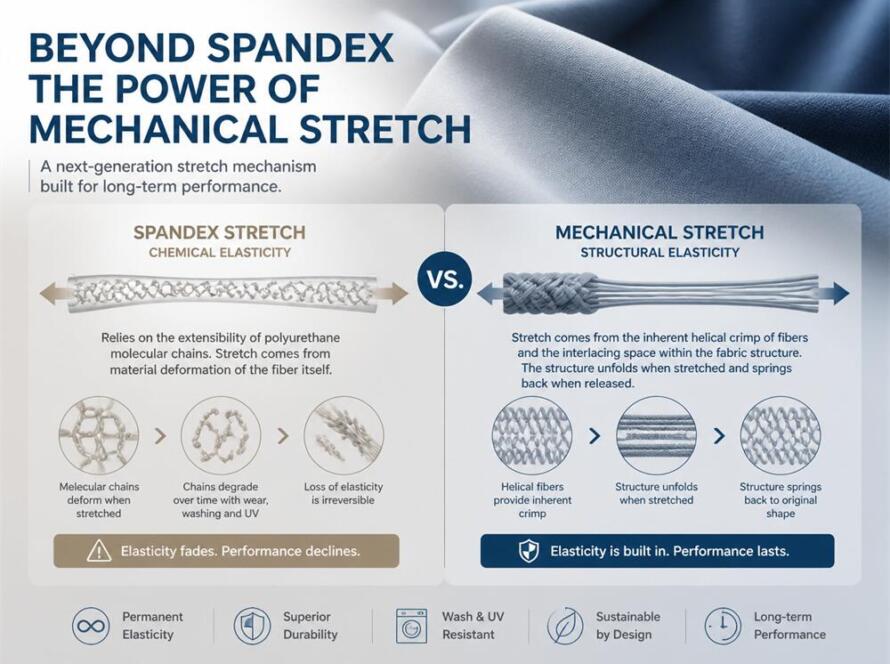
Question one: is the stretch yarn actually T400? T400 is a trade code for a bicomponent polyester — PET and PTT polymers extruded side by side into a single filament, then heat-set so the two polymers shrink at different rates and the filament takes on a permanent helical crimp. That micro-spring is the whole stretch mechanism. Full comparison in our T400 vs spandex guide.
Question two: does the fabric contain elastane? A fabric can be woven with genuine T400 weft yarn and still contain spandex — as a covered core, a plied yarn, or a small percentage in the warp. It is rare, but it exists, and section 7 covers what it looks like from the mill side.
So the verification target is not the yarn name on the invoice. It is a single, checkable fact about the finished fabric: 0% elastane, 100% polyester. Everything below is about getting that fact onto paper — and then confirming nobody quietly changed it between sample and bulk.
2. Why Buyers Are Asking for Proof at All
Spandex-free stretch used to be a preference. In workwear, uniform and swim-adjacent programs it has become a requirement, for two reasons that both trace back to elastane itself.
Color fastness. Elastane ages in wet processing and in the garment’s life. Achieving grade 4 fastness on a spandex blend takes longer dyeing, reduction clearing and repeated soaping — which is why high-fastness spandex fabrics cost more, as our colorfastness grades guide explains. Buyers who were burned by shade drift and staining on elastane programs stop asking “can you hit grade 4” and start asking “can you remove the elastane.”
Durability. Spandex loses recovery as the polymer ages — chlorine, heat and repeated industrial washing all accelerate it. A pant program that bagged at the knees after a season is a claim, a credit note and a lost reorder. Mechanical stretch has no elastane to age: recovery in our own constructions stays above 85% after 500 stretch cycles, and chlorine exposure that destroys an elastane fabric leaves a T400 fabric untouched — the chlorine-resistant rebuild case was a yarn substitution, not a finishing fix.
But a requirement is only as strong as its enforcement. “No spandex” written in an email, with nothing behind it, gets discovered in the cutting room or the customer’s wash test — a season late and a container deep. Verification is what turns the requirement into something a mill can be held to.
3. The Evidence Ladder: Five Levels of Proof
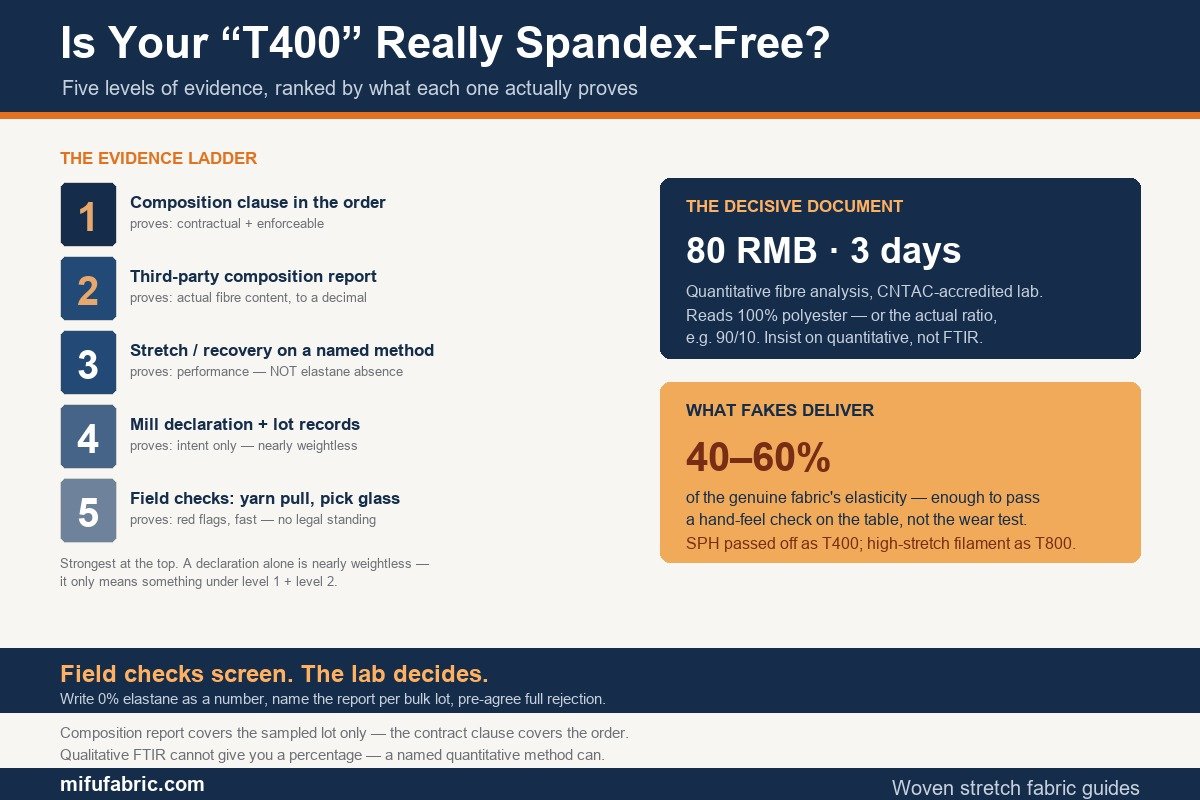
Not all evidence is equal. Ranked by what each level actually proves, from strongest to weakest:
| Level | Evidence | What it proves | What it does not prove |
| 1 | Composition clause in the order, with a stated remedy | Makes the claim contractual and enforceable | Nothing by itself — paper only |
| 2 | Third-party quantitative composition report | The actual fibre content of the sampled fabric, to a decimal | Other production lots; anything after sampling |
| 3 | Stretch and recovery data on a named method (e.g. ASTM D3107) | The fabric performs like a genuine T400 construction | Presence or absence of elastane |
| 4 | Mill composition declaration + lot records | What the mill intended and wove | Whether the yarn supplier was honest |
| 5 | Field checks — yarn pull, pick-glass density | Red flags, fast, on your desk | Percentage content; legal standing |
Two things in this table are worth pausing on.
A declaration alone is nearly weightless. A composition declaration costs the mill nothing to issue, which is exactly why it proves almost nothing. It is the weakest tier that still gets offered first, and buyers accept it most often. A declaration is worth something only when it sits under level 1 and level 2 — signed against a contract clause and backed by a lab report.
Levels 2 and 3 catch different frauds. A composition report catches elastane substitution — spandex where T400 should be. Stretch-and-growth data catches quality substitution — genuine T400 composition woven at a cheat density, which passes a fibre test while delivering a fraction of the stretch. This is why we ask buyers to run both, and why section 6 separates the fraud types so you know which test to reach for.
4. What the Composition Report Actually Says — and What It Costs
The decisive document is simpler and cheaper than most buyers expect.
In China, the standard route is a quantitative fibre content analysis from a CNTAC-accredited laboratory (China National Textile and Apparel Council system). The test chemically separates and quantifies the fibre blend, and the report reads in one of two ways:
- No elastane detected: the report states 100% polyester.
- Elastane detected: the report states the actual ratio — for example, 90% polyester / 10% spandex.
That second line is why the test is worth its price. A fabric sold as “T400, spandex-free” that comes back 96/4 does not need an argument — the ratio is printed on the report, and the remedy is whatever your contract clause says it is.
Cost and time: at our mill the test fee is 80 RMB (about USD 11) and the result takes 3 working days. For an order worth tens of thousands of dollars, the entire verification budget is one lunch. There is no credible excuse for skipping it on a program where “no elastane” is a hard requirement.
What to ask the lab for:
- Quantitative analysis, not qualitative. FTIR spectroscopy can confirm whether polyurethane is present, but it cannot give you a percentage. A qualitative pass is what you get when someone wants to say “we tested it” without answering the question. Insist on the quantitative method.
- The sample is the proof. Take the sample from the fabric you will actually receive — from the bulk roll or the approved pre-production sample, not from a hand loom the mill selected for you.
- Report the method on the document. A result without its test method named cannot be reproduced or defended in a dispute.
One caution the report itself will not give you: the result is true of the sampled lot at the sampling date. Level 1 (the contract clause) is what extends that guarantee to the rest of the shipment — the report makes the clause enforceable, the clause makes the report cover the order.
5. What You Can Check in Ten Minutes
The lab report is the proof. But between samples and shipments, there are three checks that cost nothing and catch most problems before they reach a container.
5.1 Pull a yarn and look at its shape
Pick a weft yarn out of the selvedge and look at it — ideally next to a known T400 yarn and a known spandex yarn. The difference is visible to the eye:
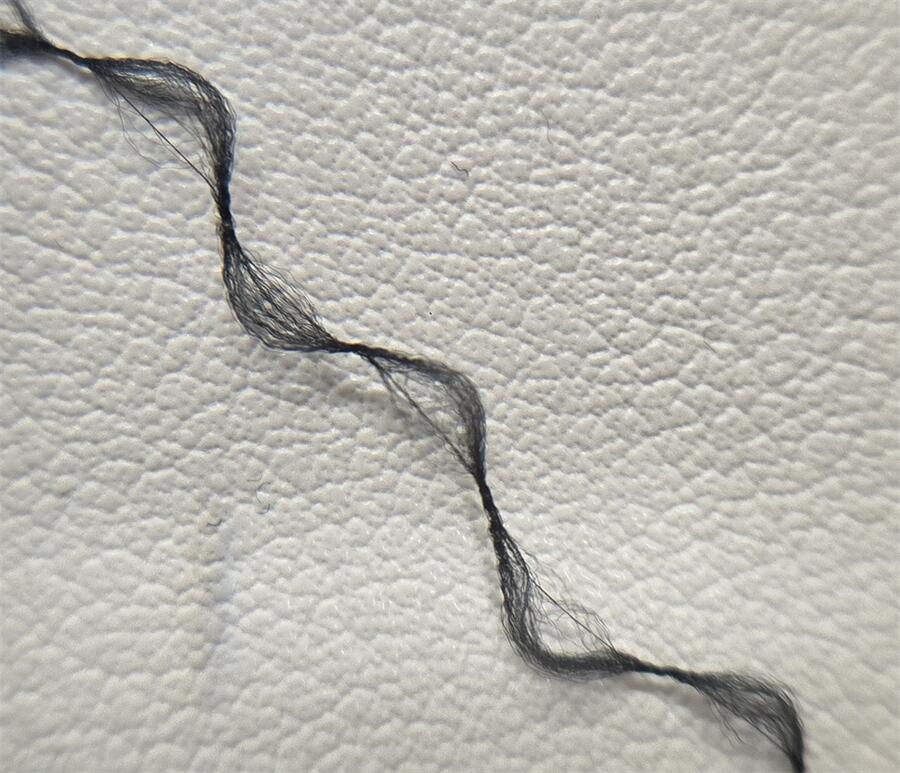
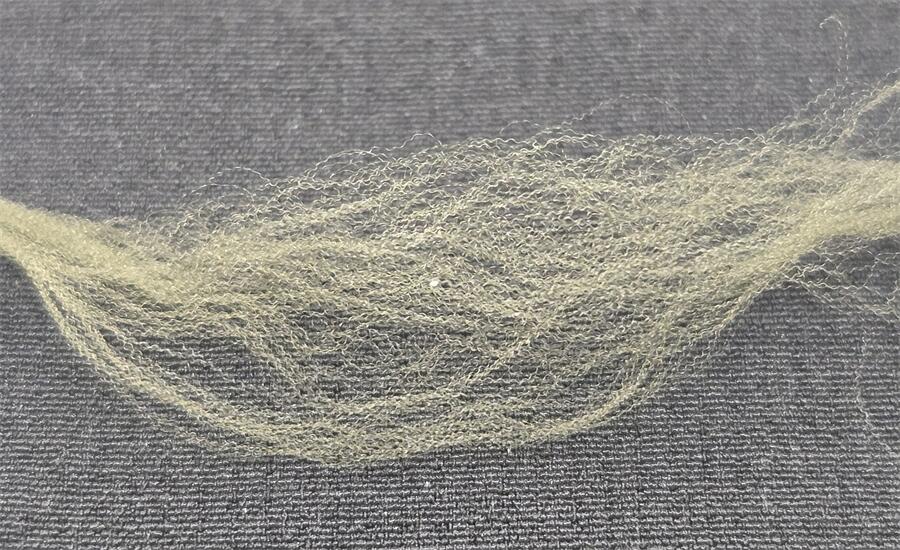
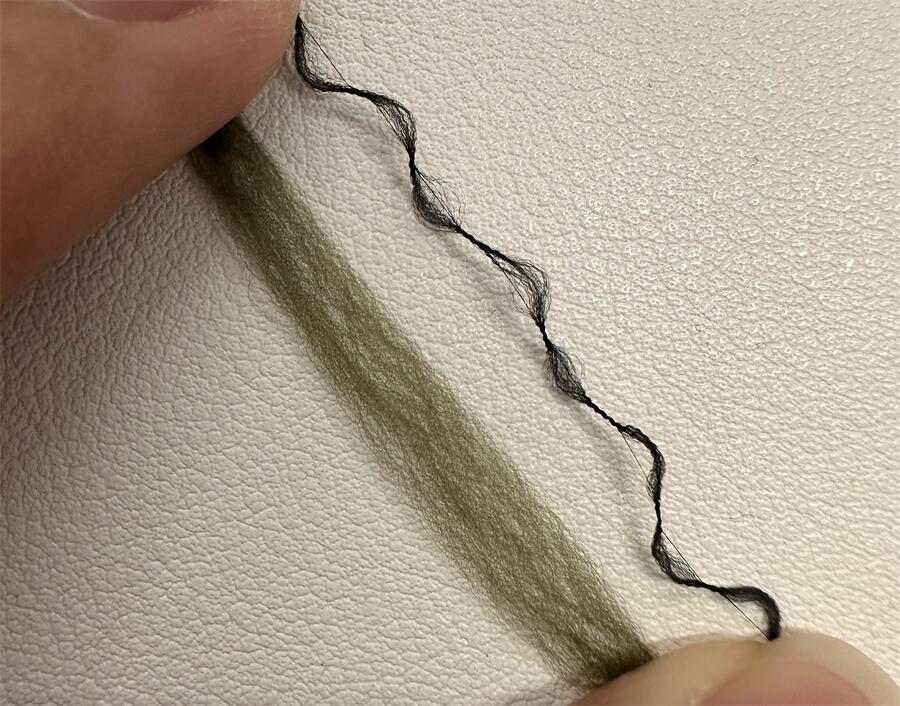
- Spandex is a clear, glassy monofilament with no crimp — a smooth elastic thread that wants to snap back onto your fingers.
- T400 is a textured filament with a visible helical crimp and bulk — it looks and feels like a tiny spring, holds a loopy three-dimensional shape at rest.
Then pull the yarn. T400 extends moderately and recovers to a stable length; its springiness comes from structure, so it neither snaps back violently nor stays stretched out. Ordinary high-stretch polyester filament — the most common T800 substitute — looks flat and lifeless next to a genuine bicomponent yarn: less bulk, weak crimp, poor snap.
5.2 Judge recovery, bulk and crimp together
The three properties that separate genuine bicomponent yarn from substitutes travel together:
- Recovery (回缩性): stretch the yarn, release, watch what it returns to. Genuine T400 settles back promptly to a consistent length.
- Bulk / loft (蓬松度): bicomponent crimp gives the yarn a springy volume; a substitute lies flat.
- Crimp of the individual filament (单根 F 卷曲): untwist to a single filament — T400’s helix is unmistakable at even modest magnification.
A substitute yarn fails all three at once. Across the samples we have seen, fakes deliver roughly 40–60% of the genuine fabric’s elasticity — enough to pass a casual hand-feel check on the table, not enough to survive the customer’s wear test.
5.3 Read the density with a pick glass
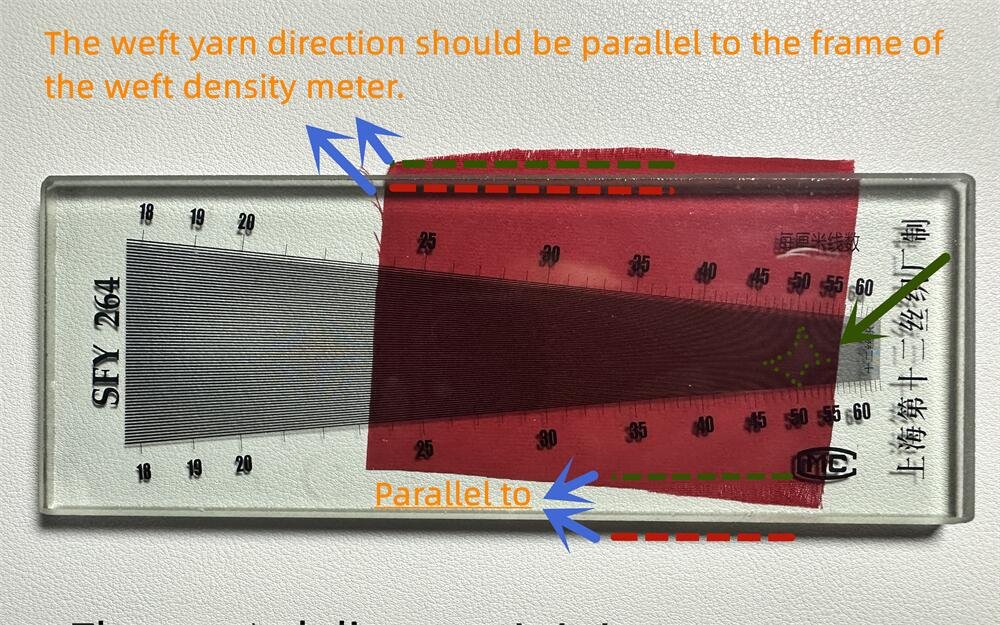
A pick glass (weft density meter) turns the third fraud — cheating the T400 content down at the loom — into a ten-minute check. Count the T400 picks per centimetre against the construction on the spec sheet. A budget “T400” fabric with a dense regular-polyester warp and a thin T400 weft can technically be 100% polyester and still deliver a fraction of the stretch: the over-dense warp locks the structure so the T400 weft has no room to work. Density is where quality dies quietly while the composition test stays green — our elasticity factors guide covers why content percentage alone never predicts elasticity.
5.4 Know the blind spot
The honest limit of every field check: from the fabric surface, you cannot tell. Hand, drape and even stretch feel on the table do not reliably separate genuine T400 from a substitute or from a small spandex content. We say this as the mill writing the guide: if the checks in this section raise a doubt, resolve it with the 80-RMB report, not with another roll on the inspection table. Field checks screen; the lab decides.
6. Three Ways “T400” Turns Out Not to Be Spandex-Free
Verification gets easier once you know the three failure patterns. In our experience they cover nearly every case.
Fraud 1: an elastane yarn standing in for T400. The fake stretch system is spandex — the very fibre the buyer is paying to avoid. On the surface it looks right; the composition report destroys it instantly (90/10 or similar), which is why this fraud only survives when nobody tests. Consequence when it is caught: in this trade, the full shipment is rejected — nobody absorbs an elastane substitution into an order that specified zero elastane.
Fraud 2: ordinary high-stretch filament sold as T800. The premium tier gets its own counterfeit: a plain high-elastic polyester filament offered where a genuine PET/PBT bicomponent should be. The yarn-pull check in 5.2 is built for this — no bulk, no crimp, weak recovery. The composition report will not catch this one, because both yarns are 100% polyester. This is the fraud that makes level 3 (stretch data) non-optional.
Fraud 3: the T400 content thinned at the loom. Composition honest, performance cheated: dense regular-polyester warp, minimal T400 weft. Passes every fibre test. Catches on the pick glass (5.3) and in the growth column of a proper stretch test — and in the field it shows up as fabric whose recovery fades well before the garment is worn out.
The matching discipline: fraud 1 dies with a composition report; frauds 2 and 3 die with performance data and a density check. A buyer who runs all three checks has closed every route in this list.
7. The Rare Exception That Breaks the Assumption: T400 With a Spandex Core
Here is the case that justifies section 1 — and the reason “it’s T400” can never be accepted as proof of “spandex-free.”
T400 fabrics can be built with elastane. It is rare and it is premium: we have seen a small number of custom developments where the T400 yarn is air-covered or twist-covered over a spandex core. The stretch is genuinely excellent — better than pure mechanical stretch — and the construction is a legitimate, deliberate engineering choice for programs that want T400’s hand and stability with an elastane-grade elongation.
What it costs: process difficulty. The covered structure is fragile in dyeing and finishing — it abrades easily, and it shows the classic chicken-track crease marks when the fabric moves wrong in the machine. That difficulty is part of why the construction stays rare and expensive.
What it means for a buyer: the yarn being T400 tells you nothing about the fabric’s elastane content. A supplier can truthfully say “this is T400 fabric” about a cloth with a spandex core inside it. The only sentence that holds the line is the one about composition: 0% elastane, 100% polyester — stated in the order, confirmed by the report, checked on the sample. If a supplier’s spec sheet says “T400” but is silent on elastane content, ask the direct question. Silence is not an answer; 100% polyester is.
8. What to Write Into the Order
Verification only works if it is written down before the fabric exists. The order is where that happens.
8.1 The composition clause
One line does the work:
Composition: 100% polyester (T400 / elastomultiester bicomponent), 0% elastane. A third-party quantitative fibre content report (CNTAC-accredited laboratory) for each bulk lot; a report showing any elastane content constitutes a breach and the lot is subject to full rejection.
Three things are deliberate in that wording: the claim is a number (0%), the evidence is named and scheduled (per lot, not “available on request”), and the remedy is pre-agreed (full rejection — which is how the trade already treats elastane substitution when it is caught late).
8.2 Label compliance — the elastomultiester trap
Care labels are where honest orders go sideways. “Elastomultiester” is the accepted generic fibre name in the EU, but in China’s domestic labeling practice it — and marketing names like “high-elastic new-fiber polyester” — are grey-area at best: under strict inspection, non-compliant 100% of the time. The compliant label is the plain chemical name: polyester (涤纶 / 聚酯纤维). Write the label into the spec the same way you write the composition clause — “polyester, 100%” — and you have removed a customs and audit risk that costs nothing to avoid. If the program also claims recycled content, the same logic applies to the GRS transaction certificate: the paper trail and the fibre claim must agree.
8.3 The rest of the specification
Composition is the headline, but the spec sheet should carry the whole verification kit:
| Item | What to state |
| Composition | 100% polyester (T400 bicomponent), 0% elastane |
| Report | Quantitative fibre analysis, CNTAC-accredited lab, per bulk lot |
| Stretch | Elongation and growth on a named method (e.g. ASTM D3107), weft 15–30% for standard constructions, recovery >85% after 500 cycles |
| Density | T400 weft picks/cm and total construction — pick-glass checkable |
| Weight | 50–300 gsm production scope, with lot tolerance |
| Label | Polyester — chemical name, not “elastomultiester” |
| Remedy | Full rejection on elastane detection |
How to get all of this into a conversation with any supplier, not just us: the RFQ framework puts each item in the exact order buyers ask for it.
8.4 When you want this engineered, not just verified
If a program genuinely needs higher elongation than pure mechanical stretch delivers, the honest routes are a spandex blend declared as one — or a custom construction developed around the target, which is what custom woven development is for. The failure mode to avoid is not “spandex is bad.” It is undisclosed spandex — the fibre the order banned, hiding inside the yarn name.
FAQ
How much does a spandex detection test cost?
At our mill, a third-party quantitative composition test through a CNTAC-accredited laboratory costs 80 RMB (about USD 11) and takes 3 working days. Composition declaration and test report are both provided. If elastane is detected the report states the actual ratio — e.g. 90% polyester / 10% spandex; if not, it states 100% polyester.
Can a burn test prove a fabric is spandex-free?
No. A burn test is a crude screen that cannot quantify a blend, and small elastane percentages are invisible in the flame. The only document that settles composition is a quantitative chemical analysis. Save the lighter for yarn triage, not for proof.
What does the report say if spandex is found?
The actual ratio — for example “90% polyester / 10% spandex.” That single line converts a suspicion into an enforceable breach, which is why the remedy belongs in the contract before the fabric is woven.
Can T400 fabric legally contain spandex?
Physically, yes — rare premium constructions cover a spandex core with T400 (air-covered or twist-covered), giving excellent stretch at the cost of difficult dyeing and finishing. Which is exactly why “T400” alone is not proof of anything: the verification target is the fabric’s composition, not the yarn’s trade name.
Can you tell from the fabric surface?
No. We state this as the mill: hand feel, drape and table-stretch do not reliably expose a substitute or a small elastane content. Counterfeit constructions typically deliver 40–60% of the genuine elasticity — a gap you feel in the wear test, not on the inspection table. Pull the yarn and count the picks; then buy the 80-RMB report.
Why did our previous spandex program fail on fastness and durability?
Elastane ages: it loses recovery under chlorine, heat and industrial washing, and high fastness on a spandex blend demands heavier dyeing and clearing. Programs that lived through both failures — shade drift plus knee bagging — usually end up where this article started: “no spandex” as a hard requirement.
What exactly should the PO say?
See 8.1 — one clause: composition as a number (0% elastane), a named third-party quantitative report per bulk lot, and a pre-agreed remedy of full rejection. Add the density and stretch rows from 8.3 and the label ruling, and the entire verification system fits in four lines of an order.
Explore Mifu’s spandex-free stretch lines: T400 fabric · what is spandex-free stretch fabric · common sourcing pitfalls · all stretch fabric guides