Almost every stretch fabric quote carries the same three words: “high colorfastness.” Buyers accept it, write “grade 4” into the PO, and move on to price and lead time. Then the first bulk test comes back at 3.5, the end customer returns the garments, and the argument starts — because “grade 4” was never a property of the fabric. It is one reading, taken by one method, on one color, under one lamp, averaged across several pairs of eyes.
This guide covers what the numbers on the grey scale measure, what each grade looks like in wear, what our own bulk production actually holds on black (our worst-case reference shade), what one step up costs in money and days — and the five specification habits that decide whether a fastness clause is testable at all.
1. A Grade Is a Measurement, Not a Property
Colorfastness is rated on the grey scale: 1 to 5, where 5 means no visible change and 1 means severe change. Half steps (3-4, 4-5) are real readings, not rounding: an assessor places the tested specimen next to an untested original, compares the contrast against the grey chip pairs, and records the matching pair. Change in shade is judged against one set of chips, staining against another.
Three consequences follow, and each of them costs buyers money when ignored:
- It is a visual judgment. Instruments can express a rating as a ΔE value, but the scale itself is read by eye under controlled light. Two trained assessors in the same lab often differ by half a grade; two labs differ more often than either will admit.
- It is averaged. A report reflects several assessments compressed into one number, which is why a certificate reading 4 can sit alongside one panel that read 3-4.
- It is bound to a method and a color. “Grade 4” without a test method is unverifiable; “grade 4” without a shade is half a spec, because black and white are not the same target.
Our in-house numbers below are read on the scale used in the Chinese GB/T test series — wash, crocking, perspiration and light each have their own standard and their own conditions. The 1–5 basis is the same one AATCC and ISO use, so the numbers are comparable, but the methods are not identical and a GB/T 4 is not automatically an AATCC 4. Treat cross-standard numbers as indicative, and name the standard you will actually be tested against.
How a mill builds fastness into the fabric — preparation, dye selection, clearing, heat setting — is covered in our colorfastness process guide. This article stays on the buying side.
2. What Each Grade Looks Like to a Customer
| Grade | What it looks like in wear | Who notices, and when | Typical fit |
| 2.5–3 | Obvious fading or staining | End customer, first few washes | Below export norm on dark shades |
| 3 | Clearly visible change | End customer, a handful of washes | Not acceptable for most export apparel |
| 3.5 | Slight change, hard to see on the garment alone | Careful side-by-side comparison | The commercial workhorse |
| 4 | Visible only when specimen and original are compared side by side | Inspector, on the grey scale | The usual spec on export POs |
| 4-5 | Faint difference, essentially invisible | Only under a different light source | Premium claims, pale shades |
| 5 | No change | — | Rarely specified; you pay for it |
Two practical readings. First, 3.5 is not a failure — it is where a large share of standard commercial production lands, and for many mid-market uses it is the correct spec. We made the same point from the cost side in our spandex-free workwear fabric guide: the grade ladder is a cost and logistics ladder before it is a quality ladder. Second, the customer-visible gap is between 3 and 4, not between 4 and 4-5. A dark garment that fades visibly after a few washes generates the returns; a 4-versus-4-5 difference generally does not.
That is why the useful question is never “how do I get to 5” but “what exactly am I buying when I move from 3.5 to 4” — which Section 5 prices out.
3. Grade 4 Is Not One Number: Wash, Crock, Perspiration, Light, Chlorine
This is where most fastness disputes begin. “Grade 4” written alone bundles together tests that measure different things, and passing one does not imply passing another.
Here is what our bulk production actually holds, measured on black — our worst-case shade, because black sits at the bottom of the range and pale shades typically run 0.5–1 grade higher:
| Test item | Polyester 4-way, regular | Polyester, high-fastness | Nylon 4-way, regular | Nylon, high-fastness |
| Wash | 2.5–3 | 4–4.5 | 3–3.5 | 4–4.5 |
| Dry crocking | same as wash | same as wash | same as wash | same as wash |
| Wet crocking | same as wash | same as wash | same as wash | same as wash |
| Wet crocking, brushed/peached finish | −0.5 to −1 | −0.5 to −1 | −0.5 to −1 | −0.5 to −1 |
| Perspiration | 3 | 4 on request | 3 | 4 on request |
| Light | 3.5 | 4 on request | 2.5–3 | 4 on request |
| Chlorine (bleach) | — | — | ≈2 | — |
Read the table by column, not by row average. Three points matter more than the rest:
Wash and crocking track together; perspiration and light do not. A fabric processed to grade 4 on wash and rubbing does not arrive at grade 4 on perspiration, light or saliva. Those are separate chemistries and require separate process work. Our default perspiration figure is 3, and light is 3.5 on polyester, 2.5–3 on nylon. Both can be lifted to 4 — but only if the requirement is stated before production. This single sentence prevents more claims than any other in this article.
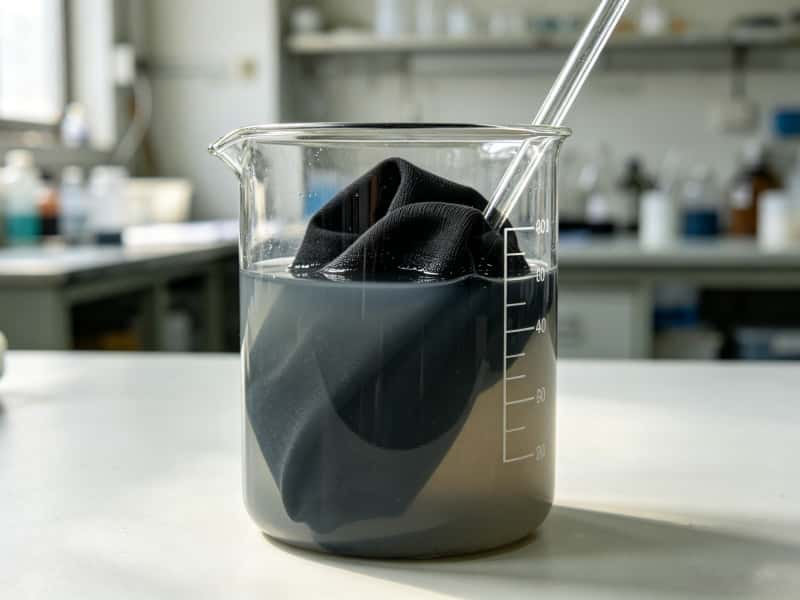
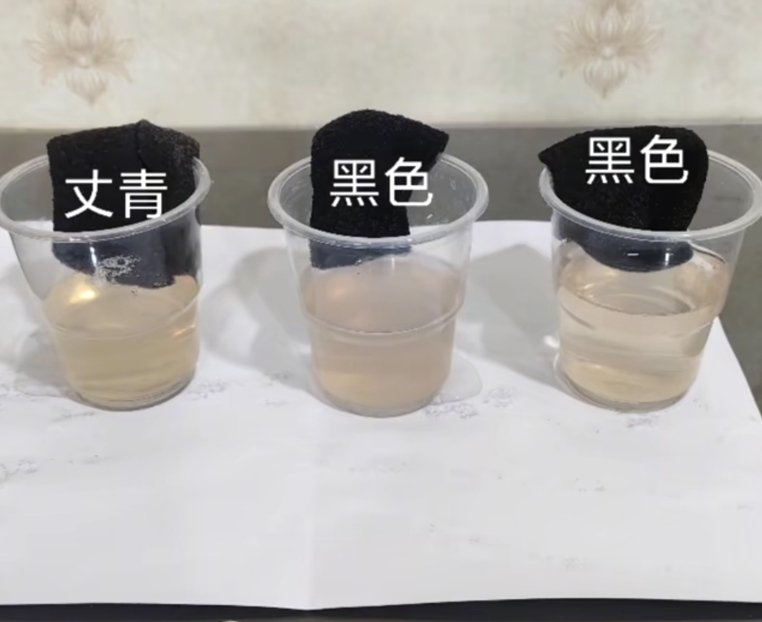
What the tests look like on our floor, in photographs. A soak test on medium-to-low fastness fabric — black and navy swatches standing in water — clouds the water within minutes:
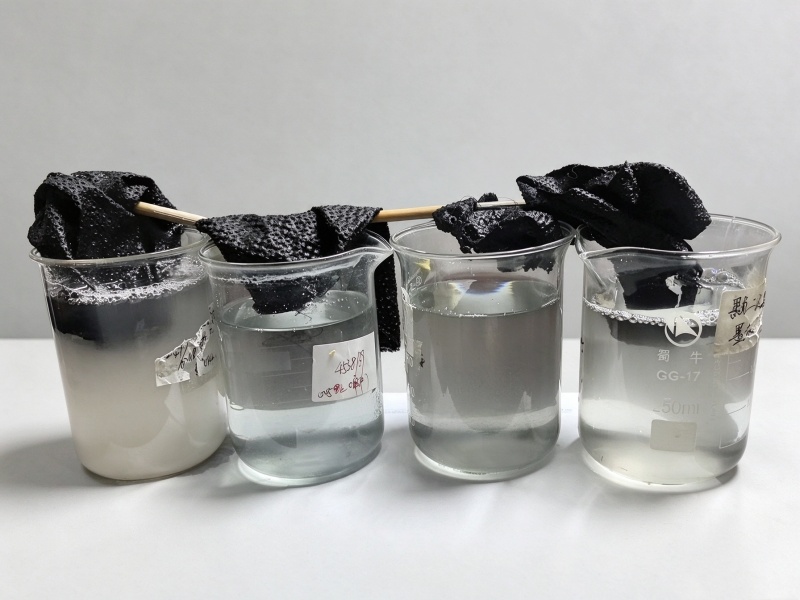
The same soak at grade 4 and above leaves the water essentially clear — the difference is the dye left inside the fiber versus the dye sitting on its surface:
Brushing and peaching cost you wet crocking. If the finish includes brushing or peaching, wet crocking drops 0.5–1 grade even when wash fastness is unchanged, because the raised surface releases dye more readily onto a wet test cloth. A PO that specifies “peached hand, grade 4 wet crock” is specifying two requirements that pull against each other; write both, and expect to pay for the combination. Dry and wet crocking pads show the difference directly:
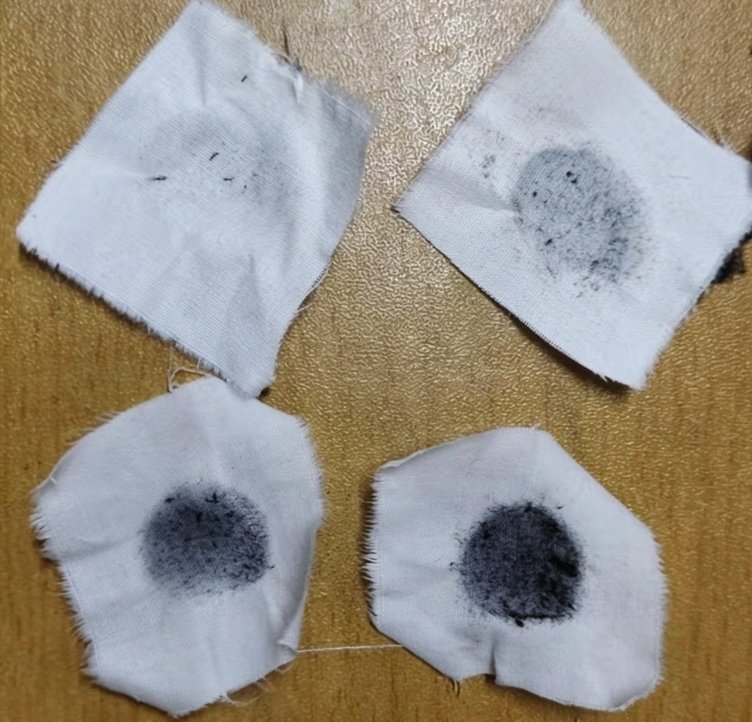
Chlorine is a different failure mode entirely. On nylon, chlorinated water produces severe shade change — around grade 2 — regardless of how good the wash fastness is. In one of our own shipments, 4,500 woven swim shorts passed every standard fastness item at grade 4 and then faded across the order after roughly a month of pool wear, because pool chlorine degrades the elastane fiber itself. Our chlorine-resistant fabric case documents the fix; the fiber reasoning is in our spandex-free stretch fabric guide. If the garment meets pool water, wash and crock grades will not protect you.
4. The Dark-Shade Penalty, and the Colors That Resist Grade 4
Grey-scale performance is not shade-neutral, and the direction is consistent: deep shades run 0.5–1 grade below pale shades of the same construction. Black is the reference point in the table above precisely because it is the hardest case. Navy and deep red behave similarly. White and pale pink reach 4-5 with little effort.
Above that baseline sits a shorter list of colors that are genuinely difficult: emerald green, turquoise, and violet — shades that require large amounts of blue as the dominant tone, built from the three primaries. These resist grade 4 no matter how carefully the recipe is managed, and they are where specification has to happen at lab-dip stage, not after bulk.
The encouraging news is that black and red are no longer the problem colors they were a decade ago; dye systems for both are mature. If a supplier still prices black as an exception, ask what specifically is driving it.
Two practical habits follow. Write the shade family into the spec, per color, not one grade for the whole order. And check the construction together with the shade: deeper shades on heavier fabric carry more dye overall, so clearing matters more and the wet-crock margin narrows. The ordering logic is the same one in our GSM and width guide: specify the real article, not an average.
5. What One Grade Step Costs — and Why Nylon and Polyester Curve Differently
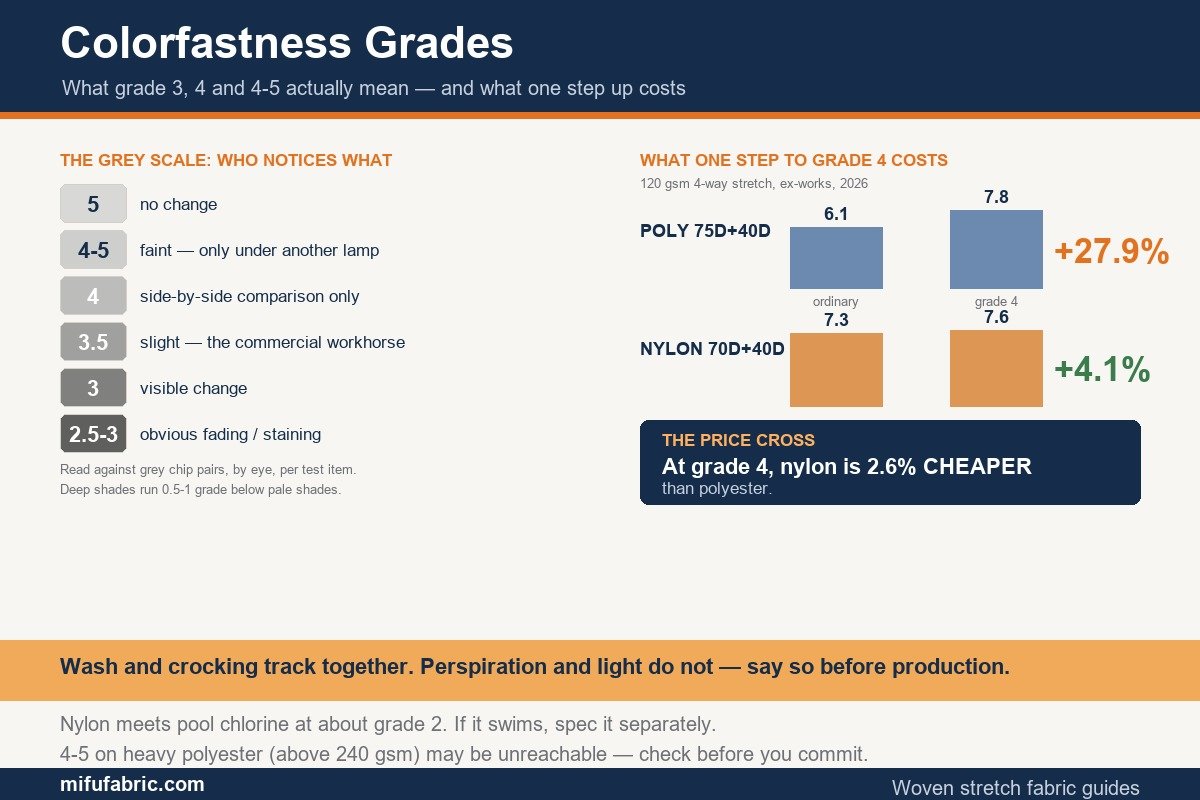
Here is the number most guides never publish. Same 120 gsm woven four-way stretch constructions, same mill, ex-works, 2026:
| Ordinary fastness | Grade 4 | Step cost | |
| Polyester 75D+40D | ¥6.1 /m | ¥7.8 /m | +27.9% |
| Nylon 70D+40D | ¥7.3 /m | ¥7.6 /m | +4.1% |
Read that twice, because it crosses. At ordinary fastness polyester is roughly 20% cheaper. At grade 4, nylon is 2.6% cheaper than polyester.
The reason is chemistry, and it also explains the lead times:
- Polyester uses disperse dyes, held in the fiber physically. Reaching 4 means high-fastness dyes plus floating-color management: dye, dry and heat-set to bring floating dye to the surface, return to the dye bath for soaping to strip it, then a final low-temperature setting so the disperse dye does not volatilise back out at high heat. That extra pass costs about 2 days per batch.
- Nylon uses acid dyes, which bond ionically to the fiber’s amine end groups. Reaching 4 means high-fastness dyes plus a fixing step in the dye bath, and because the fiber absorbs the dye readily, 2–3 extra hours of dyeing is enough. The production cycle stays the same as ordinary fastness.
Half steps are available too, and priced by weight — because heavier fabric absorbs more dye and more chemicals, and releases them less completely:
| Grade 4-5 wash fastness | Premium |
| Nylon, under 200 gsm | +¥0.5 /m |
| Nylon, above 200 gsm | re-quoted by weight |
| Polyester, under 160 gsm | dyeing fee ¥2 → ¥4 /m |
| Polyester, above 240 gsm | may be unreachable — the fabric holds too much disperse dye for floating color to be fully cleared |
Neither route costs you hand feel or stretch. That deserves saying plainly, because buyers often assume a fastness upgrade means a stiffer, deader fabric: it does not, in either fiber.
The decision rule that falls out of the price cross:
- Need grade 4 wash and crock? Start with nylon — a 4% step instead of 28%, and cheaper at the end.
- Need only ~3.5? Polyester wins on base price.
- **Need grade 4 and light stability?** This is the expensive corner: nylon’s weak item is light fastness, and polyester’s grade-4 step is the costly one. Quote it properly, not by analogy.
- Need 4-5 on heavy polyester? Above 240 gsm, check feasibility before you commit to the spec.
Product lines: polyester four-way stretch and nylon four-way stretch. The process detail behind the polyester route is in our five-stage fastness guide.
6. How to Write the Grade Into a PO So It Is Testable
A fastness clause survives only if a lab can act on it. Five things belong in the PO:
- Per item, not lumped. “Wash 4, wet crock 4, perspiration 3-4, light 4, black” — not “grade 4 colorfastness.” Lumping is how a shipment passes the specified item and fails the one nobody wrote down.
- Name the method. GB/T, AATCC or ISO, and which standard inside it. Wash results under one standard are not certificates under another.
- Declare the special items early. Perspiration, saliva, chlorinated water and color bleeding are not included when you ask for “high colorfastness” — in our quotation that phrase means wash and dry/wet crocking only. The other items need to be stated up front so targeted process work can be built in, and so the difficulty can be priced.
- Name the color per order. Black, emerald green and white are three different targets. Deep shades run 0.5–1 grade lower by nature.
- Fix the half-grade rule and the referee. When results land between grades, we record the lower value: a 3.5–4 reading is 3.5. We test in-house first, then send the passing lot to a third-party lab, and the third-party result is final. Write that order into the contract — it removes the most common post-shipment argument before it exists.
Half grades are legitimate and belong in the spec as written. Asking a supplier to “round to full grades” does not remove ambiguity; it moves it into the negotiation.
If you are assembling a full spec sheet, our RFQ guide for woven stretch fabric places fastness alongside construction, weight, stretch and finishing.
7. How Fastness Actually Fails
Five failure modes account for most of the claims we see. Only one of them is a mill problem.
- The special items were never specified. By far the most common. The buyer assumes grade 4 on wash and crocking means grade 4 everywhere; perspiration, saliva or color bleeding is never mentioned; no targeted process is applied; the end customer returns the goods. Nothing was mis-manufactured — the spec was incomplete.
- A brushed or peached finish meets a wet-crock spec. Two requirements in tension, discovered after bulk.
- A “difficult” color was promised at grade 4. Emerald green, turquoise, violet. Check feasibility at lab-dip stage.
- The report describes a different article. A lab dip, greige or yarn result is not the finished, heat-set fabric you receive; finishing moves fastness in both directions. We learned this the hard way on a 420T pongee order that passed in-mill shade checks and later failed a buyer’s coating-interface test — documented in our high-color-fastness case.
- The buyer expects a failed lot to be fixed. It cannot be. Adding fastness agents on the stenter at the rework stage buys at most half a grade, and often less; when that is not enough, the lot is downgraded and sold, not re-dyed. Plan the spec so this conversation never happens.
FAQ
Is 4-5 better than 4?
Yes, and it is a real grey-scale reading — “just short of no change” — not a rounding trick. On pale shades it is nearly free; on black it is a paid upgrade.
Can you guarantee grade 5?
No. Grade 5 means no detectable change, which leaves no room for shade depth, lab variance or assessor judgment. Serious specs sit at 4 or 4-5 on the items that matter to the end use.
Why did my bulk test come back 3.5 when the sample was 4?
Sample and bulk rarely share a dye lot or a finishing window, and deep shades amplify the gap. Two protections: test the finished article, not the lab dip; and agree the half-grade rule in advance — we record the lower reading, so 3.5–4 is 3.5.
Does higher fastness hurt stretch or hand feel?
No. Neither the polyester route (extra set-and-soap pass) nor the nylon route (fixing agent plus longer dyeing) changes hand or stretch in our production. If a supplier tells you fastness costs elasticity, ask which process step they mean.
Is a GB/T grade 4 the same as an AATCC grade 4?
The grey scale is the same 1–5 basis, so the numbers are comparable, but the test methods and conditions differ. Specify the standard you will be tested against, and let the third-party lab be the referee.
Is light fastness the same as UV protection?
No — and the two get conflated constantly. Light fastness is whether the shade changes after long exposure to light. UV protection is whether ultraviolet radiation passes through the fabric. A fabric can block UV well and still fade; a fade-resistant fabric can offer no UV protection at all. Nylon runs 0.5–1 grade below polyester on light fastness at equivalent processing, so if the end use is outdoor, say so at inquiry stage.
Which grade should I ask for?
Match it to who notices. 3.5 suits many mid-market uses; 4 is the export norm on the two items that generate complaints (wash, wet crock); 4-5 is for pale shades and premium claims. Then add the special items — perspiration, saliva, chlorine — explicitly, or they will not be there.
Can a failed lot be reworked?
Not to a higher fastness grade. Stenter-applied agents give at most half a grade. Beyond that the lot is downgraded. It is cheaper to specify correctly than to fix afterwards.