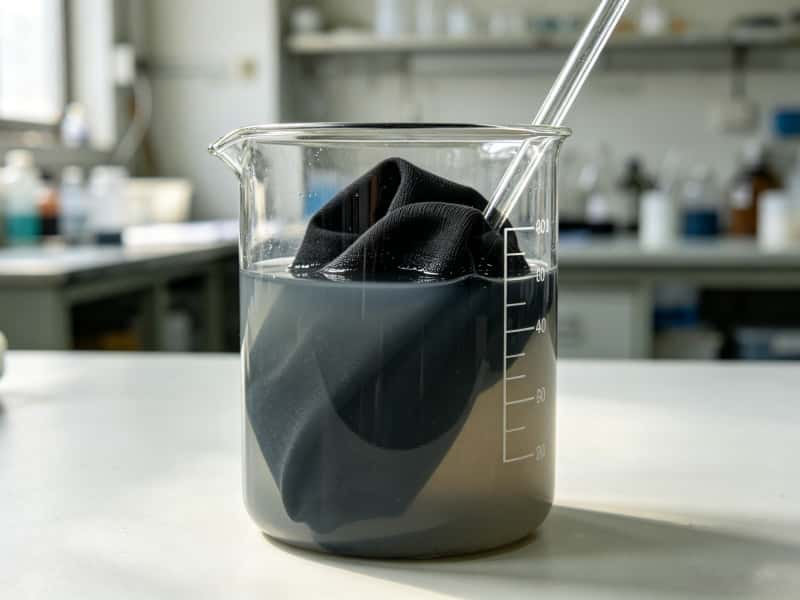
# Nylon vs Polyester 4-Way Stretch Fabric: Abrasion, UV and Cost Compared
Most nylon-versus-polyester articles compare the fibers. Almost none compare the bill. That is a problem, because the fiber choice is usually settled by a price difference of one or two RMB per meter — and that difference is not stable. It moves, and in one specific case it reverses.
We weave both fibers in the same mill, on the same looms, for the same customers. On our own cost sheet, a 120 gsm polyester 4-way stretch at normal colorfastness is cheaper than its nylon equivalent by about 20%. Ask both fabrics to hold grade-4 colorfastness, and the polyester price climbs past the nylon one. The cheaper fiber becomes the expensive one — for a reason that has nothing to do with yarn and everything to do with dye chemistry.
This guide gives you the numbers we actually quote, the standard constructions behind them, and the two failure modes buyers ask about most: abrasion (and the tear-versus-seam trade nobody warns you about) and yellowing (which is mostly not a UV problem, despite what the sun gets blamed for).
Quick Answer: When to Choose Which
| Your program | Better choice | Why |
| Backpacks, luggage, gear panels | Nylon | Highest abrasion and tear resistance per denier |
| Outdoor softshell, ski pants | Nylon face, or laminated polyester | Abrasion at the face; UV handled by finish |
| Swimwear | Nylon | Softer hand, better recovery, takes chlorine finishing |
| Everyday activewear, leggings | Polyester | Lower cost, strong UV stability, wicking holds |
| Workwear on a tight budget | Polyester | Cost at scale, laundering durability |
| Deep, saturated solids at grade 4 | Nylon | Grade-4 fastness costs nylon far less than polyester |
| Sublimation-printed programs | Polyester | Disperse-dye sublimation is a commodity process |
The one-sentence version: nylon wins where things rub, tear, or must hold color; polyester wins where sunlight and a normal colorfastness spec set the budget. The exception — high colorfastness — is where most of this article’s value sits.
1. The 90-Second Fiber Background
Both fibers are synthetic filaments, but three differences drive everything below.
- Moisture regain. Nylon absorbs roughly 4–4.5% of its weight in water; polyester absorbs around 0.4%. Nylon therefore feels softer and cooler at first touch; polyester feels drier and sheds moisture faster.
- Dye class. Polyester is dyed with disperse dyes at high temperature under pressure. Nylon is dyed with acid dyes, at lower temperature, where the dye bonds to the amine end-groups of the polyamide. This single difference sets both the cost structure and the lightfastness story.
- Melting behaviour. Polyester softens and melts around 250–260 °C; nylon 6 around 215–220 °C. That gap defines the safe heat-setting and lamination window, and it is why a stenter recipe written for polyester cannot simply be copied onto nylon.
Keep the dye-class point in mind. It explains a price reversal, a cost premium, and most yellowing claims — all in the same mechanism.
2. The Price Difference, With Real Numbers
Here is our own ex-works price at 120 gsm, same width, same finish level, ordinary solid shade. Both fabrics are woven to the same end use.
| 120 gsm, solid shade, ex-works | Fiber + elastane | Normal colorfastness | Grade-4 colorfastness |
| Polyester 4-way stretch | 75D polyester + 40D spandex | RMB 6.10 / m | RMB 7.80 / m |
| Nylon 4-way stretch | 70D nylon + 40D spandex | RMB 7.30 / m | RMB 7.60 / m |
| Difference | — | nylon +RMB 1.20 (+19.7%) | nylon −RMB 0.20 (−2.6%) |
Two things are worth staring at.
First, at normal colorfastness polyester is roughly 20% cheaper. That matches the market expectation, and it is why most volume activewear programs default to polyester without a second thought.
Second, the premium to reach grade 4 is not shared equally. Polyester moves from 6.10 to 7.80 — a 27.9% increase. Nylon moves from 7.30 to 7.60 — a 4.1% increase. So the two lines cross somewhere between grade 3 and grade 4, and above the crossing point nylon is the cheaper fabric, by 2.6% in this example. On a 30,000 m order that is not a rounding error.
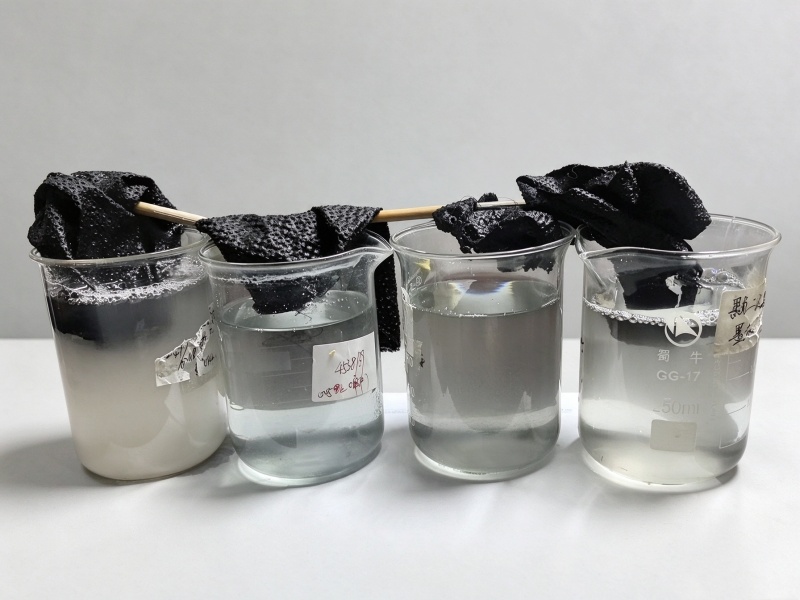
Why polyester pays so much more for grade 4
Disperse dyes sit inside the polyester filament as dispersed particles. They are held physically, not by ionic bonds. Anything that is not fully diffused into the fiber and fixed there will migrate out in washing — so the route to grade 4 runs through:
- higher dyeing temperature and pressure, for longer, to drive full penetration;
- reduction clearing after dyeing — a caustic and hydrosulfite treatment that strips unfixed surface dye;
- soaping and rinsing stages that must be repeated until the wash liquor runs clear;
- tighter shade correction, because reduction clearing shifts shade and forces a re-check.
Every one of those steps is steam, chemicals, water, time, and a chance of re-dyeing the lot. Acid dyes on nylon bond ionically to the amine end-groups, and reach grade 4 with a lighter after-treatment — one soaping cycle instead of a full clearing sequence. The fiber that is more expensive per kilogram is the cheaper one to dye to a high standard.
The other side of that trade
The same ionic bond that makes acid dyeing efficient has a weakness: acid dyes are, on average, less light-fast than disperse dyes. That is why nylon’s lightfastness trails polyester’s, and it is where most yellowing complaints originate. Section 5 covers that in detail — but the headline is that you cannot optimise dye cost, wash fastness, and light fastness independently. Pick two, then engineer around the third.
A note on the numbers. These are our own RMB ex-works figures for reference. Export prices move with incoterms, order quantity, payment terms, and whether the shade needs a lab dip or a re-dye. At around RMB 7.1 to USD 1, the two 120 gsm fabrics sit at roughly USD 0.86/m and USD 1.03/m — treat that as an order of magnitude, not a quote. If you need a real number for your spec, send the construction and we will cost it.
3. What We Actually Weave: Standard Constructions
Price comparisons are meaningless if the constructions differ. These are the builds in our sample book — the ones a buyer is most likely to be quoted.
| Nylon 4-way, plain | Polyester 4-way, plain | |
| Standard yarn | 70D+40D × 70D+40D | 75D+40D × 75D+40D |
| Composition | 92% nylon / 8% spandex | 90% polyester / 10% spandex |
| Width | 57/58 in | 57/58 in |
| Typical weight | 150 gsm (range 130–160) | 120 gsm (range 120–130) |
| Lightweight build | 40D+40D × 40D+40D, 98–110 gsm | 75D at 95–100 gsm |
| Mid-weight build | 70D+40D × 140D+40D, 160 gsm | 100D, 160 gsm |
| Heavy build | 320D gear cloth, 220–250 gsm | 150D+40D × 150D+40D, 170 gsm; 300D, 240 gsm |
Read the composition line carefully. At the light end, the polyester plain carries 10% spandex, while the nylon plain carries 8%. Spandex is the most expensive yarn in either fabric, so part of polyester’s filament saving is handed straight back at the elastane feeder. On a 120 gsm polyester you are buying 12 gsm of spandex; on a 150 gsm nylon you are buying 12 gsm of spandex for 25% more fabric weight. That is where the ~20% price gap comes from — not from the nylon yarn alone.
Two practical consequences:
- Do not compare quoted prices at different weights. A 120 gsm polyester and a 150 gsm nylon are not substitutes; the nylon one has 25% more material in it. Compare at equal gsm, or better, at equal finished garment weight.
- Spandex percentage is a lever, not a constant. Heavier deniers need less elastane for the same recovery — our 150D polyester runs at 6% spandex, not 10%. If a supplier quotes you 10% spandex on a 300 gsm fabric, ask what the recovery target was, because it is probably overbuilt.
For the full range of plain, twill, satin, ripstop and gear-cloth builds, see the nylon 4-way stretch fabric line and the polyester 4-way stretch line. Both pages carry the same spec-sheet format.
4. Abrasion: The Test Buyers Ask For, and the Failure They Actually Get
Nylon is the tougher fiber at equal denier. Its polymer chains hydrogen-bond in a way that lets the filament bend and recover rather than fracture, which is why high-tenacity nylon dominates backpack bottoms and gear panels.
But here is the honest mill-floor observation: on 4-way stretch apparel, customers almost never specify an abrasion test. No Martindale cycles, no Taber. The spec sheet says “abrasion resistant” and the conversation moves on. Abrasion shows up later, as a complaint about the seat of a pair of pants, not as a failed test report at inspection.
What we do get asked about, constantly, is hand feel — and hand feel has a mechanical cost that is rarely written into the PO.
The tear-versus-seam trade
On a woven stretch fabric, the softness of the hand and the tightness of the construction pull in opposite directions. Loosen the weave and soften the finish, and the yarns slide and stretch before they break — tear strength goes up, but the yarns also slide at the seam line. Tighten it, and the seam holds while the yarns snap.
| Hand feel requested | Tear strength | Seam slippage / seam grin | What we tell the buyer before bulk |
| Extra soft, slick, peach-skin | Better | Worse | Specify seam slippage limits; use lapped or felled seams, longer seam allowance, lower stitch density |
| Standard | Balanced | Balanced | — |
| Extra stiff, crisp, papery | Worse | Better | Reinforce stress points: pocket corners, bar-tacks, fly, waistband ends; check tear before grading |
This is not a defect and it is not fixable by “better quality”. It is a trade in the physics of the cloth. When a customer asks for a specially soft hand, or a specially crisp one, we say so upfront and put the risk in writing — because the failure will appear at the seam, six weeks later, in a finished garment, and by then nobody remembers that the hand was the request.
If you do need an abrasion number
Ask for it properly, or do not ask at all:
- Name the method and the end-point. Martindale to hole, or to a defined appearance change (e.g. fuzzing/pilling grade), at a stated pressure. “Martindale 30,000” without an end-point is not a specification.
- Test the actual construction. A high-twist, dense polyester will out-abrade a loose nylon. Fiber is one variable; yarn twist, cover factor and finish are three more.
- Separate abrasion from pilling. Nylon resists wearing through but its softer surface can pill against a rougher companion in the garment. Polyester pills less on the surface but cuts through sooner under sustained rub.
If abrasion is genuinely a program risk — gear, uniform knees, upholstery-adjacent applications — the answer is usually construction, not fiber: twisted nylon 4-way stretch at a higher cover factor beats a plain build of either fiber.
5. UV and Yellowing: Why Most Nylon Complaints Are a Dye Problem
Polyester is more UV-stable than nylon. That part is true, and it is chemistry: polyester’s aromatic rings absorb UV and dissipate it, while nylon’s amide bonds are attacked directly, losing strength and, in pale shades, shifting colour.
But the claim that follows in most articles — “nylon yellows in sunlight” — is where the industry misdiagnoses itself. In our experience, roughly 90% of nylon yellowing has nothing to do with sunlight. It is the dye structure. Residual or poorly fixed dye molecules undergo modification under humid heat, and the fabric comes out of the container with a yellow cast that was not there at inspection.
Where it actually happens
The classic scenario: fabric passes inspection in the mill, ships in a sealed container across a hot, humid route, and arrives with a visible yellow shift — often on the outer rolls, often on the side facing the container wall. The buyer blames UV. The fabric never saw direct sun. What it saw was six weeks at 50–60 °C and high humidity inside a steel box.
The mechanism is dye-dependent. Some acid dyes — particularly certain azo structures and dyes with free amine groups — are sensitive to humidity and heat, and yellow with residual moisture and residual auxiliaries present. The same shade dyed with a better-selected dye structure ships clean and stays clean.
What we do about it
- Select the dye for the shipping route, not just the lab dip. For programs going to hot, humid destinations or long sea freight, we specify acid dyes with better humidity/heat stability, even when they cost more per kilogram. That is a real cost line — and it is still cheaper than a container of yellowed fabric.
- Control what stays on the fabric. Residual softener, inadequate soaping, and leftover dyeing auxiliaries all feed the reaction. Thorough soaping after dyeing is part of the answer.
- Control moisture at packing. Fabric is conditioned and packed dry; desiccant goes in the bale for long sea routes, and container ventilation is specified where the route justifies it.
- Watch the packaging, too. The second known cause of “container yellowing” is phenolic antioxidant migrating from polyethylene packaging — BHT from bags and films. If a lot yellows despite a clean dye recipe, the bags are the next suspect.
- Test for the failure you fear. Light fastness (ISO 105-B02 or AATCC 16) tells you about sun. It does not tell you about a container. Ask for a humidity/heat aging check, and run a container trial before a full program.
For programs with genuine chronic sun exposure — fishing shirts, cycling, awnings — polyester is the safer starting point, or nylon with a UV finish. On how those finishes work and how they survive laundering, see UV protection fabrics: three processes compared. The key specification is not initial UPF; it is UPF after 20 washes, because many treatments wash out.
6. Moisture, Hand Feel, and Instant Cool Touch
Nylon’s 4–4.5% moisture regain is why it feels cool and slightly damp at first touch, and why it drapes softer than polyester of the same weight. Polyester’s near-zero regain is why it feels dry, dries fast, and pairs naturally with wicking finishes — covered in our wicking and quick-dry guide.
The commercial translation matters more than the lab number:
- Next-to-skin and warm-climate programs generally prefer nylon’s cool initial touch. This is the “instant cool” claim several activewear brands market, and it is a fiber property, not a finish.
- High-sweat, fast-drying programs prefer polyester. It moves liquid to the surface and releases it; nylon holds a little of it.
- Static builds in high-twist polyester in dry climates. Nylon’s moisture uptake largely prevents it.
Hand feel is subjective, so test it subjectively: order both fibers in the same construction, cut two garments, and wear them. It costs two sample lengths and settles arguments that no data sheet can.
7. A Case Where the Cheaper Fabric Was the Wrong Fabric
A customer developed a stretch bottom program on 120 gsm polyester 4-way — the sensible default, about 20% cheaper at normal colorfastness. Two problems surfaced in wear testing: the recovery was not holding the way the fit model needed, and the instant cool touch the brand had promised in its marketing was not there.
The fix was a move to nylon 4-way at slightly higher weight. Recovery improved because the construction carried the elastane more effectively, and the cool touch came free with the fiber. Cost went up about 20% per meter on the fabric line — and the program stayed on nylon for the following seasons.
The lesson is not “nylon is better”. It is that the price comparison in section 2 is a fabric-level comparison, and programs fail at the garment level. If your product promise depends on hand, cool touch, or recovery under load, price per meter is the wrong metric.
8. Decision Framework: Five Questions Before You RFQ
1. What rubs against it, and how hard? Hard surfaces daily → nylon. Skin and washing machines → either. 2. What colorfastness grade is in the tech pack? Grade 4 changes the price ranking. Cost both fibers at grade 4 before you decide. 3. How much sun, how often, and how long is the sea freight? Chronic sun → polyester or UV-finished nylon. Long humid route → specify the dye for the route, not just the shade. 4. Is hand feel a product promise? Extra soft or extra stiff both carry a mechanical risk. Write the acceptance criteria into the PO, not into an email. 5. What does the spec sheet need to survive? Put colorfastness grade, tear strength, seam slippage and growth limits into the RFQ — the format is in how to write an RFQ for woven stretch fabric.
If nylon wins, start from the nylon 4-way stretch range; if polyester does, the polyester 4-way range. For programs that need a membrane or a bonded backer, the decision moves up a level — see 2-layer vs 3-layer laminated fabric and the laminated fabric line.
FAQ
Is nylon 4-way stretch always more expensive than polyester?
No. At normal colorfastness on a 120 gsm solid, nylon is about 20% more expensive in our book — RMB 7.30 against RMB 6.10 per meter. At grade-4 colorfastness the order reverses: polyester rises to RMB 7.80 while nylon rises only to RMB 7.60. Disperse dyeing on polyester needs reduction clearing and longer fixation to reach grade 4; acid dyeing on nylon does not.
Which fiber lasts longer in the sun?
Polyester. Nylon’s amide bonds degrade under UV and pale shades can shift. But if your nylon yellowed inside a shipping container rather than in sunlight, the cause is almost certainly the dye structure reacting to humid heat, not UV — and that is fixable at the dyehouse.
Why did my nylon turn yellow in the container?
Residual or poorly fixed dye modifying under heat and humidity during sea freight. It shows up on arrival, often on outer rolls, and it is not a UV effect. Prevention: specify humidity-stable acid dyes for long routes, soap thoroughly after dyeing, pack dry with desiccant, and check packaging for phenolic antioxidants if a clean recipe still yellows.
Which is better for swimwear — nylon or polyester 4-way stretch?
Nylon, for hand and recovery, provided the fabric is engineered for chlorine. Polyester and PBT variants trade hand feel for chlorine and UV durability. Swimwear is its own specification problem; the chlorine and sunscreen side is covered in a dedicated guide.
Can I get grade-4 colorfastness on polyester stretch fabric?
Yes, at a cost. In our example it adds RMB 1.70 per meter at 120 gsm, because the route needs longer high-temperature fixation, reduction clearing and repeat soaping. If the shade allows it, a higher-wash-fastness disperse dye selection can reduce the number of after-treatment cycles — ask for the cost both ways.
Does nylon or polyester stretch fabric shrink more?
Fiber choice is a minor factor. Growth and shrinkage are set by heat setting, overfeed and tension during finishing, and by how the elastane is protected through dyeing. See why stretch fabric loses recovery after washing and shrinkage control on the stenter.
Can I get the same stretch recovery from both fibers?
Stretch comes from the elastane, not from the fiber — so the answer depends on spandex percentage and on how the construction protects it. Our 120 gsm polyester plain runs 10% spandex; our 150 gsm nylon plain runs 8%. Equal recovery is achievable in both, but not at equal cost, and not with the same construction. For spandex-free routes, see T400 vs spandex and the T400 mechanical stretch range.
Specifying a nylon or polyester 4-way stretch program? Send the weight, width, colorfastness grade and end use — we will cost both fibers at the same construction and tell you which one is cheaper for your spec, including the dyeing route. Request swatches and a cost comparison.
References
- ISO 105-B02 / AATCC 16 — colour fastness to light
- ISO 105-C06 / AATCC 61 — colour fastness to laundering
- ISO 105-X18 — phenolic yellowing of textiles
- AS/NZS 4399, AATCC 183, EN 13758-2 — UV protective fabrics
- ASTM D4966 (Martindale), ASTM D5587 (tongue tear), ISO 13936 (seam slippage)