Most polyester 4-way stretch RFQs we receive contain one weight and one width: “120 gsm, 150 cm, please quote.” That sentence can be answered by at least three fabrics we weave, and only one of them will make the garment the buyer has in mind.
The reason is that grams per square metre is not an input. It is the output of three decisions — yarn denier, weave density, and how far the finished width is pulled in during heat setting. Change any of them and the same 120 gsm behaves like a different fabric: different hand, different tear strength, different opacity, different seam behaviour.
This guide sets out the actual weight ladder we weave in polyester 4-way stretch, what each step is used for, and how width trades against elasticity. All figures below come from our own order book and finishing lines, not from a supplier catalogue.
1. Why “120 gsm” alone does not describe a fabric
Take two fabrics we make every week. Both are 120 gsm. Both are plain-weave 4-way stretch. Both are 147 cm cuttable.
- 75D + 40D, 12% spandex. Fine yarn, high pick density, tight and compact surface.
- 100D + 20D, 4.5% spandex. Coarser yarn, lower density, lighter spandex content.
Put them side by side and a buyer can tell them apart in the hand within seconds. The 75D is denser and more opaque at the same weight; the 100D is airier and, in pale shades, closer to the transparency limit. One is a standalone shell fabric. The other is built to be bonded to a membrane or a fleece.
Yet on an RFQ both are “120 gsm polyester 4-way stretch”. If the mill quotes the cheapest match, the buyer receives a fabric that meets the number and fails the garment — usually at fit sample, when the light colour turns out to show through, or when the laminated panel comes back stiffer than the development sample.
So the number to send is not one number. It is four: denier + spandex percentage, weight, construction, and cuttable width — plus the application. With those five, a mill can identify the fabric family and quote a real price instead of a range. The six information blocks a complete RFQ needs are set out in our RFQ guide; this article fills in the two blocks buyers most often get wrong.
2. The weight ladder we actually weave
This is the working range for polyester 4-way stretch in our mill. Widths are cuttable unless stated.
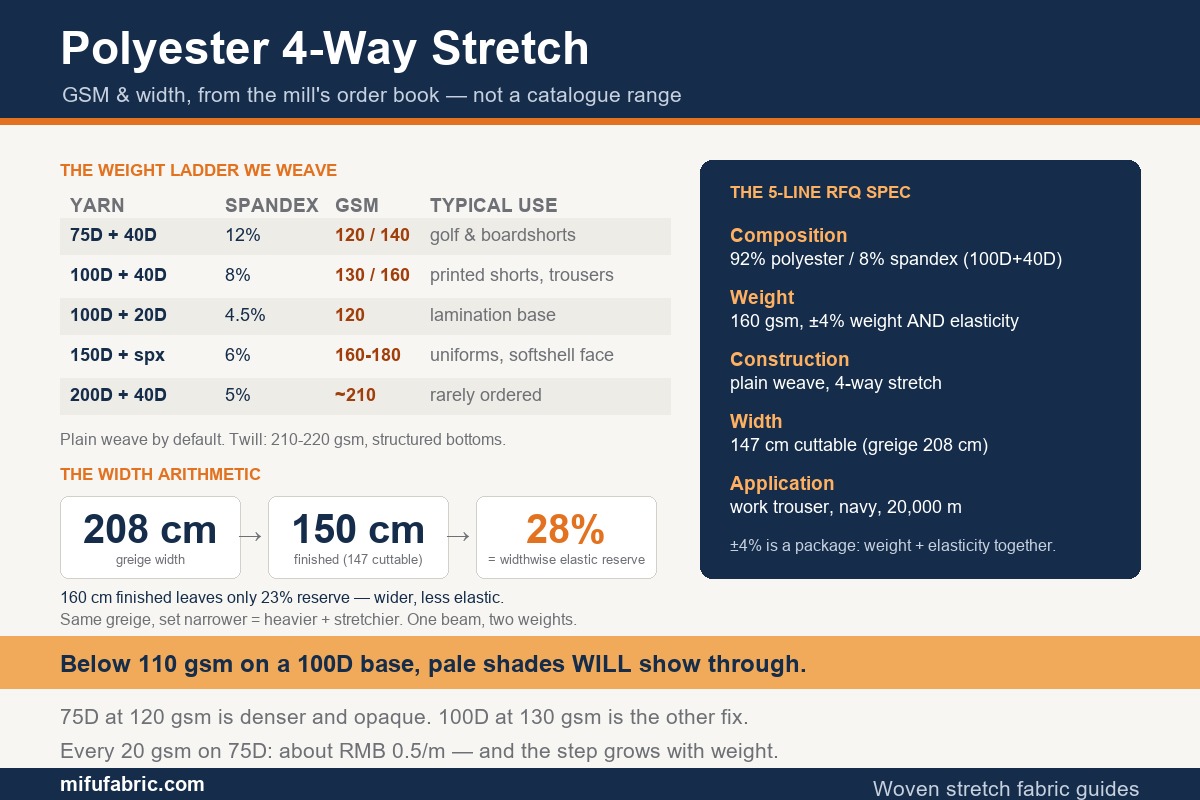
| Construction | Spandex share | Common finished GSM | Typical use | What to know |
| 75D + 40D | 12% | 120, 140 | Direct-use light apparel, golf shorts, boardshorts | Highest spandex share; densest surface at 120 gsm |
| 100D + 20D | 4.5% | 120 | Lamination base (membrane, bonded fleece) | Lowest spandex; not intended as a standalone shell |
| 100D + 40D | 8% | 130, 160 | Boardshorts with print, work and school trousers at 160 | The workhorse; the 130 gsm sits at the opacity-safe line |
| 150D + spandex | 6% | 160–180 | Trousers, uniforms, softshell face fabric | Same greige for both weights — see the note below |
| 200D + 40D | 5% | ~210 | Rarely ordered | Denier/spandex ratio is mismatched; performance only fair |
| Twill | — | 210–220 | Structured bottoms, workwear | Twill adds body; plain weave is the default. Custom constructions are developed on our custom woven fabric line. |
Two rows in that table surprise buyers, so they are worth explaining. The 8% and 6% constructions are also where most of the sourcing disputes start — colour fastness, weight labelling and selvedge tension are covered in the six common pitfalls.
The 150D row is one greige, two weights. The greige beam is the same. What changes is how far the finisher pulls the width in during setting. A batch set tighter comes out narrower, so the same amount of yarn is packed into fewer square metres — the fabric weighs more, and it also stretches more. A batch set wider comes out lighter and less elastic. When a supplier quotes both 160 and 180 gsm in 150D, this is usually what is happening: not two yarns, but two finishing decisions.
The 200D row is honest about a limit. 200D polyester with only 40D spandex is an unbalanced pairing. The yarn is heavy enough that 40D cannot pull it back cleanly, so recovery and hand are mediocre and the fabric sits at around 210 gsm without earning it. If a programme needs a 200D-class surface, the spandex has to go up; if it needs 210 gsm, a twill or a denser 150D is the better route. We keep the construction available, but we do not recommend it for new development.
3. Spandex percentage: the number that decides recovery
Weight tells you how much fabric there is per square metre. Spandex percentage tells you how much of the stretch is being driven by elastic yarn — and that is what determines whether the fabric recovers after a garment is worn, washed and pulled on.
- 4.5% (100D + 20D, 120 gsm). Deliberately low. This fabric exists to be bonded: the membrane or fleece supplies body, the stretch fabric supplies surface and a little give. Sold as a standalone shell for a fitted garment, it will feel flat and recover slowly. Used as a lamination base, it is efficient and cost-effective, which is why it is the single largest volume construction we run.
- 8% (100D + 40D, 130 and 160 gsm). The balanced middle. Enough elastane for real 4-way recovery, enough polyester for print definition and durability. The 130 gsm is what most boardshort programmes specify; the 160 gsm goes into trousers and uniform bottoms where the extra body matters.
- 12% (75D + 40D, 120 and 140 gsm). The highest elastic share in the range, paired with the finest yarn. At 120 gsm the density is high enough that the fabric reads as compact and opaque — the practical answer for pale colours at light weights.
- 6% (150D, 160–180 gsm). Moderate spandex on a heavier yarn: recovery is adequate for trousers, not for compression or swim. The weight, not the elasticity, is the point of this fabric.
Where the application cannot tolerate elastane at all — pool programmes, mono-material recycling targets — the alternative is mechanical stretch such as T400 polyester, which reaches 15–30% elongation with no polyurethane in the cloth. It changes the weight range too, so it is a decision to take before the GSM is fixed, not after.
The instinct that “more spandex is better” costs money without buying performance. Above the requirement, additional elastane makes dyeing harder (two fibre families, two dye classes in one bath), raises cost, and adds a component that is sensitive to chlorine and heat. Specify the recovery you need; let the mill choose the percentage. For a fibre-level comparison of how polyester stretch behaves against nylon under abrasion and UV, see nylon vs polyester 4-way stretch.
4. Width: the 208 cm to 150 cm arithmetic
This is the part of the spec most buyers never see, and it explains most of the arguments about “why is your 160 cm fabric less stretchy”.
We weave polyester 4-way stretch as a greige around 208 cm wide. The finished fabric is 150 cm full width, of which 146–147 cm is cuttable after the selvedge. Run the numbers: 150 ÷ 208 = 72%. The 28% of width that disappeared during finishing is exactly the widthwise elasticity reserve — the yarn that was pulled in is the yarn that can stretch back out.
Now ask for 160 cm finished width. 160 ÷ 208 = 77%, so only 23% of the width remains as elastic reserve. The fabric is wider, and it is measurably less elastic across the width. That is not a defect; it is arithmetic.
There are two ways to get to 160 cm, and they cost different things:
| Route | What happens | Cost | Trade-off |
| Keep the greige, finish wider | Same yarn spread over more width → GSM drops | No change | Less widthwise elasticity, lighter fabric |
| Keep the GSM, finish wider | More yarn / wider greige needed | +5% to 10%, rising with weight | Cost; elasticity still reduced versus 147 cm |
In practice, heavier fabrics hurt more on route two: the same percentage width increase consumes more yarn, so the premium grows with GSM. A 120 gsm style may add a few percent; a 210 gsm twill adds more.
At the narrow end, the floor is around 130 cm. Some qualities start to wrinkle below that, because the widthwise tension needed to hold the cloth flat is no longer there. Buyers who want more stretch usually specify 135–140 cm rather than pushing to the minimum: the fabric is flatter, the elasticity is better, and the garment marker still works for most bottoms.
Practical consequence for the spec sheet: state cuttable width, state the greige width if you know it, and state whether the GSM must hold at that width. A 160 gsm at 147 cm and a 160 gsm at 160 cm are different purchases, and the second one is not simply “a bit wider”.
5. Weight by application: what buyers actually order
Weight follows the garment, and the garment decides how much body the fabric needs to carry. Boardshorts are a separate decision in their own right — fibre choice, print method and chlorine exposure are covered in nylon vs polyester for boardshorts.
| Application | Typical finished GSM | Notes from our order book |
| Boardshorts / beach shorts | 130–160 | Mostly sublimation print; 130 is the common light end, 160 for a fuller hand |
| School uniform and work trousers | 160–220 | Below 160 the cloth lacks body and wears through at seat and knee |
| Outdoor softshell | 180–330 after lamination | Weight is set by the warmth target, not by the face fabric alone |
| Golf and light casual bottoms | 140–180 | Priorities are drape and a dry hand rather than durability |
| Lamination base | 120 (100D + 20D) | The composite supplies the body; the base supplies surface and stretch. See lamination fabric for how the bond is built. |
One threshold deserves a hard number. Below 110 gsm, a 100D polyester 4-way stretch in a pale colour will show through. Not “may” — will. Stretch the cloth over a form and the light passes. If the design needs a light weight and a light shade, the fix is not a different finish; it is a finer, denser yarn at the same weight (75D at 120 gsm) or one step up in weight (100D at 130 gsm). Both are standard for us and both are cheaper than discovering the problem at fit sample.
When a customer has no physical sample and asks us to recommend a weight, we ask what the garment is before answering. If the weight they name does not fit the use, we say so — a 120 gsm request for work trousers will not survive the first season, and it is better to argue about that before the order than after.
6. What 20 gsm costs
Weight is yarn, and yarn is the largest single line in the price. On our 75D polyester 4-way stretch, moving from 120 gsm to 140 gsm adds roughly RMB 0.5 (~US$0.07) per metre. For reference, a 120 gsm 75D + 40D in standard colour fastness sits around RMB 6.1 (~US$0.86) per metre ex-works; the grade-4 colour fastness version of the same fabric is around RMB 7.8 (~US$1.10). US dollar figures are converted at RMB 7.09/US$ for comparison only — contracts are priced in RMB.
That 0.5 figure is a data point, not a formula. The increment is not linear: every additional 20 gsm costs more than the previous 20, because heavier fabrics use coarser yarns, run slower in finishing, and consume more dye. A 210–220 gsm twill is not “two steps” above a 120 gsm plain weave in cost; it is a different price category.
Two other cost levers sit next to weight:
- Colour fastness. Grade 4 rather than standard adds roughly 25–30% at the same weight, because it means longer high-temperature dyeing, reduction clearing and repeated soaping. If the programme is a dark navy boardshort for pool use, budget for it at the start.
- Width beyond 150 cm. As above, +5% to 10% if the weight must hold.
Width and weight are both set during finishing, and the same setting line controls shrinkage. If the programme also carries a wash-shrinkage limit, the two have to be agreed together — see heat washing and shrinkage control.
7. A five-line spec you can paste into an RFQ
If the goal is a quote that means something, this is enough:
Weight: 160 gsm, tolerance ±4% with elasticity / ±2% weight only
Construction: plain weave, 4-way stretch
Width: 147 cm cuttable (150 cm full; greige 208 cm)
Fastness: grade 4 wash and rub; grade 4–5 for pale shades
Application: work trouser, dark navy, 20,000 m
And the three mismatches we see most often:
- Light weight with light colour. 110 gsm and below in white or sand on a 100D base — translucent. Move to 75D 120 gsm or 100D 130 gsm.
- Light weight for a hard-wearing bottom. 120–130 gsm specified for work or school trousers. It will look right in the sample room and fail at the seat within a season. 160 gsm minimum.
- Wide width with the same weight expectation. 160 cm requested at the 147 cm price and weight. Either accept a lower GSM and less stretch, or accept +5–10% cost.
8. Tolerance: 4% is a package, not a weight number
A ±4% tolerance on our polyester 4-way stretch means weight and elasticity are both held inside 4%. The two are linked: if the finisher pulls more width in, the fabric gets heavier and stretchier at the same time. Allowing 4% on weight alone while expecting elasticity to stay fixed is not physically consistent.
If a buyer genuinely only cares about weight — a lining, a print base where stretch is secondary — we can hold ±2% on weight and let the elasticity float. That is a tighter commercial commitment, and it is available on request. What is not available is 2% on both at once.
Weight tolerance is not the same question as short yardage. A roll can be within tolerance on GSM and still be short on length; the three-point weighing method for checking that on receipt is set out in our nylon sourcing guide, and the arithmetic is identical for polyester.
FAQ
What GSM polyester 4-way stretch should I use for boardshorts?
130–160 gsm. Most programmes print the fabric by sublimation, which effectively means polyester. 130 gsm gives a lighter, faster-drying short; 160 gsm gives a fuller hand and better opacity on pale grounds.
Can you weave 160 cm width?
Yes, but the widthwise elasticity drops, because less of the greige width is pulled in during finishing: 160 ÷ 208 leaves about 23% elastic reserve instead of 28%. You can keep the weight and pay 5–10% more, or keep the cost and accept a lighter fabric with less stretch.
What is the narrowest width you can make?
Around 130 cm finished. Some qualities wrinkle below that. Most buyers choose 135–140 cm, where the cloth is flat and the elasticity is better than at the minimum.
Is 120 gsm too light for a white or sand colour?
On a 100D base, yes — below about 110 gsm pale shades are translucent, and 120 gsm is close to the line. The reliable options are 75D at 120 gsm, which is denser at the same weight, or 100D at 130 gsm.
How much more does 140 gsm cost than 120 gsm?
On our 75D range, about RMB 0.5 (~US$0.07) per metre. The step is not fixed: it grows as weight rises, because coarser yarns, slower finishing and more dye all cost more.
Why is 200D + 40D not recommended?
The ratio is unbalanced. 200D polyester needs more than 40D of spandex to recover cleanly, so the fabric lands around 210 gsm with only fair recovery and hand. For a 200D-class surface, increase the spandex; for 210 gsm, use a twill or a denser 150D.
What weight tolerance should I write into the contract?
±4% if weight and elasticity both matter, which covers most apparel programmes. ±2% on weight alone if elasticity is not a requirement — but then do not also specify a recovery figure.
If you are choosing between two weights and cannot decide from a swatch card, send the application, the colour and the target garment weight. We will tell you which construction we would run — and if the number you have been quoted does not exist in a commercially sensible form, we will say that too.