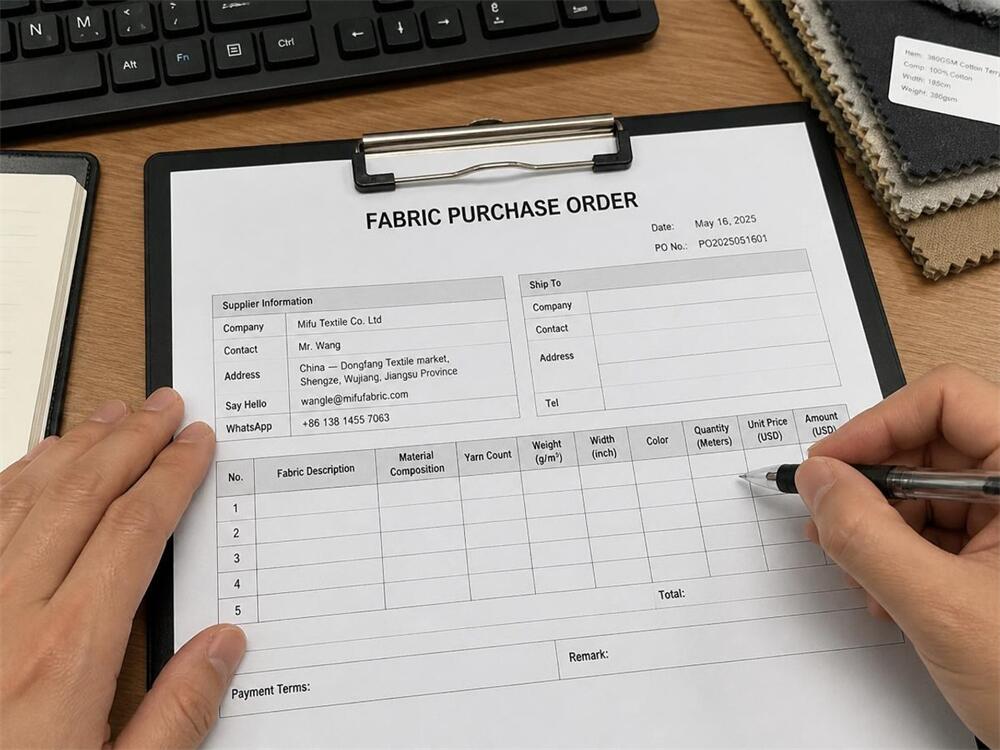
A complete request for quotation (RFQ) for woven stretch fabric needs six blocks of information: who you are, what the fabric is made of, its weight and width, what it will be used for, how much you need, and the commercial terms you expect. Send fewer, and you will still get a reply — but it will be a question rather than a price, and every unanswered question costs a day or more in a supply chain where bulk production runs around 70 days.
This guide covers each block in turn, shows what an experienced mill can work out on its own (more than most buyers expect), and ends with a free copy-ready template.
Why “Please Quote Your Stretch Fabric” Gets You a Vague Price
Most first enquiries look like this: “Hi, we are interested in your stretch fabric. Please send your best price.” The problem is not laziness on the mill’s side. Woven fabric is a non-standard product — two fabrics that look identical in a photo can differ by 30% in cost, because one is polyester and the other is nylon, or because one stretches 15% and the other 45%.
When an enquiry arrives with no composition, no weight and no reference, the only honest answer is a set of questions. Multiply that by three or four exchanges and a week has gone before pricing has even started.
The reverse is equally true, and it is worth knowing before you write anything: composition + weight + one clear photo is usually enough for an experienced mill to identify around 70% of what you are asking for. Add your end product and you will get a realistic price and a recommendation — often a better construction than the one you had in mind.
Two enquiries are not worth sending at all: “send me your price list” and “what is your cheapest fabric”. A mill running thousands of constructions has no single price list. A supplier who replies with a number anyway is guessing, and you will pay for that guess later.
The Six Blocks of a Complete Woven Stretch Fabric RFQ
1. Company and Contact Details
- Company name and country, plus your website if you have one
- Contact person, email, and WhatsApp or WeChat
- What you are: brand, garment factory, or trading company
- Estimated volume per season or per year, if you can share it
- Whether you need certification documents (see block 4)
This is not paperwork. It tells the mill which product line fits you, whether you are a first-time or repeat customer (which changes payment terms), and whether your enquiry deserves a technical recommendation instead of a stock price.
2. Composition and Construction — The One Field You Cannot Skip
Composition is the first thing any mill reads, because the price gap between polyester and nylon is large enough that a quote without it means nothing. Write the fibre family plus the stretch type:
- Polyester spandex, 4-way stretch — the standard starting point for outerwear and activewear
- Nylon spandex, 4-way stretch — softer hand feel and better abrasion resistance, at a higher cost
- Spandex-free constructions — options such as T400 for dimensional stability, chlorine resistance and industrial washing
If you already know the yarn counts, give them. A line such as 75D+40D × 75D+40D + 150D describes the warp, the weft and the stretch yarns at once, and moves the answer from “probably this” to “exactly this”.
Two clarifications worth carrying into any RFQ:
- “4-way stretch” describes direction, not performance. Two fabrics both labelled 4-way can behave completely differently in elasticity and recovery — and in price. If stretch matters to your garment, ask what values are achievable at your target weight.
- Spandex is not the only option. Where industrial washing, chlorine exposure or elastane-free labelling applies, say so at enquiry stage. It changes the construction and the price from the beginning, not at the contract stage.
If you do not know the composition, do not guess — send a physical sample. Composition and yarn count testing is free and results come back within two days. A clear photo can be identified; a blurry one cannot.
3. Weight and Width
Two numbers, in the units your mill actually uses:
- Weight — GSM, grams per square metre
- Width — centimetres. For woven stretch fabric we quote cuttable width, which defaults to 146 cm; where higher elasticity is required, the fabric is woven narrower as a trade-off.
- Inches (58/60″) are widely used in the US, but centimetres give a more precise instruction for stretch fabrics. State which you mean.
One application note worth having before you write the number: for tight-fitting garments such as leggings, weights below roughly 130 GSM can turn translucent in pale colours once stretched. If your target weight is below that and your colour is light, mention it in the RFQ rather than discovering it at fit-sample stage.
4. Application and Performance Requirements
Tell the mill what the fabric becomes: yoga leggings, swim shorts, softshell jacket, outdoor trousers, medical uniform. Each one points to a different construction, finish and certification path, and this single line often changes the recommendation more than any other field.
One piece of honest advice, because it saves buyers real money: woven 4-way stretch is rarely the right choice for tight-fitting leggings — the hand feel is not as body-hugging as a knit. If your application needs a second-skin fit, say it up front and a mill will steer you to a knit or to a different construction. For outerwear — softshells and laminated three-layer fabrics — woven stretch is exactly the right base.
| Parameter | Default if you say nothing | What to write in the RFQ |
|---|---|---|
| Shrinkage | Heat shrinkage <3%, washing shrinkage <5% | “Maximum 5% wash shrinkage” plus test method (AATCC 135 / ISO 6330) |
| Colour fastness | Standard mill level | Required grade + test method (AATCC 61 / ISO 105-C06) |
| Functional finish | None | Moisture-wicking, water-repellent, antibacterial, flame-retardant — name the finish and the standard |
| Certification | None | GRS, OEKO-TEX or REACH — declare at enquiry and put it in the contract |
Two rules follow from this table. Performance requirements belong in the first RFQ, not at contract stage — whether a finish is achievable changes the price you are quoted. And certification must be declared at enquiry and written into the contract, because it changes yarn sourcing. Functional finishes do not affect the minimum order quantity.
A third rule is harder to write down but saves the most time: check that your requirements can coexist before you send them. Some combinations are physically opposed. Level 4 oil repellency and Level 4 soil release pull the fibre surface in opposite directions and cannot both be maximised on one finish, and a 30D lightweight base with a thin wet coating will not hold 2,000 mm hydrostatic after four washes. An RFQ that asks for both does not come back with a price; it comes back with a technical review — which is a good outcome if you expected it, and a lost week if you did not. Here is a real enquiry we answered with a decline instead of a quote.
5. Volume, Target Price, and How Fabric Is Actually Priced
Quantity is what turns a price into a real price. Woven fabric is priced per metre worldwide, and the practical minimums are:
| Order type | Minimum |
|---|---|
| Single colour, solid dyed | 1,000 m per colour |
| Ordered by dye lot | 2,500–4,000 m, depending on vat capacity |
| Multi-colour order | Each colour must meet the minimum independently |
In practice: if you need four colours, each one is quoted and scheduled on its own. A colour below the minimum is not refused — it is quoted higher, and a mill should tell you exactly how much higher before you commit. If most of your colours are large, an experienced mill can often absorb the shortfall on one small colour and keep the whole order at bulk pricing. That is a negotiation to have, not an assumption to make.
Two things move the price of the same construction:
- Colour — fluorescent shades and highly saturated pale colours cost more
- Quantity — fewer metres per colour costs more
Then there is the question almost no buyer asks, and every buyer should: how long is this price valid? Ours is 20 days. Currency matters too. We quote against a stated rate — currently USD 1 = CNY 6.7 — and the quote holds while the rate moves within 5%. Beyond that the difference is split 50/50: at a 6% move, each side absorbs 0.5%. Ask your supplier for their FX clause. A quote without one is a quote with an expiry date nobody told you about.
6. Commercial Terms, Packing and Documents
| Incoterm | FOB Shanghai (half a day from the mill) or EXW, which suits buyers with an agent in China who inspects before shipment |
|---|---|
| Payment, first order | 30% deposit, 70% before shipment (T/T) |
| Payment, repeat order | 70% against bill of lading copy |
| Letter of credit | Accepted — sight L/C for new customers, usance L/C for repeat customers; issuing bank must be a major bank |
| Nominated forwarder | Accepted, with payment 100% before shipment |
| Packing | Two layers: inner nylon film plus outer woven plastic bag (waterproof and abrasion resistant); cartons optional at extra cost |
| Roll length | 130–230 m per roll, no joints; fixed lengths such as 100 m or 200 m accepted (with joints) |
| Shipping marks | Your format produced by us, or our format sent to you for approval |
| Documents | Invoice, packing list, bill of lading, certificate of origin — request anything else early |
| Quality standard | US 4-point system; tighter standards can be agreed within it |
Two terms catch first-time buyers. If you nominate your own forwarder, expect payment before shipment — a nominated forwarder takes the bill of lading out of the mill’s hands, so the terms have to reflect that risk. And quality standards must be settled before the order, not after the shipment: third-party inspection is welcome as long as the criteria are agreed in advance. “No defects at all” is not a workable standard for fabric; 4-point grading is.
Sampling: Lab Dip, Hand Loom, Pre-Production and Shipping Samples
Sampling is where most schedules slip, usually because buyers do not know which sample comes when. There are four stages:
| Sample | What it is | Cost | Time |
|---|---|---|---|
| Lab dip | Small swatch of the intended colour, usually three options (A/B/C) to choose from | Free; up to 4 revision rounds free | 4 days per round |
| Hand loom sample | Trial weave on a sample loom, greige (undyed) — shows construction and structure; the first stage of custom development | CNY 400, plus CNY 200 if dyeing is needed | 7 days |
| Pre-production sample | Woven with bulk yarns and bulk process before bulk production starts | Sample rates | Quoted per quantity and difficulty |
| Shipping sample | Pulled from the finished bulk after dyeing; represents the quality of the shipment | Free | Matches the production schedule |
- Colour: send a Pantone TCX number. Printed colour cards vary slightly between buyer and mill, so two or three rounds are normal, and up to four are free.
- Sample yardage: free up to 3 m for new customers with freight on your account; free with freight on us for repeat customers; charged above 3 m.
- Freight: express shipping for samples is on the mill.
- Pre-production samples are rarely sent out — in most programmes the mill confirms internally and production proceeds. Your reference for the delivered goods is the shipping sample.
A full development programme runs the same four stages but repeats them: performance targets first, then hand loom trials, then dyeing trials, then a pre-production run, with the fabric re-sampled each time a target is missed. One workwear programme took three rounds of sampling against four performance targets before it was signed off for bulk — worth knowing when you budget the calendar, not just the price.
Weak vs. Strong: The Same Enquiry Written Two Ways
Weak:
Dear Sir, we are a garment company. Please quote your stretch fabric, we need good quality and competitive price. Thank you.
What the mill can do with this: nothing. Composition unknown, weight unknown, application unknown, volume unknown. The reply is not a price — it is “could you tell us the composition, weight and application?”
Strong:
Hello, we are [company], a softshell outerwear brand in [country]. We are developing a 3-layer bonded jacket for SS27 and need the woven stretch face fabric:
- Composition: polyester spandex 4-way stretch; spandex-free T400 also acceptable
- Weight: 240 GSM, 146 cm cuttable width
- Application: 3-layer bonded softshell, mid-tier price point
- Performance: wash shrinkage max 5%, colour fastness grade 4–5 on AATCC 61
- Certification: GRS required
- Volume: 8,000 m first order, around 5,000 m per month after
- Terms: FOB Shanghai; target price under USD 3.20/m
- Please quote lab dip timing and bulk lead time.
The second email takes eight minutes to write and typically removes three rounds of questions — roughly a week of calendar time, on a product where the mill needs about 70 days to weave and dye.
Download the Free RFQ Template
Everything in this guide is condensed into a two-page template: the six information blocks, the defaults a mill applies when you leave a field blank, and the sampling plan. Fill in what you know, leave the rest blank, and send it back — you will get a real price, not a questionnaire.
If you can send a physical swatch with it, we will test the composition and yarn count free of charge and confirm the construction within two working days.
Frequently Asked Questions
What information do I need to provide to get a fabric quotation?
Six blocks: company and contact details; composition and construction; weight and width; application and performance requirements; volume and price expectations; and commercial terms. In practice, composition, weight and application are the minimum — with those three plus a clear photo, an experienced mill can identify roughly 70% of the fabric you are describing and quote realistically.
Can I get a price without sending a physical sample?
Yes, if you can supply composition, weight and a clear photo. If you have no specification at all, send the competing sample: composition and yarn count testing is free and results come back within two days. Blurry photos cannot be identified, and a mill will normally decline rather than guess.
What is the minimum order quantity for woven stretch fabric?
Woven fabric is quoted and ordered per metre. For solid-dyed single colours the minimum is 1,000 m per colour (a 950 m request is run as 1,000 m, because dyeing and finishing carry inspection and shrinkage loss); when ordered by dye lot it is 2,500–4,000 m depending on vat capacity. In multi-colour orders each colour must meet the minimum independently; colours below the minimum are quoted higher, and the mill should tell you exactly how much higher before you commit.
How long does woven stretch fabric production take?
Weaving plus dyeing takes approximately 70 days; dyeing alone takes approximately 25 days. Stock greige programmes save at least 25 days, often more. There is no longer a pronounced peak season, so you can ask for a schedule at any time of year — or give your required date and ask the mill to confirm whether it is achievable.
What is a lab dip, and how much does it cost?
A lab dip is a small swatch showing the intended colour, usually presented as three options (A/B/C) for you to select from. It is free, takes about four days per round, and up to four revision rounds are free. Send a Pantone TCX number; printed colour cards vary slightly between buyer and mill, so extra rounds are occasionally needed.
What are the standard payment terms for a first order?
For new customers: 30% deposit with the order and 70% before shipment by T/T. For repeat customers: 70% against the bill of lading copy. Letters of credit are accepted — sight L/C for new customers and usance L/C for repeat customers, with the issuing bank required to be a major bank. If you nominate your own forwarder, payment is 100% before shipment.
Do you accept third-party inspection, and who pays for testing?
Yes — SGS, Intertek and BV are all accepted, provided the inspection criteria are agreed in advance; indicators cannot be added after production has started. In-house test reports for shrinkage and colour fastness are supplied with the order. Third-party testing on bulk orders is paid by the mill; testing on sample orders is paid by the customer. The default quality standard is the US 4-point system, major defects are borne by the mill, and disputed items are either remade or settled by negotiated deduction.
How much extra fabric should I order, and will repeat orders match in colour?
Order 5–10% above your calculated consumption to cover cutting and production loss — small top-up orders are priced as sample orders and become expensive. Dye lot variation is controlled within standard tolerance; for colour-critical programmes an approval sample is sent from the bulk lot before shipment.
Start With What You Have
If you have a specification sheet, a competitor sample, or just a garment photo and a weight, we can start from there. Send what you have: composition, weight and application are enough for a first real price, and if you can send a sample, testing takes two days and costs nothing.
Use our online RFQ form to send a complete enquiry in one go: request a quotation. If you would rather talk it through first — especially for GRS-certified, spandex-free or custom-woven developments — message us on WhatsApp and we will tell you what is achievable and by when.
Related reading: T400 fabric, the spandex-free option · nylon 4-way stretch fabric · polyester 4-way stretch fabric · laminated and bonded fabrics · custom woven fabric development.