# Boardshort and Beach Short Fabric: Nylon vs Polyester 4-Way Stretch
Boardshorts and beach shorts are the one apparel category that treats fabric worse than a workwear uniform: soaked in chlorinated water, dried in the sun, covered in sunscreen, and — for the printed programs that dominate the export market — asked to hold a full-surface photorealistic print at a cost per garment of a few dollars.
That combination rules out more fabrics than buyers expect, and it makes the first real question in any shorts program a simple one: nylon or polyester four-way stretch?
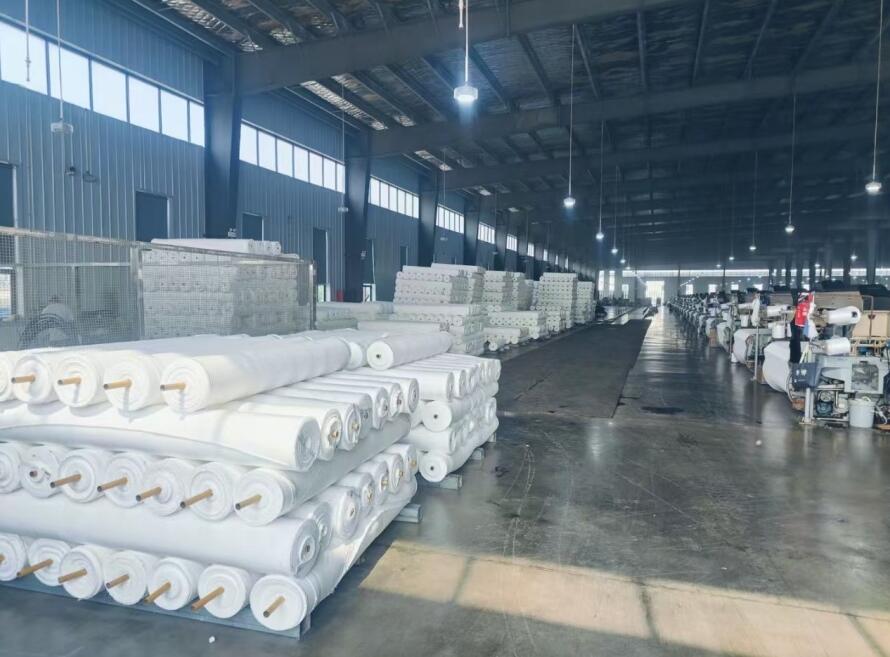
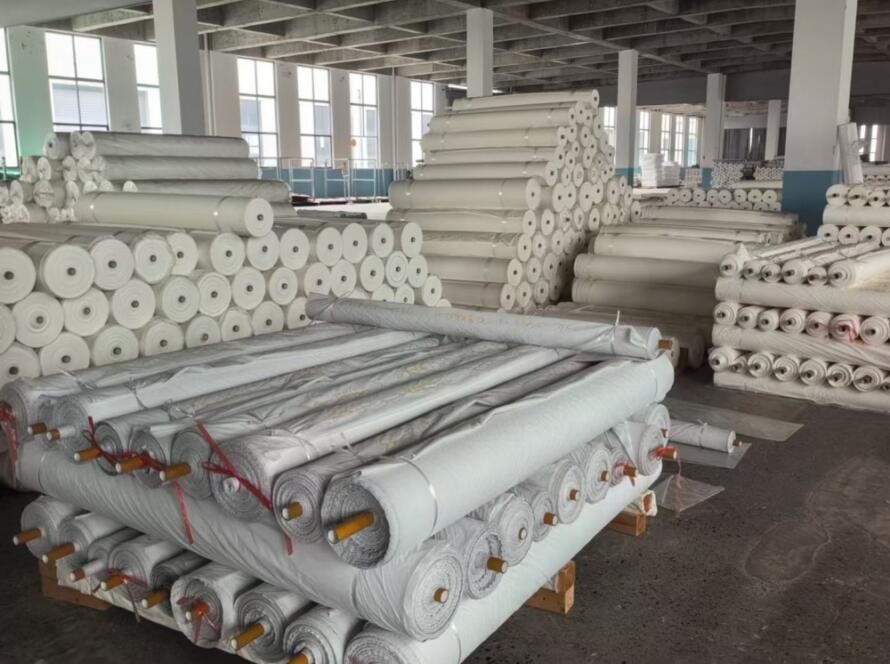
This guide answers it from the mill floor. We weave both families — nylon flat-weave 70D+40D at 130–160 gsm and polyester flat-weave 75D/100D+40D at 120–150 gsm — so the comparison below is not a fiber brochure. It is the set of decisions we actually walk a customer through when a beach-short or boardshort spec lands on our desk, including the one requirement that has cost a customer 4,500 pieces.
Quick Answer: Which Fiber for Which Short
If you want the conclusion before the reasoning:
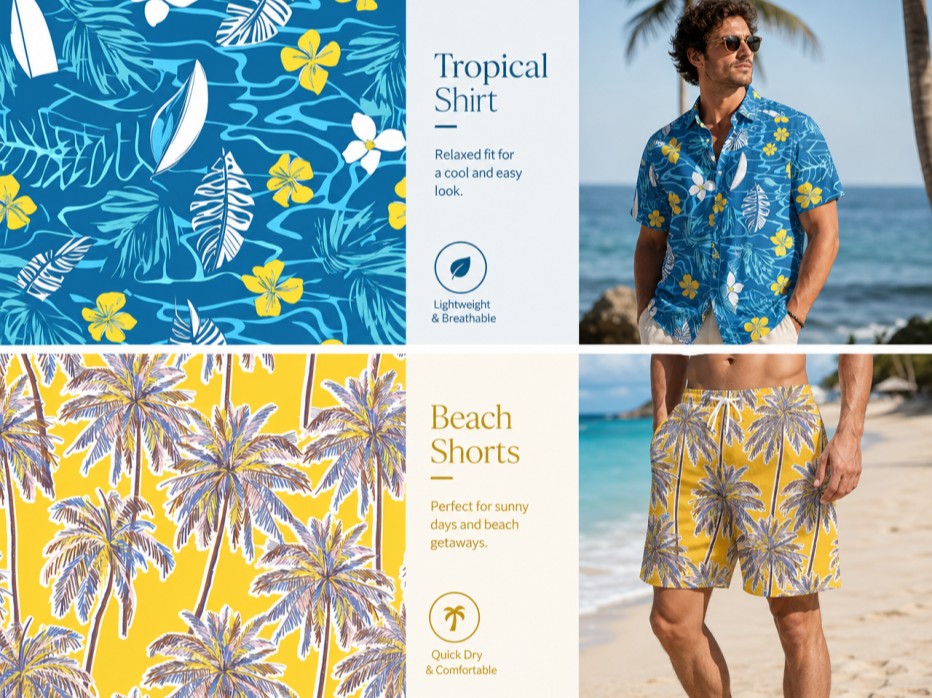
- Printed beach shorts (sublimation), the volume business → polyester-spandex, 75D or 100D + 40D, 120–150 gsm, plain weave, disperse-print ready. This is not a close call; it is the only workable route, and it has already replaced peach-skin in most Asian export programs.
- Solid-dyed boardshorts at a target price → polyester-spandex 75D+40D around 120 gsm is the economical shell and dries fastest.
- Nylon-spandex, 70D+40D, 130–160 gsm → worth considering for a premium hand, deeper solid shades, or a specific drape a brand has already committed to — but only after the chlorine question is settled in writing.
- Pool, resort or swim-school programs → neither of the above. Specify a spandex-free mechanical stretch (T400/T800-type) shell; the spandex is the component chlorine destroys first.
This article covers the shorts-specific case. For the general apparel comparison — abrasion, UV, container yellowing and cost across garment types — see our nylon vs polyester four-way stretch guide.
Why Beach Shorts Are a Different Fabric Problem
Most four-way stretch fabric is specified for dry service: pants, jackets, uniforms. Water is an incident, not the operating environment.
A beach short inverts that. Across one afternoon the shell is:
1. Saturated — and under body load while wet (climbing out of a pool, sitting on a wet deck). 2. In chlorinated water — which attacks both dyestuff and, if present, polyurethane elastane. 3. In direct sun — on a thin 120–150 gsm shell, drying repeatedly. 4. Printed edge to edge — which changes what “colorfast” has to mean.
Each of those four lines eliminates a different candidate. A fabric that wins on dry-apparel metrics — tear strength, dry hand, price per metre — can still fail here, which is why the answer for beach shorts is not the same answer as for a softshell jacket.
What Actually Ships: The Specs We Weave
For the printed beach-short business, our standard recommendation is specific:
| Parameter | Polyester 4-way stretch (beach short grade) | Nylon 4-way stretch (boardshort grade) |
| Construction | 75D+40D × 75D+40D, plain weave | 70D+40D × 70D+40D, plain weave |
| Composition | Polyester/Spandex 88/12 (75D) or 92/8 (100D) | Nylon/Spandex 92/8 |
| Weight | 120–150 gsm | 130–160 gsm (150 typical) |
| Width | 57–58″ | 57–58″ |
| Print route | Disperse / sublimation, ready | Acid dye or print, separate route |
| Typical end use | Printed beach shorts, swim shorts, boardshorts | Solid boardshorts, premium shorts |
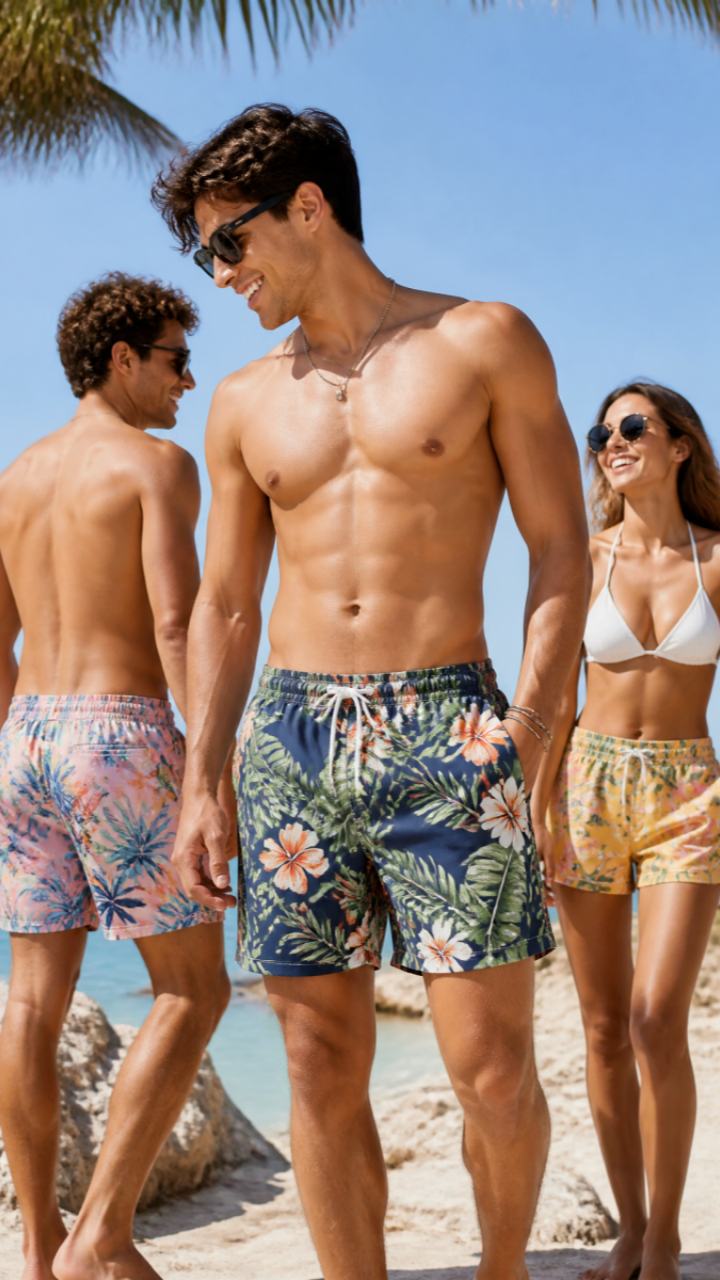
The 100D version is the one to look at when the print needs more coverage or the shorts need a slightly firmer hand — 92/8 polyester/spandex at the same 120–150 gsm band gives you a denser cover factor for the same weight, which matters when a print has large flat colour areas and the buyer is worried about show-through. Both sit inside our standard polyester four-way stretch range, and the nylon side is on the nylon four-way stretch page.
Why polyester displaced peach-skin here. Peach-skin was the default printed-short fabric for years: a sanded surface that takes print with a soft, matte look. Two things killed it. The sanding process produces wastewater that is hard to treat — an increasingly expensive problem in Chinese dyeing parks — and the market now reads the peach-skin hand as low-end. Polyester four-way stretch replaced it on both counts: no sanding step, and stretch for actual outdoor use rather than just appearance.
Printing Decides More Than Fiber Choice Does
Here is the part of this decision that most fiber-comparison articles skip, and it is the reason the answer for beach shorts is so lopsided.
Sublimation printing only works on polyester. The process prints disperse dye onto paper at around 200 °C and drives it into the fibre as a gas; the dye has an affinity for polyester and essentially none for nylon. On a nylon shell you are pushed onto acid-dye printing or piece dyeing — a different, slower, more expensive route with a different colour gamut and different fastness behaviour.
So for a printed beach-short program, the fiber question is already answered before hand feel, wet strength or anything else gets discussed. If your design is a full-surface print — the standard case for men’s beach shorts sold into Europe, the US and Latin America — you are specifying polyester four-way stretch, and the useful questions become: which denier, which weight, and is the greige print-ready.
That last one is worth saying out loud: “disperse-print ready” is a finishing commitment, not a fiber property. It means the fabric is heatset for dimensional stability before printing, has no finish that will repel the ink, and holds width through the print and bake cycle. Ask for it explicitly. We cover the print routes in more detail in our guide to printing on polyester and nylon.
Wet Strength: A Non-Issue — With One Yarn to Avoid
Buyers arrive with the textbook line that nylon “keeps its strength when wet”. It is true in the lab, and it is close to irrelevant for a 120–150 gsm shorts shell, so let us be precise about what it does and does not mean.
Between synthetic filament yarns, wet strength is not a differentiator. Polyester and nylon both hold essentially the strength they have dry. Where wet strength genuinely collapses is in the cellulosic family: rayon and viscose lose a large share of their strength when wet. So if someone proposes a “natural hand” blend for a beach short — viscose, rayon, or a spun cellulosic — that is the real wet-strength risk on the table, and it is a risk you avoid by not putting those yarns in a garment that lives in water.
Nylon does have higher dry tenacity than polyester. At these weights, though, the fiber is not what limits the garment — the seam is. What actually fails on a wet boardshort is seam slippage and seam grin at the crotch and side seams, because that is where body load concentrates on a lightweight plain weave. Whether the shell is nylon or polyester, the fix is the same: specify seam slippage on the seams you will actually sew, at the stitch density you will actually use, rather than assuming the fiber choice covers it.
Quick-Dry: Polyester Wins on Physics, Finishing Wins Overall
This one does go polyester’s way, and the mechanism is simple. Nylon is inherently more absorbent — its moisture regain is roughly ten times polyester’s (around 4–4.5% versus about 0.4%). Water that goes into the fibre has to come back out through the fibre, so a nylon shell stays damp longer, and a polyester shell sheds its water from the surface and between the yarns and dries faster.
How much faster in minutes? We do not publish a number, because we have not run that comparison and we are not going to invent one. As a fabric mill we produce to the quick-dry target a customer specifies, then test the bulk before shipment. What we can tell you honestly is that we do not see end-consumer wear feedback — our customers see that, not us.
What we can say with confidence is that the finishing route moves the result more than the fiber does. A hydrophilic wicking finish pulls moisture to the surface and spreads it for fast evaporation; a hydrophobic finish makes water bead and run off; a heavy mechanical finish or a coating slows drying down. If “quick-dry” is going on a hangtag, put the finish and the test method in the RFQ, not just the fiber content. Our moisture-wicking vs quick-dry checklist covers how to write that requirement so it is testable.

Chlorine: The One Requirement That Changes the Fiber
If a beach short will ever be worn in a pool, this section decides your fabric. It is also where nylon’s advantage in colour depth turns into a liability.
Active chlorine attacks the dye chromophore. Nylon, dyed with acid dyes that sit on the fibre through ionic bonds with its amine end-groups, is the most exposed: pool water oxidises the chromophore and the shade shifts or fades, often unevenly. Polyester’s disperse dyes are physically locked inside the fibre and resist chlorinated water far better. Add spandex and the problem compounds — spandex requires high-temperature heat setting, and that setting weakens the dye-to-fibre bond that the fastness depends on.
This is not theory. It is a case from our own order book, and it is worth walking through because the fabric passed every conventional test.
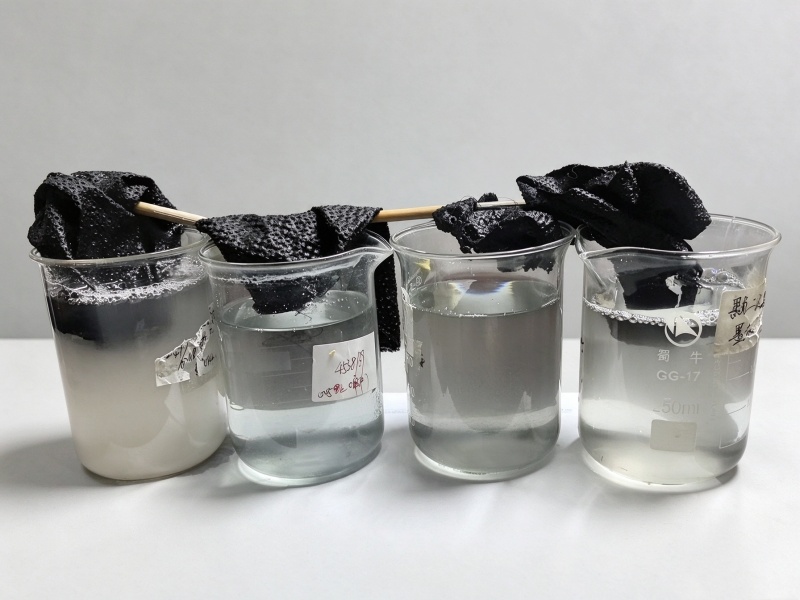
The case: 4,500 pieces of men’s beach shorts, delivered on time, failed in the pool.
The customer had used the same fabric — a 75D full-dull polyester warp with a weft mixing 70D full-dull nylon and 75D polyester covering 40D spandex, woven in a 20/20 cycle to create a regular two-colour stripe with a natural crinkle from spandex shrinkage — for three years in men’s casual long-sleeve shirts. When the designer re-ordered it for a summer beach-short line, nothing in the communication changed: same article, same process, same tests.
We produced it on the mature route and controlled two indicators hard: C0 fluorine-free water repellency and grade-4 colourfastness to washing. Everything passed. The bulk shipped on time, and the customer’s incoming inspection raised no complaint.
Thirty-three days after delivery, the customer sent photographs: large-area, uneven, severe discolouration across finished garments during wear testing. Unsellable, with launch materials already printed.
Our traceability re-test told the real story. Wash fastness, dry rub and wet rub were all still at grade 4 — the fabric was exactly as specified. The failure was environmental: the shorts had been worn in swimming pools, and chlorinated water had oxidised the nylon’s dye. With a two-colour nylon/polyester system plus spandex and its high-temperature setting, there was no process window that would have reached grade-4 chlorine resistance on that construction — the limitation was structural, not a matter of trying harder.
The fix kept the appearance and changed the chemistry: the 70D nylon weft was replaced with 75D cationic polyester, the spandex-covered yarn with 75D T800 mechanical stretch, and the two-colour effect was rebuilt with low-temperature differential dyeing — cationic yarn dyes at low temperature, conventional polyester stays pale. Same stripe, same crinkle, same hand; different fibre system.
What we now put in front of every shorts customer, in writing:
1. Declare the end use, not just the garment type. “Shirts” and “beach shorts” are different fabric briefs. The single biggest cause of this failure was that the terminal use changed while the spec did not. 2. If pool contact is possible, say so before the order, and specify colourfastness to chlorinated pool water — AATCC 162 is the test we work to — with a grade on the purchase order, typically grade 4. 3. Do not assume nylon can be pushed to grade 4 in chlorine. On a nylon or nylon-blend shell, a chlorine-fastness requirement is a red flag to be resolved at the fiber-selection stage, not at the dyeing stage.
The full write-up, including the yarn and dyeing changes, is in our chlorine-resistant fabric case study.
Sun: UPF Is Mostly a Weight Question — and Nylon Sits Half a Grade Lower
For a beach short, UV protection is usually already there. Above roughly 100 gsm, a tight plain-weave synthetic shell is effectively opaque and tests around UPF 40+ without any dedicated UV finish — you do not need to add a chemical block to a 120–150 gsm beach-short fabric. Density, cover factor and shade do the work; dark shades and delustred yarns help further.
Two practical qualifications. First, if the buyer needs a claimed UPF 50+ on the hangtag, test the actual shade and construction — do not assume it from the weight, because white and pale shades with a more open sett can fall below the claim. Second, there is a sunlight issue that is not about UV protection at all: under the same production route, nylon’s light fastness runs about half a grade to one grade lower than polyester’s. For a garment that dries in the sun repeatedly, that difference shows up as shade drift over a season rather than as sunburn risk. Our UV protection fabric guide covers the finishing options if a program genuinely needs more than the base fabric delivers.
Sunscreen: Not the Villain Buyers Expect
Buyers routinely ask us to “sunscreen-proof” a beach-short shell, and the honest answer is that it is not where the risk is.
Consumer sunscreens are formulated close to neutral and are not aggressive to polyester or nylon; there is no acid or alkali attack to design around. What does happen in the field is mechanical and cosmetic — white residue in the weave, oil marks that need a proper wash, and build-up on a dark ground — none of which a fabric spec can solve.
So when a brand lists “sunscreen resistance” as a requirement, we redirect the budget to chlorine fastness, light fastness and seam integrity, which are the three things that actually generate claims on this garment. (And note that the garment care label matters more than the fabric here: rinse after salt or pool water, wash before storage.)
Cost: The Numbers We Quote
The pricing below is the same set we publish for general four-way stretch, and it holds for beach-short and boardshort constructions. Ex-works, at a comparable plain-weave spec:
| Spec (plain weave, 57–58″) | Standard fastness | Grade-4 fastness |
| Polyester 4-way stretch (75D+40D, ~120 gsm) | ¥6.1 / m | ¥7.8 / m |
| Nylon 4-way stretch (70D+40D, ~150 gsm) | ¥7.3 / m | ¥7.6 / m |
Read three things out of that table:
1. At standard fastness, nylon costs about 20% more. On a short that uses roughly 1.3 m of shell, that is around ¥1.5 per garment — not fatal on a premium program, painful on a 100,000-piece promotional one. 2. At grade-4 wash fastness the gap collapses, and even inverts slightly — because hitting grade 4 on polyester requires high-temperature dyeing, reduction clearing and repeated soaping, while nylon gets there with a single soaping pass on its acid-dye route. This is the one place where the “nylon is expensive” assumption stops being true. 3. But grade-4 wash fastness is not grade-4 chlorine fastness. The crossover above is about washing. It does not rescue nylon in a pool, and no dyeing budget will. That is why, for beach shorts, the recommendation stays polyester even where the price gap closes.
(Prices are ex-works, indicative, and carry our standard 20-day quote validity — yarn and FX movements move them. Treat the table as a decision aid, not a quotation.)
Decision Framework: Five Questions Before You Send an RFQ
1. Is it printed? If yes, polyester four-way stretch, and the rest of this article is about denier and weight. 2. Will it be worn in a pool? If yes, the shell has to survive chlorine: polyester at minimum, spandex-free if pool use is regular. 3. What hand are you selling? Nylon’s softer, deeper-dyeing character is real; if the brand has committed to it, keep it, but put chlorine fastness in the spec and accept the price. 4. What is the target FOB? At standard fastness polyester buys you roughly 20% of shell cost back versus nylon. 5. What is on the test list? Weight and width tolerance, stretch plus growth/recovery limits, colourfastness to washing, to chlorinated pool water, to light and to rubbing, plus seam slippage on your seams. Our RFQ guide has a template for exactly this list, and our note on recovery and growth clauses explains how to write the recovery limit so it means something.
If the answer to question 2 is “yes, regularly”, the honest conclusion is that neither nylon-spandex nor polyester-spandex is the right shell — chlorinated water degrades polyurethane elastane regardless of the fibre around it, and the waistband bags out before the fabric visibly fails. That is a T400/T800 conversation: spandex-free mechanical stretch keeps a woven short comfortable without the chlorine clock. It is a big enough topic to have its own article rather than a paragraph here.
Specification Quick Reference
| Parameter | Polyester 4-way stretch (beach short) | Nylon 4-way stretch (boardshort) |
| Construction | 75D+40D or 100D+40D, plain weave | 70D+40D × 70D+40D, plain weave |
| Composition | 88/12 (75D) or 92/8 (100D) polyester/spandex | 92/8 nylon/spandex |
| Weight | 120–150 gsm | 130–160 gsm |
| Width | 57–58″ | 57–58″ |
| Wet strength | Unchanged wet vs dry | Unchanged wet vs dry |
| Quick-dry | Faster — low moisture regain | Slower — absorbs more water |
| Sublimation / disperse, print-ready | Acid dye or print, separate route | |
| Chlorine (shade) | Good; specify AATCC 162 grade | Poor — oxidises, severe shade shift |
| Light fastness | Baseline | 0.5–1 grade lower, same process |
| UPF at 100 gsm+ | 40+ without extra finish | 40+ without extra finish |
| Standard-fastness price | ~¥6.1/m | ~¥7.3/m |
| Grade-4-fastness price | ~¥7.8/m | ~¥7.6/m |
FAQ
Is nylon or polyester better for beach shorts?
Polyester four-way stretch, for three reasons that compound: it is the only fibre that takes sublimation print, it dries faster, and it holds shade in chlorinated water far better. Nylon-spandex still makes sense for solid-dyed premium shorts where the brand wants its specific hand and has settled the chlorine question in the spec.
What weight and denier should a beach short use?
120–150 gsm plain weave is the working range, in 75D+40D (88/12) or 100D+40D (92/8) polyester/spandex. Go to 100D when the print needs more coverage or the short needs a firmer hand; stay at 75D for a lighter, softer, faster-drying shell.
Can you sublimation print on nylon four-way stretch?
Not as a production route. Sublimation drives disperse dye into polyester at around 200 °C; nylon has essentially no affinity for that dye. A nylon shell needs acid-dye printing or piece dyeing — different colour gamut, different cost, and it changes the fastness profile you can promise.
Why did my nylon beach shorts fade after swimming?
Almost certainly chlorine. Active chlorine oxidises nylon’s acid-dye chromophore, and the shade shifts unevenly — often badly enough to make goods unsellable, even when wash fastness tested grade 4 before delivery. See the 4,500-piece case in our chlorine-resistant fabric study.
Do beach shorts need a UPF finish?
Usually not. Above about 100 gsm a tight plain-weave synthetic shell is effectively opaque and lands around UPF 40+ with no dedicated finish. If the hangtag needs a specific UPF 50+ claim, test the actual shade and construction first — pale, open-sett shades can miss it.
Does sunscreen damage stretch fabric?
No — consumer sunscreens are near-neutral and do not attack polyester or nylon. Marks are cosmetic and wash out. The real threats to a beach-short shell are chlorine, sunlight and seam slippage, in that order.
How do I write the chlorine requirement into my spec?
State the end use (“pool and beach wear”), name the test — AATCC 162, colourfastness to chlorinated pool water — and give a grade, typically 4. Also state whether the garment will be worn in pools regularly: if yes, ask for a spandex-free construction, because chlorine destroys elastane whatever fibre surrounds it.
References
- AATCC 162 — Colorfastness to Water: Chlorinated Pool Water.
- AATCC 61 — Colorfastness to Laundering (for the grade-4 wash fastness figures quoted above).
- Our published case: Chlorine-Resistant Fabric — Fixing 4,500 Fading Swim Trunks.
— a growing library of guides on sourcing, specs and finishing of woven stretch fabrics.
Have a beach-short or boardshort program to quote? Send us the print route, target weight and whether pool contact is expected — we will come back with a polyester, nylon or spandex-free construction and real lead times.