A Complete Sourcing Guide for Apparel Brands & Manufacturers
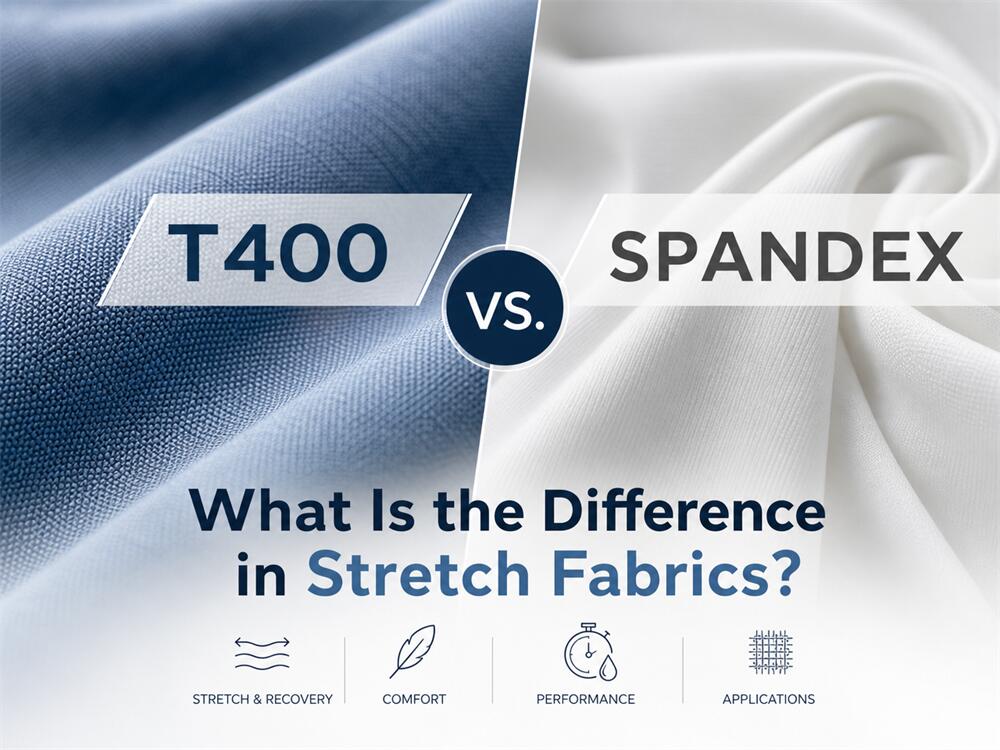
Stretch fabrics are a foundational component of modern apparel, from casual trousers and workwear to outdoor jackets and performance garments. For decades, spandex (elastane) has been the default solution for adding stretch to textiles. However, as brands demand better durability, higher color fastness, recyclability and long-lasting shape retention, T400 mechanical stretch fabric has emerged as a high-performance, spandex-free alternative.
This guide breaks down the core differences between T400 and spandex stretch fabrics, compares their performance side by side, and helps you choose the right material for your apparel line. Whether you are a brand sourcing manager, garment factory technician or textile wholesaler, you will find clear, actionable data to make better fabric decisions.
2. Quick Overview: What Are T400 Fabric and Spandex?
2.1 What Is Spandex (Elastane)?
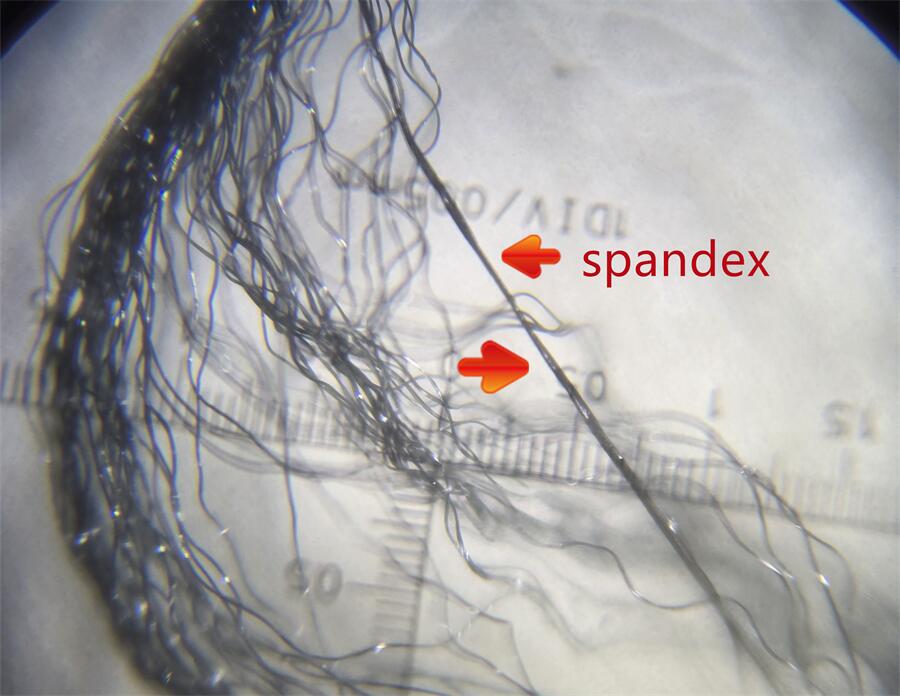
Spandex, also known as elastane, is a synthetic polyurethane fiber famous for its extreme stretchability. It can stretch to multiple times its original length and snap back to its original shape. In apparel production, spandex is almost never used alone. It is typically used as a core fiber inside covered or core-spun yarns, blended with polyester, nylon or cotton to add stretch to fabrics. It is well known for ultra-high elongation but has well-documented drawbacks in long-term durability and dyeing performance.
2.2 What Is T400 Fabric?
T400 fabric is a type of spandex-free stretch fabric that delivers elasticity without any spandex or elastane fiber content. It is made from 100% polyester bicomponent fiber, most famously sold under the LYCRA T400 fabric brand by Invista.
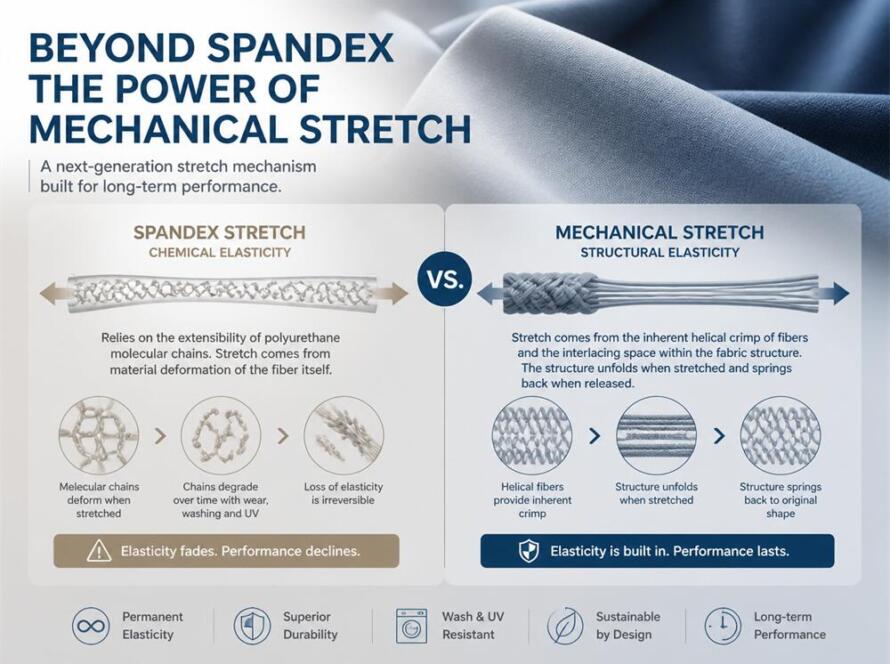
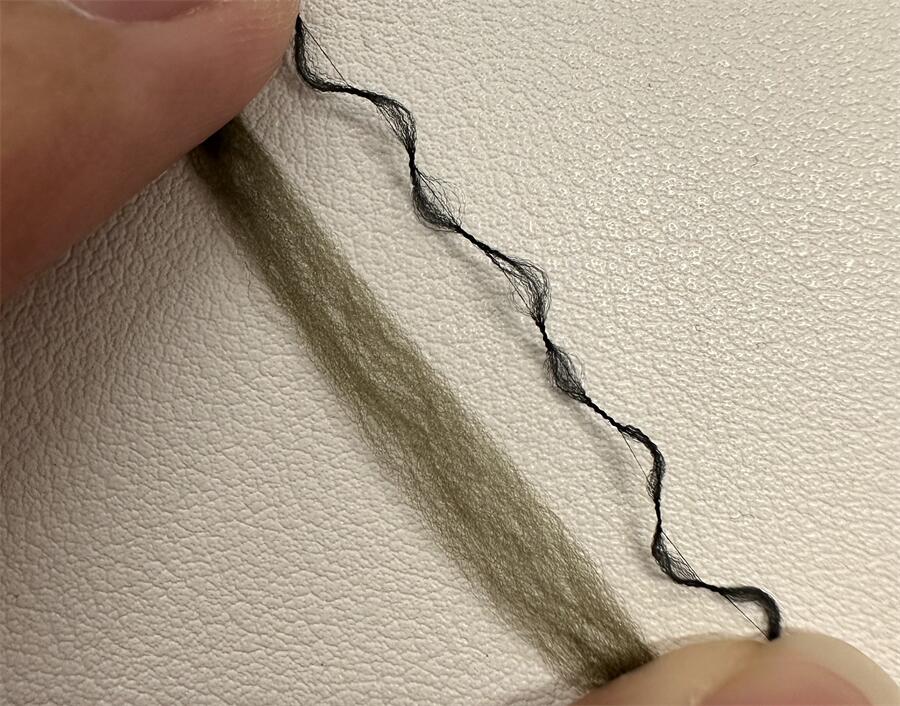
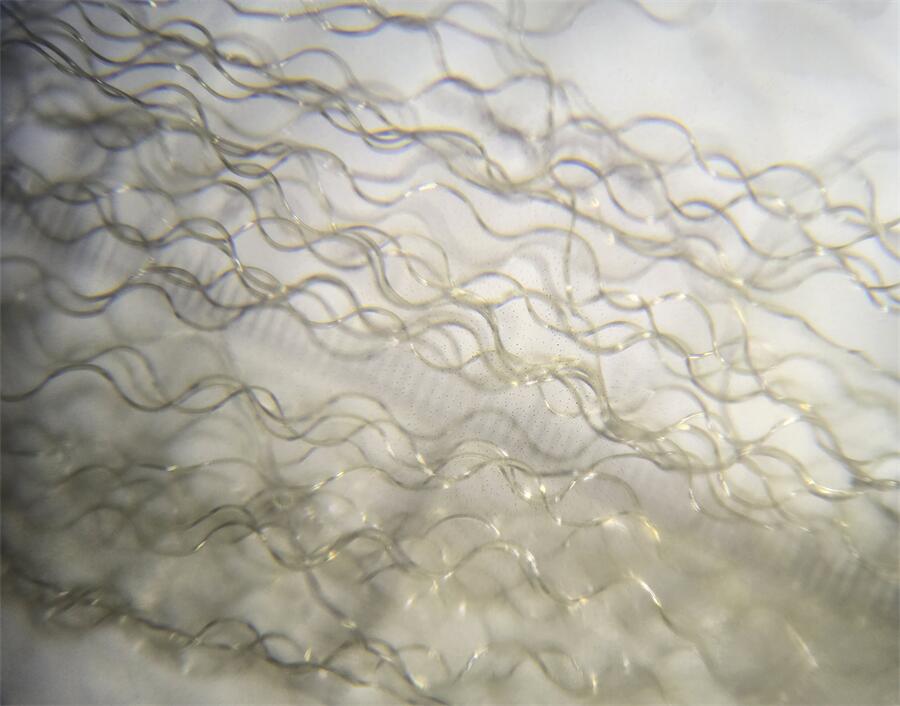
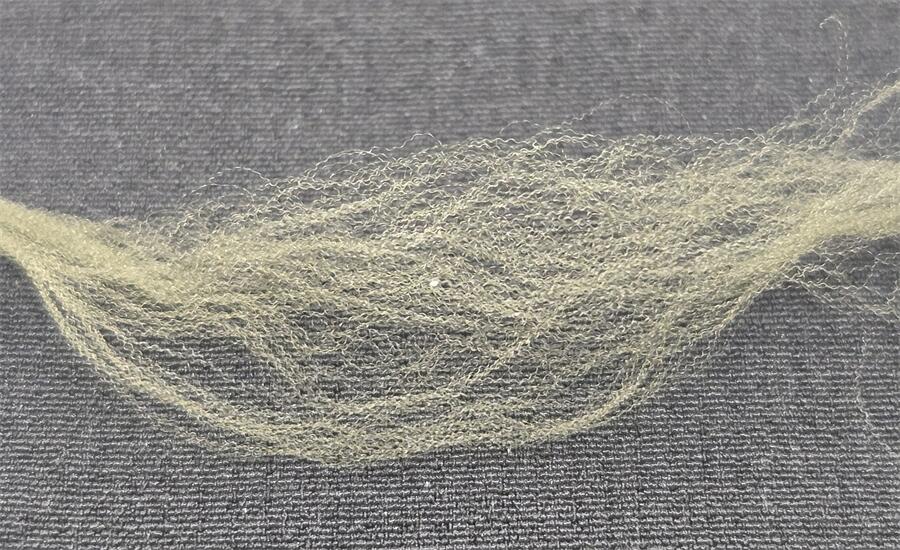
Instead of relying on an added elastic fiber, T400 uses two different polyester polymers (PET and PTT) with different thermal shrinkage rates, spun side by side into a single filament. After heat setting, the difference in shrinkage creates a permanent three-dimensional helical crimp inside each fiber — like a tiny built-in spring — that delivers consistent stretch and recovery. This makes it a true mechanical stretch fabric.
3. Core Difference: How Each Fabric Creates Stretch
The biggest difference between T400 and spandex is not how much they stretch, but why they stretch. This fundamental difference explains almost all of their performance gaps.
3.1 Spandex: Chemical Elasticity
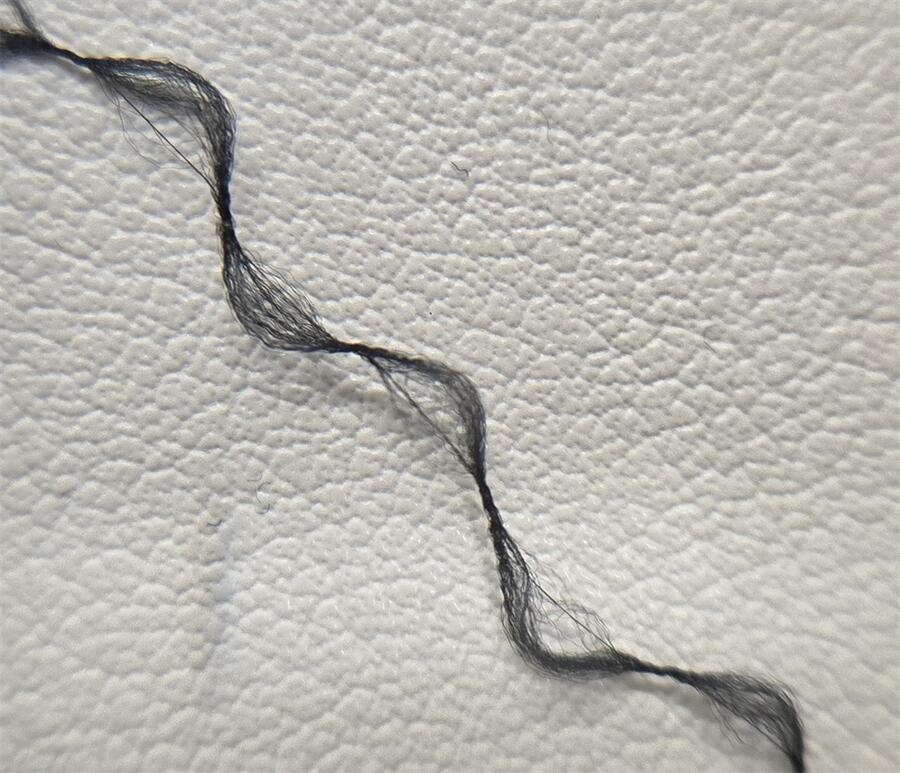
Spandex creates stretch through chemical elasticity. Think of a regular rubber band: the polyurethane molecular chains inside spandex fibers themselves stretch and deform when pulled, then contract back when released.
The stretch comes from the material itself. The problem is that over time, with repeated washing, heat, UV light and body oils, those molecular chains gradually break down. Once broken, they cannot repair themselves — so elasticity permanently decreases, and the fabric sags, bags and loses its shape.
3.2 T400: Mechanical Structural Elasticity
T400 creates stretch through mechanical structural elasticity. Think of a coiled spring: the fiber itself does not stretch at the molecular level. Instead, the permanent helical crimp shape of the fiber straightens out when pulled, then springs back to its original curled shape when released.
Because elasticity is built into the physical structure of the fiber, not dependent on a chemical elastomer, it does not degrade or wear out. The crimp is permanent, so stretch and recovery stay consistent for the entire life of the garment. This is the defining advantage of fabric stretch without spandex.
4. Side-by-Side Performance Comparison (T400 vs Spandex)
Below is a full performance comparison across 9 key sourcing criteria, with real production data to help you quantify the differences.
| Performance Category | T400 Spandex-Free Stretch Fabric | Spandex / Elastane Blend Fabric |
| Stretch Power & Recovery 100m Greige Fabric Dyeing Comparison | 27% total shrinkage; ~37% actual elongation (moderate comfort stretch) | 42% total shrinkage; ~72.4% actual elongation (very high stretch) |
| Dimensional Stability | Excellent; low shrinkage, shape-memory effect | Poor; high shrinkage, prone to bagging and distortion |
| Color Fastness (standard dyeing) | Grade 3–4 (wash, rub, perspiration) | Grade 2.5–3.5 (wash, rub, perspiration) |
| Chlorine & Chemical Resistance | Excellent; pure polyester structure | Very poor; chlorine breaks polyurethane chains |
| Durability & Aging Resistance | Excellent; permanent structural elasticity | Poor; elasticity degrades over time |
| Hand Feel & Wear Comfort | Crisp, structured, tailored drape | Soft, clingy, smooth second-skin feel |
| Weaving & Production Cost | Simpler process; 10–20% lower grey fabric cost | Complex process; requires covered yarns; higher cost |
| Recyclability & Sustainability | 100% recyclable polyester; GRS certifiable | Non-recyclable blend; hard to separate elastane |
| Available Yarn Sizes | 30D, 50D, 75D, 150D, 300D (pure polyester) | 30D+20D, 50D+20D, 75D+40D, 100D+40D, 150D+40D, 200D+40D (polyester + spandex core) |
Detailed explanation by category
- Stretch Power & Recovery Stretch performance can be quantified from two independent dimensions: fabric shrinkage rate after dyeing & finishing, and actual fiber elongation capacity (the true stretch ability of the material). In real production, when 100 meters of grey fabric goes through full dyeing and heat setting at maximum shrinkage:
- 100 m greige T400 fabric yields 73 m finished fabric after dyeing.
- 100 m greige Spandex blend fabric yields 58 m finished fabric after dyeing.
1) Calculation based on shrinkage rate
- T400 fabric shrinkage = (100 − 73) ÷ 100 = 27%
- Spandex blend fabric shrinkage = (100 − 58) ÷ 100 = 42%
- Relative gap: spandex fabric delivers approximately 55.6% higher shrinkage capacity than T400 ((42% − 27%) ÷ 27% × 100% ≈ 55.6%).
2) Calculation based on actual elongation rate (true stretch ability)
In standard textile evaluation, real elasticity is measured by elongation rate = total shrinkage ÷ finished length. The shorter the fabric remains after maximum shrinkage, the higher the inherent stretch potential of the fiber.
- T400 elongation rate = (100 − 73) ÷ 73 ≈ 36.99% (can stretch ~37% beyond its relaxed length)
- Spandex elongation rate = (100 − 58) ÷ 58 ≈ 72.41% (can stretch ~72.4% beyond its relaxed length)
- Relative gap: spandex fabric delivers approximately 95.8% higher actual elasticity than T400 ((72.41% − 36.99%) ÷ 36.99% × 100% ≈ 95.8%), nearly double the stretch capacity of T400.
Why is there such a large difference?
T400 is an elastic memory fiber. Its stretch relies entirely on the unwinding of its helical crimp structure — it delivers excellent recovery but has a moderate maximum elongation limit. Spandex is a dedicated high-elastic polyurethane fiber with extremely extendable molecular chains; its maximum shrinkage rate can reach 40%–50% or even higher under full draw.
- Dimensional Stability & Shape Retention T400 fabrics have excellent dimensional stability thanks to their low thermal shrinkage and built-in shape-memory effect. Garments resist wrinkling, keep their cut lines and do not bag at the knees, elbows or seat over time. Spandex fabrics have higher shrinkage and are prone to shape distortion, rippling and sagging after repeated wear and washing.
- Color Fastness (Wash, Rub, Perspiration) With standard dyeing processes:
- T400 consistently achieves grade 3–4 across wash, dry rub, wet rub and perspiration fastness.
- Spandex blends typically achieve grade 2.5–3.5, with darker shades often scoring lower.
If you require grade 4+ color fastness, the cost gap widens significantly:
- Spandex fabric dyeing cost roughly doubles (from ~$$0.28/m to $$0.56/m or more) to reach grade 4.
- T400 fabric only requires a 30% cost premium (1.3x standard dyeing cost) to hit grade 4+ fastness.
- Chlorine & Chemical Resistance T400’s pure polyester structure is naturally resistant to chlorine, bleach, acids and alkalis. It withstands pool water and industrial washing without damage or yellowing. Spandex, by contrast, is highly sensitive to chlorine. Even low chlorine levels break down the polyurethane molecular chains, causing yellowing, loss of elasticity and eventual fiber breakage.
- Durability & Aging Resistance Mechanical stretch from T400 is permanent. The helical fiber structure does not degrade with age, washing or UV exposure. Spandex elasticity gradually declines with use, leading to sagging, bagging and lost recovery — the main reason stretch garments wear out prematurely.
- Hand Feel & Wear Comfort T400 has a crisp, structured, tailored hand feel with good body and drape, ideal for tailored pants and outerwear. Spandex blends have a softer, smoother, clingier feel that works well for next-to-skin garments but can look cheap in structured apparel.
- Weaving Process & Production Cost T400 yarn can be woven directly on standard air-jet, water-jet and rapier looms with no special preparation. This simplifies production and reduces defect rates. Spandex must first be processed into covered or core-spun yarns before weaving, adding cost, lead time and complexity. Overall, grey T400 polyester fabric costs 10–20% less than comparable spandex stretch fabrics.
- Recyclability & Sustainability T400 is 100% polyester, so it can be collected, shredded, melted and respun into new fiber — supporting closed-loop recycling and GRS certification. Spandex-blended fabrics cannot be efficiently recycled, because the polyurethane elastane cannot be separated from the base fiber. This makes spandex blends a poor fit for circular fashion and brand sustainability targets.
- Yarn Size Availability
- T400 is available as pure polyester yarn in standard deniers: 30D, 50D, 75D, 150D, 300D.
- Spandex stretch fabrics use blended yarns where a spandex core is wrapped with staple or filament fiber. Common combinations include 30D+20D, 50D+20D, 75D+40D, 100D+40D, 150D+40D and 200D+40D, where the second number (20D, 40D) is the denier of the spandex core.
5. Pros and Cons: T400 vs Spandex Stretch Fabrics
5.1 Pros & Cons of Spandex
| Pros | Cons |
| Extremely high stretch and elongation | Elasticity degrades over time (sags and bags) |
| Very soft, smooth next-to-skin feel | Poor color fastness; easy to fade and crock |
| Ideal for tight, body-hugging apparel | Poor chlorine and chemical resistance |
| Widely available and well understood | Cannot be recycled; not sustainable |
| Available in 4-way stretch knit constructions | More complex and expensive to weave and finish |
5.2 Pros & Cons of T400 Mechanical Stretch Fabric
| Pros | Cons |
| Permanent stretch; does not age or lose recovery | Lower total elongation; not for ultra-tight garments |
| Excellent dimensional stability and shape retention | Not ideal for 4-way stretch tight knitwear |
| Higher color fastness at lower dyeing cost | Hand feel is crisper, not as soft as spandex |
| Excellent chlorine and chemical resistance | — |
| 100% recyclable polyester; GRS certifiable | — |
| Simpler weaving; 10–20% lower production cost | — |
| Mature, mass-producible with consistent quality | — |
6. Which One Should You Choose? (By Apparel Type)
Best applications for T400 spandex-free stretch fabric
T400 excels in woven garments where shape retention, wrinkle resistance, durability and long-lasting comfort stretch are priorities. It is the superior choice for:
- Hiking pants, golf pants and travel pants
- Workwear pants and industrial uniforms
- Casual trousers and chinos
- Softshell jackets and outdoor apparel
- School uniforms and corporate wear
- Button-down stretch shirts and tailored separates
For these categories, T400 fabric for pants is almost always the better choice over spandex, delivering better wear life, cleaner appearance and lower total cost.
Applications where spandex is still preferred
Spandex remains the better choice when ultra-high stretch, extreme recovery and a soft second-skin feel are required. T400 is generally not suitable for:
- Yoga leggings and tight fitness leggings
- Compression wear and medical compression garments
- High-stretch swimwear
- High-stretch sports bras
- Shapewear and body-shaping garments
- Tight-fitting cycling shorts
7. Frequently Asked Questions
Is there nylon in T400 yarn?
No. Pure T400 yarn is 100% polyester, made from PET and PTT bicomponent fiber. There is no nylon in the yarn itself. That said, you can certainly have nylon T400 fabrics where T400 polyester yarn is used as weft and interwoven with nylon warp yarns. This is a common construction for outdoor and tactical fabrics.
Is T400 fabric better than spandex?
It depends on your application. For most woven apparel — pants, shirts, jackets, uniforms, outerwear — T400 is generally better: it lasts longer, holds shape better, has higher color fastness, is more sustainable and costs less. For ultra-tight, high-stretch next-to-skin garments, spandex still delivers higher elongation and a softer feel.
Does T400 fabric have spandex in it?
No. Authentic T400 mechanical stretch fabric contains zero spandex, zero elastane and no rubber additives. All stretch comes from the permanent helical crimp structure of the bicomponent polyester fiber itself. It is a true stretch fabric without elastane.
Is T400 stretch fabric cheaper than spandex?
In most cases, yes. Grey fabric cost for T400 is typically 10–20% lower than comparable spandex stretch fabrics. The cost gap grows even wider when you require grade 4+ color fastness, because achieving high fastness with spandex is significantly more expensive.
Can T400 fabric be GRS certified?
Yes. T400 can be produced with recycled polyester content. LYCRA T400 EcoMade, for example, contains 50% to 60% recycled polyester and is available with full GRS (Global Recycled Standard) certification. It can also be combined with C0 fluorine-free water-repellent finishes for full sustainable apparel compliance.
How to Source T400 Stretch Fabric: A Buyer’s Checklist
- Prioritize fabrics with a higher T400 fiber content — more T400 weft density means better, more consistent stretch.
- Consider weave structure when evaluating stretch. Stretch performance by weave, from strongest to weakest: double weave > jacquard > twill > check > plain weave.
- Verify yarn denier and weft density, not just the “T400” name on the label.
Why do some T400 mechanical stretch fabrics lose recovery?
Poor recovery is almost always a fiber ratio and density problem, not a problem with T400 itself. Many budget “T400” fabrics use a high density of regular polyester warp yarns and only a low density of T400 weft yarns.
For example, a common budget T400 oxford fabric may have 98 ends/inch warp (regular polyester) and only 30 picks/inch weft (T400). The over-dense warp locks up the structure, preventing the T400 weft from freely stretching and recovering. Always check both warp and weft density when sourcing.
Is T400 fabric chlorine resistant?
Yes. T400’s pure polyester structure is naturally chlorine-resistant. It withstands repeated exposure to pool water, bleach and industrial laundering without yellowing or losing elasticity. This makes it a popular choice for swimwear linings, poolside apparel and workwear that undergoes frequent industrial washing.
8. Final Thoughts
When comparing T400 vs spandex, the takeaway is not that one is universally better than the other — it is that they serve different purposes. Spandex is the right choice when you need ultra-high elongation and a soft, clingy feel for tight, next-to-skin garments. But for the vast majority of woven apparel — pants, shirts, jackets, uniforms, workwear and outerwear — T400 spandex-free stretch fabric delivers a better overall package: longer-lasting stretch, better shape retention, higher color fastness, easier production, lower cost and full recyclability.
As global brands raise their standards for durability, quality consistency and sustainable sourcing, mechanical stretch vs spandex is increasingly an easy call. T400 has moved from a niche alternative to a mainstream stretch fabric solution, and it continues to replace spandex in core woven apparel categories.
We specialize in high-quality T400 stretch fabrics including T400 polyester and nylon-blend constructions, available in a full range of weights, weaves and finishes. We support GRS recycled certification, C0 fluorine-free processing and custom development for specific apparel applications. If you are sourcing T400 fabrics for your brand or factory, welcome to contact us for samples, specifications and competitive pricing.