Preface
The waterproofing processes for stretch fabrics mainly include three technical routes: auxiliary agent waterproofing, composite membrane waterproofing, and coating waterproofing. These processes differ greatly in air permeability, hand feel, water pressure resistance and application scenarios, serving as the core basis for functional fabric selection. This article focuses on a detailed explanation of the composite membrane waterproofing method, the mainstream high-end production process for stretchable waterproof fabric, while the other two waterproofing processes are only referenced for differentiation.( Learn more about the production methods of waterproof fabrics-links )
I. Application Scope of Stretchable Waterproof Composite Fabric
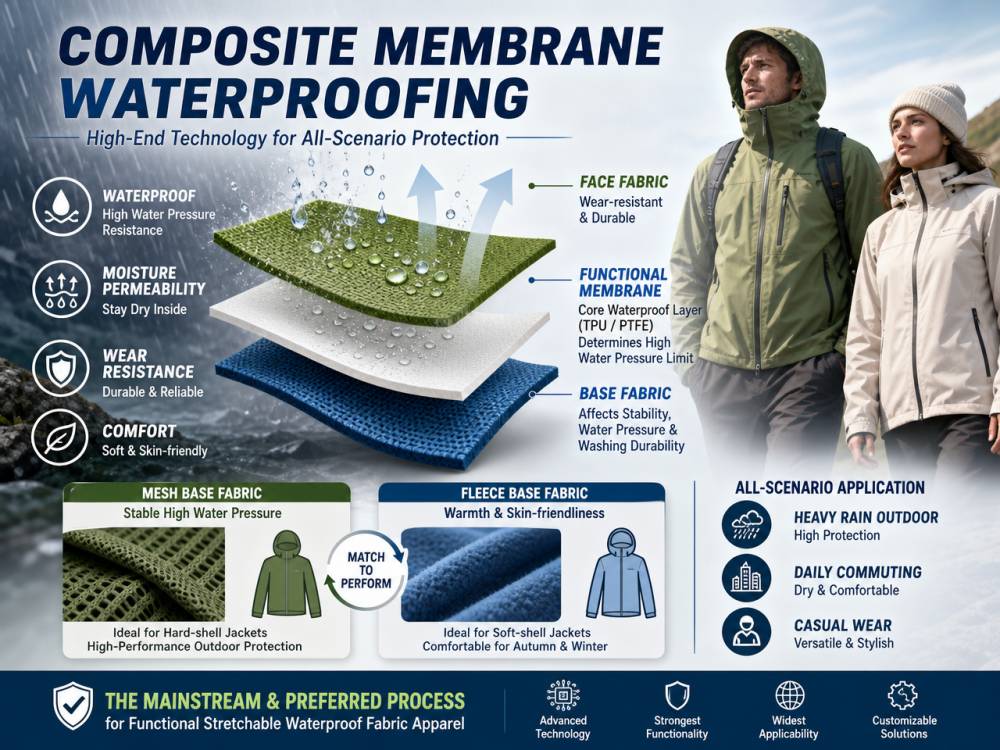
Stretchable waterproof fabric is suitable for making jackets and hard-shell garments for heavy rain outdoor scenarios, as well as soft-shell coats, autumn and winter jackets, and daily commuter apparel. It features dual core functions of waterproofing and air permeability, adapting to most functional clothing scenarios.
II. Interpretation of Core Indicator: Water Pressure
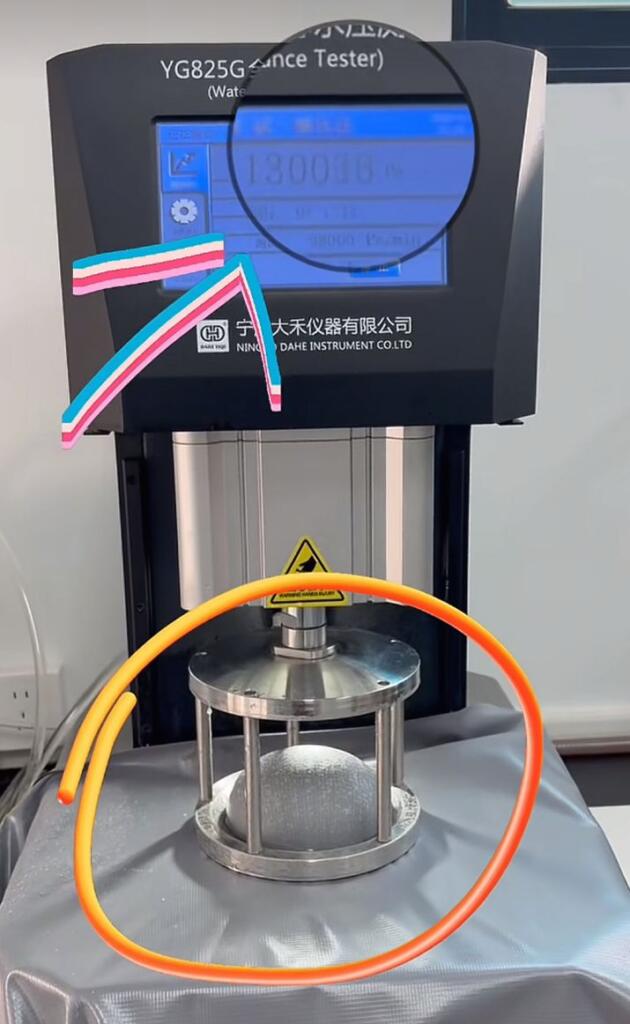
Water pressure refers to the fabric’s ability to resist rainwater penetration. The higher the value, the better the waterproof performance, with the unit of mm (millimeter of water column).
- 3000mm: Resists light rain and daily water splashing
- 5000mm: Copes with moderate rain, meeting daily travel needs
- 8000-10000mm: Resists heavy rain and torrential rain, preventing water penetration during outdoor hiking
- Above 15000mm: Professional-grade waterproofing for extreme heavy rain conditions
Summary: The higher the water pressure value, the better the rainproof performance of the fabric.
III. Two Mainstream Structures of Composite Fabric
1. Two-layer Composite (Face Fabric + Membrane)
This structure features a relatively stiff hand feel. The membrane directly contacts the skin and tends to stick to the body. It is mostly used for low-end garments with poor fabric durability.
2. Three-layer Composite (Face Fabric + Membrane + Base Fabric)
This is the mainstream process for outdoor functional fabrics, delivering high-quality finished products with excellent wash resistance and wearing comfort. The standard top-down three-layer bonding structure is: Face Fabric (Surface Layer) → Functional Membrane (Middle Layer) → Base Fabric (Inner Layer). The three layers are firmly bonded into an integral whole through high-pressure hot pressing with dot hot melt adhesive, which is non-detachable. Structure Advantage Summary: The face fabric ensures wear resistance and shaping, the functional membrane realizes waterproof and breathable performance, and the base fabric protects the membrane and improves skin friendliness. The three-layer stretchable waterproof fabric integrates well-shaped wear resistance, outdoor waterproof air permeability and skin-friendliness, with comprehensive performance far exceeding that of ordinary waterproof fabrics.
1) Face Fabric / Outer Layer
The outermost protective layer of the fabric
- Functions: Wear resistance, tear resistance, scratch resistance and shaping, determining the fabric’s appearance style (mountain cloth, twill, oxford cloth, etc.)
- Characteristics: High density, stiff and durable, with outdoor windproof, water-repellent and UV-resistant properties
2) Functional Membrane / Middle Layer
The core functional layer and carrier of waterproof and breathable performance, mainly including PU membrane, TPU membrane and PTFE microporous membrane
- Functions: Windproof, waterproof and moisture-permeable
- Principle: It blocks rainwater and discharges body surface moisture through special microporous or hydrophilic structures, serving as the core source of waterproof and breathable performance for jackets and functional coats
3) Base Fabric / Lining Layer
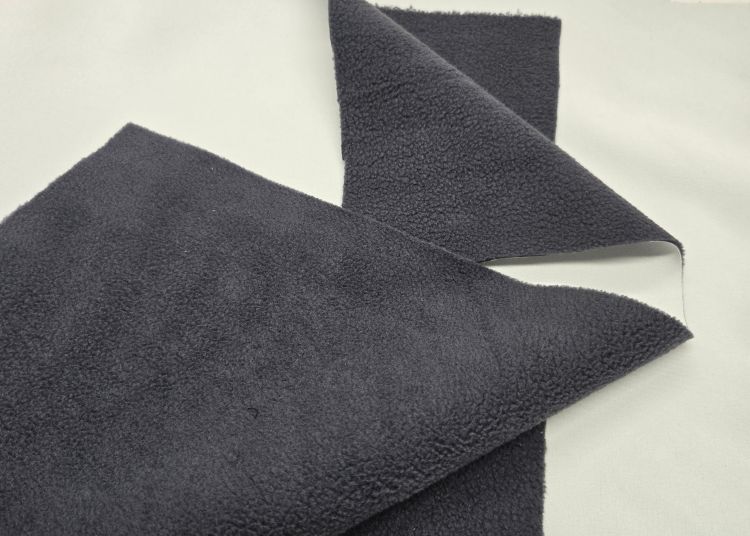
Skin-friendly inner layer, commonly made of polyester pongee, warp-knitted mesh, knitted fabric, fleece and thin plain fabric
- Functions: Protect the middle functional membrane, reduce membrane wear, optimize skin contact feel and avoid direct adhesion of the membrane to the skin
- Advantages: Isolates the cold and sticky touch of the membrane, greatly reduces the risk of membrane delamination and damage after washing, and effectively improves the overall quality and wearing experience of stretchable waterproof fabric
IV. Production Method and Core Principle of Composite Fabric
The composite membrane waterproofing method bonds one or more layers of functional waterproof membranes to stretch fabrics through lamination technology, enabling stretchable waterproof fabric to achieve both waterproof and moisture-permeable performances, a seemingly contradictory combination. It is the mainstream waterproof technology for high-end outdoor garments such as hiking jackets. All functional properties of the fabric derive from the middle functional membrane, which is divided into two categories: microporous membrane and non-porous membrane, with completely different waterproof and moisture-permeable principles:
| Membrane Type | Representative Material | Waterproof Principle | Moisture-permeable Principle |
| Microporous Membrane | PTFE (Polytetrafluoroethylene), mostly used for high-end stretchable waterproof fabric | The membrane is covered with micron-scale micropores smaller than water droplets (approximately 100 microns), preventing liquid rainwater from penetrating | Water vapor molecules are much smaller than the micropores, which can freely pass through the membrane and discharge human sweat and moisture |
| Non-porous Membrane | TPU (Thermoplastic Polyurethane), the most widely used membrane material for civilian stretchable waterproof fabric | The dense non-porous membrane physically blocks liquid water penetration | The membrane contains hydrophilic groups that export body surface moisture through molecular conduction of adsorption, diffusion and resolution |
V. Complete Production Process of Composite Membrane
- Membrane Preparation: Produce microporous PTFE membranes or dense TPU membranes through biaxial stretching and other processes
- Fabric and Membrane Pretreatment: Conduct corona discharge treatment to improve surface adhesion for subsequent bonding
- Dot Gluing: Apply hot-melt TPU adhesive in dot or mesh form via rotary screen coating; the adhesive dosage directly determines the fabric’s moisture permeability and peeling strength
- Laminated Hot Pressing: Stack the face fabric, functional membrane and base fabric in order, and perform constant-temperature and constant-pressure hot pressing to melt the adhesive for permanent lamination of the three layers
VI. Performance Comparison and Selection Suggestions of Different Functional Membranes
1. PTFE Microporous Membrane
- Disadvantages: Original micropores are easily blocked and contaminated by grease in sweat and detergent residues, leading to gradual attenuation of waterproof performance
- Upgrade Solution: PTFE double-component composite membrane with PU protective layer
- Advantages: The PU layer isolates oil and dirt, protecting micropores to maintain long-term stable waterproof performance
- Disadvantages: The additional PU layer slightly reduces the overall moisture permeability
2. TPU Non-porous Membrane
- Advantages: Environmentally friendly production, low cost, and excellent elasticity matching stretch fabrics
- Moisture Permeability Grading: Low permeability >1000g/m²·24h, medium permeability >3000g/m²·24h, high permeability >5000g/m²·24h
- Application: Suitable for functional garments made of stretchable waterproof fabric, such as jackets, workwear and shoe materials
VII. Key Selection of Stretchable Waterproof Composite Fabric: Influence of Base Fabric on Water Pressure
Core Conclusion
- The membrane determines the water pressure upper limit of stretchable waterproof fabric: fabrics with the same face fabric and TPU/PTFE membrane have a fixed theoretical maximum water pressure resistance (10000-20000mm);
- The base fabric directly determines the measured water pressure value and washing durability of stretchable waterproof fabric: mesh base fabric ensures stable water pressure, while fleece base fabric leads to lower measured water pressure and faster performance attenuation.
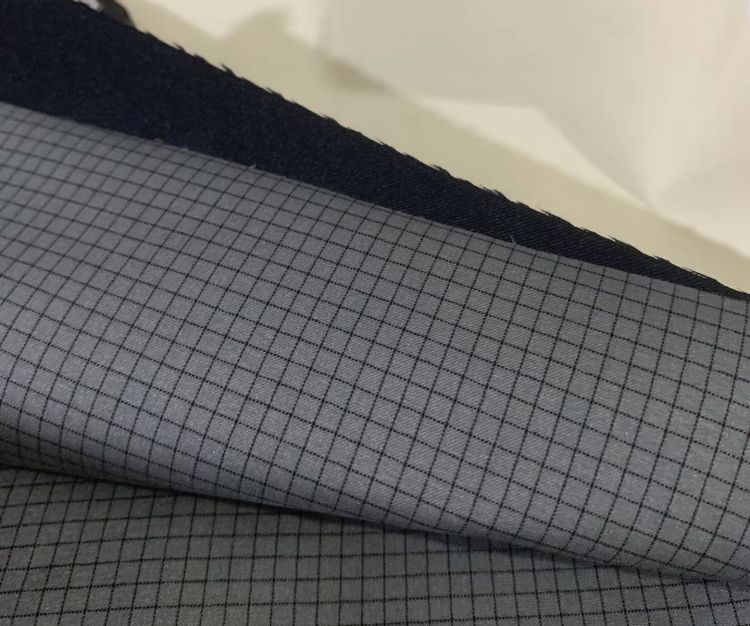
1) Warp-knitted Mesh / Bird-eye Mesh Base Fabric
- Structural features: Lightweight, breathable, high support and minimal deformation
- Stress performance: Evenly supports the membrane during water pressure testing, preventing membrane stretching, bulging and water seepage
- Performance: The measured water pressure is close to the theoretical value of the membrane, with high water pressure retention rate after washing (e.g., 10000mm remains 8000mm after washing)
- Application: High-standard stretchable waterproof fabric for hard-shell jackets and heavy rain outdoor garments requiring high water pressure and wash resistance
2) Polar Fleece / Short Plush / Coral Fleece Base Fabric
- Structural features: Thick and fluffy with loose fibers and easy compression deformation
- Stress performance: The fleece layer collapses and stretches under water pressure, pulling the membrane to expand micropores and cause local water seepage
- Performance: The measured water pressure is 10%-30% lower than that of mesh fabric, with significant attenuation after multiple washes (e.g., 10000mm drops to 5000-6000mm after washing)
- Application: Warm and comfortable stretchable waterproof fabric for autumn and winter soft-shell jackets and daily commuter garments, allowing slight water pressure reduction
Full-text Summary: In summary, the composite membrane waterproofing method is the high-end waterproof production process with the strongest functionality and widest applicability for stretchable waterproof fabric. Different from ordinary auxiliary agent waterproofing and coating waterproofing, composite fabric adopts a scientific three-layer structure of face fabric, functional membrane and base fabric, achieving comprehensive performance of waterproofing, moisture permeability, wear resistance and comfort.
The water pressure upper limit of stretchable waterproof fabric is determined by functional membrane materials such as TPU and PTFE, serving as the core functional factor. The base fabric material directly affects the measured water pressure, stability and washing durability of finished fabrics. Mesh base fabric guarantees stable high water pressure output, while fleece base fabric focuses on warmth and skin-friendliness. Reasonable matching of membrane and base fabric structures can customize professional high-water-pressure hard-shell fabrics for outdoor use and comfortable soft-shell fabrics for autumn and winter, fully meeting the all-scenario clothing needs of heavy rain outdoor activities, daily commuting and casual wear. It is the mainstream and preferred process for current functional stretchable waterproof fabric apparel.