Preface: Essential Differences Between Fabric Printing and Solid Dyeing
In textile finishing processes, dyeing and printing are two completely different coloration methods with distinct coloring logic, visual effects, process characteristics and application scenarios, which are key to distinguishing finished fabric styles. Fabric solid dyeing is an overall uniform coloring process. The entire fabric is fully immersed in dye liquor to allow the dye to penetrate the fibers evenly, presenting a solid color without patterns. It only realizes basic base color finishing and cannot create personalized visual effects such as textures, patterns and gradients.
In contrast, fabric printing is a local fixed-point coloring process. With dedicated inks, dyes and customized production equipment, preset patterns and textures are printed on designated areas of the fabric, realizing diverse visual effects including multi-color splicing, gradients, geometric textures and complex graphics. Simply put, dyeing determines the overall base color of the fabric, while printing determines the surface pattern of the fabric. In addition, fabric printing can match different coloring principles and production processes according to fabric materials, adapting to mainstream chemical fiber fabrics such as polyester and nylon, and serves as a core finishing process for functional and fashionable textile garments.
I. Principle Differences in Printing Coloring Between Polyester and Nylon Fabrics
As mainstream chemical fiber fabrics for outdoor, sports and casual apparel, polyester and nylon differ greatly in fiber molecular structure, porosity and heat resistance. They cannot share the same printing system, and feature completely different coloring dyes, core principles and applicable processing methods, which constitute the core basis for industrial printing process selection.
1.1 Polyester: Gas-phase Coloring by Sublimation
Polyester is a thermoplastic fiber whose molecular chain structure expands under high temperature. Therefore, polyester fabric printing mainly adopts disperse sublimation ink. The working principle is as follows: disperse dyes are first printed on transfer paper; under high temperature (approximately 200℃) and high pressure, the dyes sublime directly from solid to gas, diffuse into the amorphous region of polyester fibers, and fix inside the fibers after cooling. This gas-phase coloring method delivers bright colors, soft hand feel and excellent color fastness.
Two mainstream processing methods for polyester printing
- Traditional rotary paper transfer printing: Patterns are engraved on copper rollers, printed on transfer paper via roller pressure, and then thermally transferred to polyester fabrics.
- Digital paper transfer printing: The plate-making procedure is eliminated; patterns are directly printed on transfer paper by digital printers and then thermally transferred to fabrics.
1.2 Nylon: Liquid-phase Bonding with Acid Dyes
The molecular chains of nylon (polyamide fiber) contain amino and carboxyl groups, enabling ionic bonding with acid dyes, similar to wool and silk. Sublimation printing is not applicable to nylon. High temperature will cause nylon fabric shrinkage and hardening. Moreover, disperse dyes have no affinity for nylon fibers, resulting in severe color bleeding and fading even if forced coloring is achieved.
Two common processing methods for nylon printing
- Digital direct fabric printing: Specially formulated acid dye ink is directly sprayed on pre-treated nylon fabrics through digital nozzles, followed by steaming, washing and other fixing procedures.
- Water transfer printing: Using water as the medium, patterns on printed transfer films are transferred to nylon fabrics via wet lamination and low-pressure fixing.
II. Analysis of Four Mainstream Fabric Printing Production Methods
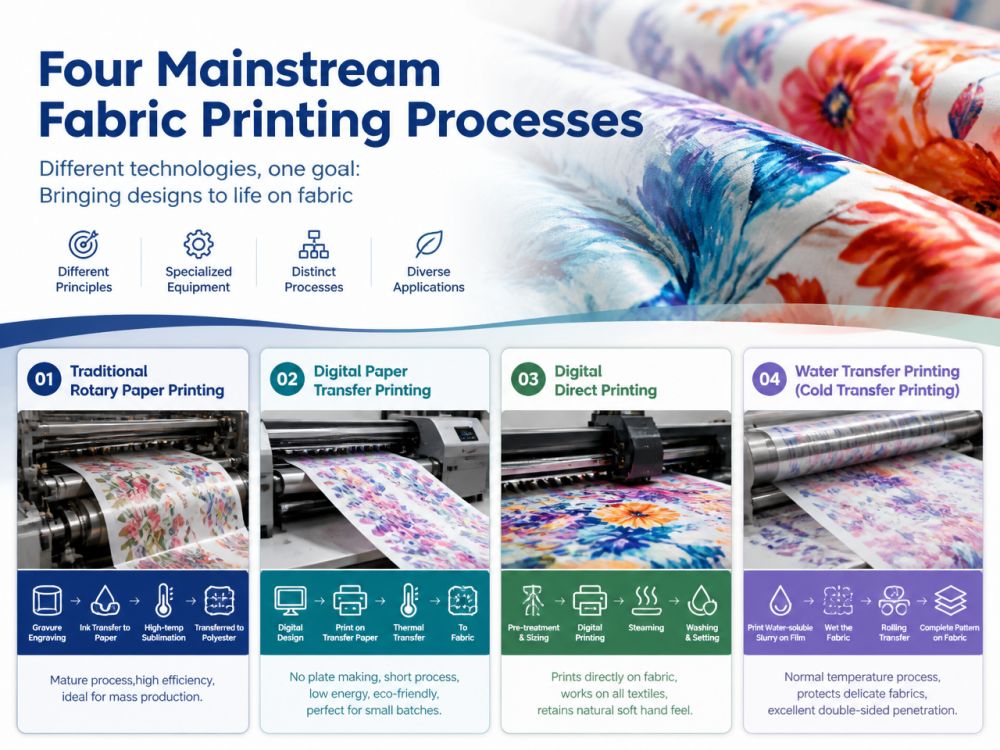
The textile industry adopts four mainstream fabric printing processes, which are targeted at polyester and nylon fabrics respectively with unique principles, equipment configurations and technological procedures. Detailed explanations are provided below.
2.1 Traditional Rotary Paper Printing
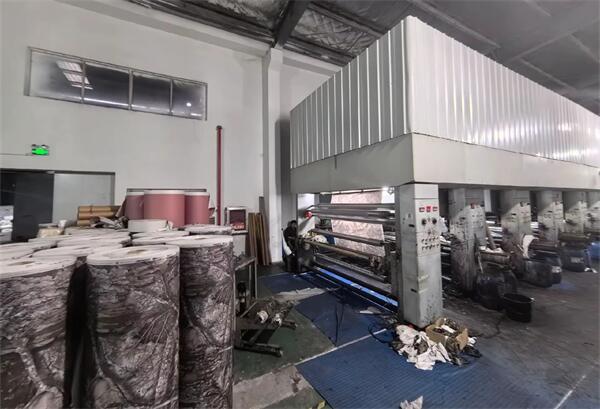
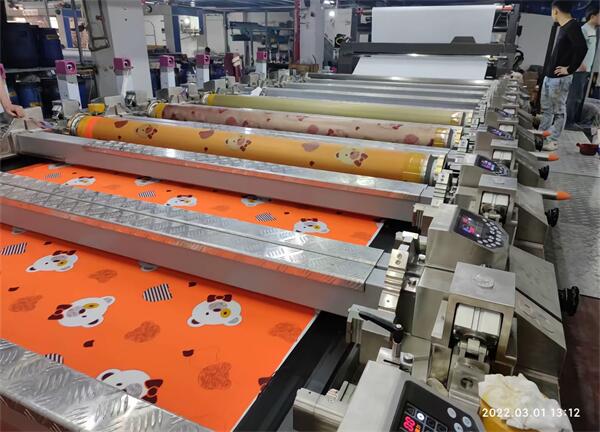
It is a large-scale mass production process based on gravure printing principles. The production process includes engraving patterns on copper plates, scraping off excess ink, transferring ink from plate grooves to transfer paper, and finally sublimating and transferring patterns to polyester fabrics under high temperature. Covering color separation, plate making, color matching, paper printing and fabric printing, it is the foundational process for mass production of chemical fiber printed fabrics.
2.2 Digital Paper Transfer Printing
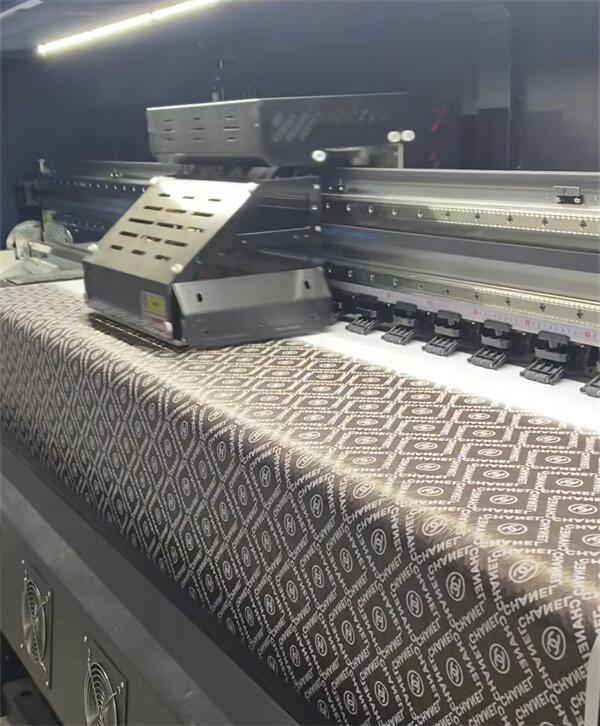
As a digital upgrade of traditional thermal transfer printing, this process utilizes the sublimation characteristics of polyester disperse ink. Patterns are directly printed on transfer paper by computer-controlled digital printers and then thermally transferred to fabrics. Eliminating cumbersome plate-making procedures, it shortens the process flow, features low energy consumption and zero pollution, and is highly suitable for small-batch and multi-pattern flexible production.
2.3 Digital Direct Printing
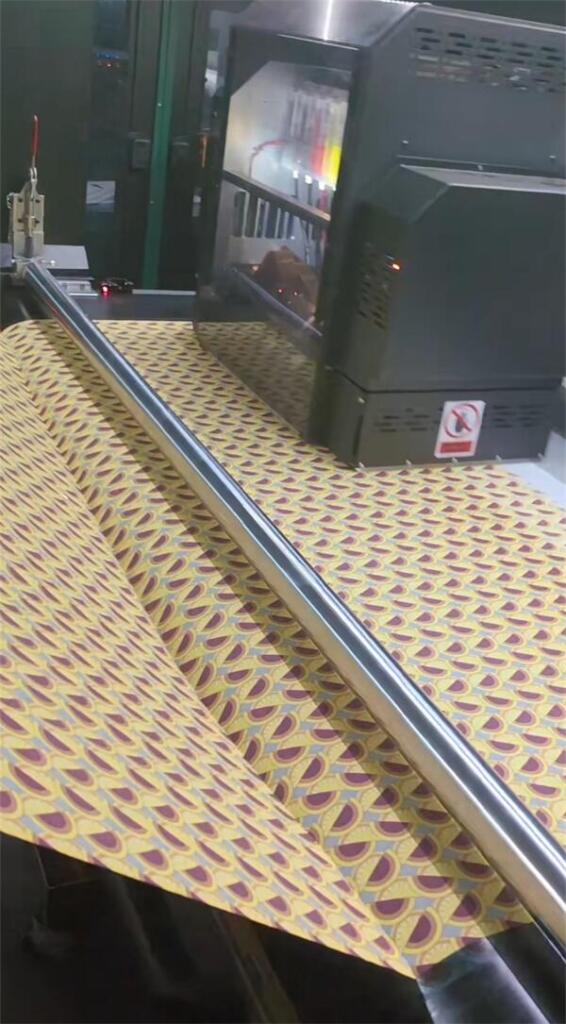
This process sprays pigment ink directly onto pre-treated fabrics via computer-controlled digital printers. The complete workflow includes fabric sizing, color matching, printing, steaming, washing and setting. Breaking the limitation of fabric materials, it is applicable to cotton, silk, chemical fibers and all other textiles, perfectly retaining the original soft hand feel of fabrics.
2.4 Water Transfer Printing (Cold Transfer Printing)
It is a normal-temperature wet transfer process. Water-soluble slurry is printed on the carrier film; after the fabric is wetted, the water-soluble slurry dissolves under rolling pressure and transfers complete patterns to the wet fabric. The whole process is carried out at room temperature, which effectively protects the soft hand feel of ultra-thin nylon fabrics and achieves excellent double-sided color penetration.
III. Advantages and Disadvantages Comparison of Four Printing Methods
The four printing processes vary greatly in applicable fabrics, production cost, minimum order quantity, pattern accuracy and production efficiency. Distinguishing their pros and cons accurately is the core reference for fabric procurement, garment development and order quotation.
3.1 Traditional Rotary Paper Printing
Advantages: Significant scale benefits with low unit cost and fast production speed, ideal for large-batch conventional orders.
Disadvantages: High minimum order quantity and additional plate-making fees. Limited by physical precision, it cannot produce high-precision patterns. Pattern misalignment and seam marks frequently occur when manufacturing multi-color grids and circular dot patterns.
3.2 Digital Paper Transfer Printing
Advantages: Breaking the precision limitation of traditional printing, it perfectly reproduces high-difficulty patterns such as gradients and precise grids. No minimum order quantity is required; customized production is available for orders as small as 1 meter with complete pattern source files.
Disadvantages: Relatively low production efficiency with an hourly output of about 200 to 300 meters. Restricted by sublimation principles, it is completely incompatible with nylon fabrics.
Special Restriction: The above two paper transfer processes rely on high-temperature sublimation and cannot be used for nylon fabric printing.
3.3 Digital Direct Printing
Advantages: Strong universality, applicable to all fabric types. Ultra-high pattern restoration accuracy with no minimum order limit, perfect for high-end customization and complex pattern production.
Disadvantages: High processing cost with a much higher unit price than other printing methods; low production efficiency, and difficult weft skew control for knitted fabrics.
3.4 Water Transfer Printing
Advantages: Wide fabric adaptability with cost-effective pricing. The most prominent feature is excellent pattern penetration and color uniformity on both fabric sides while maintaining soft hand feel.
Disadvantages: Large minimum order quantity. Unable to produce ultra-high-precision patterns compared with digital printing; pattern misalignment may occur during mass production.
IV. Common FAQs About Fabric Printing
4.1 Why Cannot Nylon Fabrics Adopt Sublimation Paper Transfer Printing?
Sublimation paper transfer printing requires high-temperature thermocompression at 200℃-230℃ and relies on gaseous dye penetration of polyester fibers, which is completely incompatible with nylon materials for two core reasons.
- First, nylon has poor heat resistance. Temperatures above 180℃ will cause irreversible damage including fiber shrinkage, fabric hardening, hand feel embrittlement and elasticity attenuation, completely destroying the physical properties of nylon fabrics.
- Second, nylon fiber molecules cannot adsorb sublimation disperse dyes. Dyes fail to penetrate and fix under high temperature, resulting in floating color, fading and color mottling. Therefore, nylon fabrics can only adopt low-temperature acid dye printing processes (digital direct printing and water transfer printing) instead of sublimation transfer.
4.2 Causes and Solutions of Color Difference During Garment Sewing of Printed Fabrics
Causes: On the one hand, batch differences exist in ink ratio, thermocompression temperature and fixing time of different printed fabric batches, resulting in inconsistent base colors and obvious color difference after splicing. On the other hand, unstable equipment temperature and pressure during mass production lead to uneven coloring on the left, right, head and tail of fabrics, highlighting color difference after garment splicing.
Solutions
- Classify and use fabrics of the same batch uniformly before cutting to avoid cross-batch splicing. Arrange adjacent cutting pieces on the same fabric layer of the cutting bed to prevent layered splicing.
- Strictly control equipment parameters including constant temperature, pressure and speed, and unify ink proportioning during fabric printing to reduce color deviation within a single batch.
4.3 Optimal Printing Method for Polyester-Nylon Blended Fabrics
Polyester-nylon blended fabrics contain dual fiber characteristics and cannot adopt single polyester sublimation processes. The optimal printing solution depends on order requirements.
- High precision, small batch and high-end quality: Priority to digital direct printing. Special composite ink can fix colors on both polyester and nylon fibers, delivering precise patterns, uniform color and no fabric damage, suitable for high-end customized boutique garment orders.
- Low cost, large batch and conventional patterns: Priority to water transfer printing. Featuring strong process compatibility, uniform coloring, excellent penetration and stable color fastness, it is cost-effective for mass-market bulk garment orders.
Key Avoidance: Rotary and digital paper sublimation transfer are strictly prohibited. High temperature will damage nylon fibers, fail to color nylon components, and cause printing fading, uneven color and fabric hardening.
V. Summary of Fabric Printing Selection Solutions
The core selection logic of fabric printing processes depends on fabric material, pattern precision, order batch and cost budget.
- For low cost, fast production and simple patterns with large order volume, traditional rotary printing is the first choice for polyester fabrics.
- For personalized, high-precision and zero-inventory production, digital paper transfer printing is the optimal solution for polyester pattern customization.
- For nylon and complex blended fabrics, digital direct printing provides the highest production flexibility with higher cost investment.
- For low-cost mass production of nylon printed fabrics, water transfer printing is a mature choice with acceptable precision compromise.
There is no perfect printing process, only the most suitable one for your demands. Feel free to contact us if you have any questions about fabric printing!
VI. Overseas Professional Websites for Fabric Printing Pattern Selection
High-quality and trendy patterns are the core competitiveness of fabric printing. For foreign trade orders, outdoor functional fabrics and fashion apparel development, professional overseas pattern websites provide mass production-ready, high-definition, seamless and copyright-compliant printing designs. Below are classified mainstream overseas pattern platforms, perfectly matching four fabric printing processes including rotary printing, digital transfer printing, direct digital printing and water transfer printing.
6.1 Free & Commercial Print-Ready Pattern Platforms (Factory Mass Production Priority)
6.1.1 Patternbulk
Official Website: https://www.patternbulk.com/
It is a professional textile exclusive pattern library specially designed for fabric printing. All patterns adopt standard seamless repeat design without white edges and dislocation problems, fully adapting to thermal sublimation, direct digital printing and water transfer printing processes. It covers outdoor textures, geometric grids, circular dots, gradients, camouflage, plants and retro textures. A large number of high-definition source files are available for free commercial use, supporting direct mass production with zero copyright risk, which is the most commonly used platform for textile printing factories.
6.2 Premium Copyright Pattern Platforms (High-End Brand & Foreign Trade Orders)
6.2.1 Shutterstock
Official Website: https://www.shutterstock.com/
As the world’s top commercial design library, it has more than 4 million original textile printing patterns. It focuses on high-end gradients, outdoor functional textures, minimalist geometric patterns, tie-dye and Ikat textures. The ultra-high-precision pattern files are perfectly compatible with digital paper transfer printing and high-end direct digital printing, suitable for high-grade outdoor jackets, sports and fashion apparel foreign trade orders.
6.2.2 iStock
Official Website: https://www.istockphoto.com/
It mainly updates European and American mainstream trendy patterns, covering minimalist sports style, outdoor casual style and high-precision fine line grid patterns. All vector files support infinite amplification without blurring, effectively solving the dislocation and distortion problems of traditional printing, and meeting the strict pattern precision requirements of mid-to-high-end printed fabrics.
6.3 Overseas Original Fabric Brand Pattern Libraries (Fashion Trend Reference)
6.3.1 Art Gallery Fabrics
Official Website: https://artgalleryfabrics.com/
A high-end American fabric brand platform, updating seasonal popular printing patterns all year round. Its styles cover European and American women’s wear, outdoor leisure and daily fashion styles, which can be used as the latest trend reference for new fabric printing development.
6.4 Process Matching Selection Guide
- Traditional Rotary Printing & Water Transfer Printing: Prioritize regular cycle patterns from Patternbulk and Riley Blake Designs, which are stable for mass production and not easy to be dislocated.
- Digital Paper Transfer Printing & Direct Digital Printing: Prioritize high-precision gradient and fine line patterns from Shutterstock and iStock to restore complex design details perfectly.
- Nylon & Blended Fabric Printing: All seamless patterns from the above platforms are universally applicable, only matching professional acid dye printing process in actual production.