1. Definition, Concept and Testing Methods of Moisture-Wicking & Quick-Dry Fabrics
1.1 Core Concept Definition
The moisture-wicking & quick-dry function is a composite functional property composed of two core dimensions: moisture wicking and quick drying. A qualified moisture-wicking & quick-dry fabric must possess both properties simultaneously, which is the core standard for evaluating functional textile performance.
- Moisture Absorption: It refers to the ability of moisture-wicking & quick-dry fabrics to actively capture and adsorb sweat (water vapor or liquid water) on the human skin surface, which relies on the affinity of fabric fibers for water molecules.
- Quick Drying: It refers to the ability of moisture-wicking & quick-dry fabrics to rapidly release absorbed water to the external environment through diffusion, conduction and evaporation. Its core lies in the migration speed of water inside the fabric and the evaporation efficiency of the fabric surface.
The two properties are indispensable. Fabrics with only moisture absorption but no quick-drying performance will become wet, cold and cling to the skin. Fabrics with only quick-drying capacity but no moisture absorption cannot capture sweat in time, resulting in sweat remaining on the skin surface and causing sticky discomfort.
1.2 Chinese Standard Testing Methods
The domestic testing of moisture-wicking & quick-dry fabric uniformly follows the national standard GB/T 21655.1-2023. Under standard temperature and humidity conditions, the fabric performance is comprehensively evaluated through four core indicators, serving as the authoritative basis for domestic product quality inspection of moisture-wicking & quick-dry fabric.
Water Absorption Rate Test: Immerse the fabric sample in tertiary water for 6 minutes, hang it vertically until no water drips, calculate the water absorption ratio by comparing the fabric mass before and after water absorption, so as to intuitively reflect the moisture absorption capacity of the moisture-wicking & quick-dry fabric.
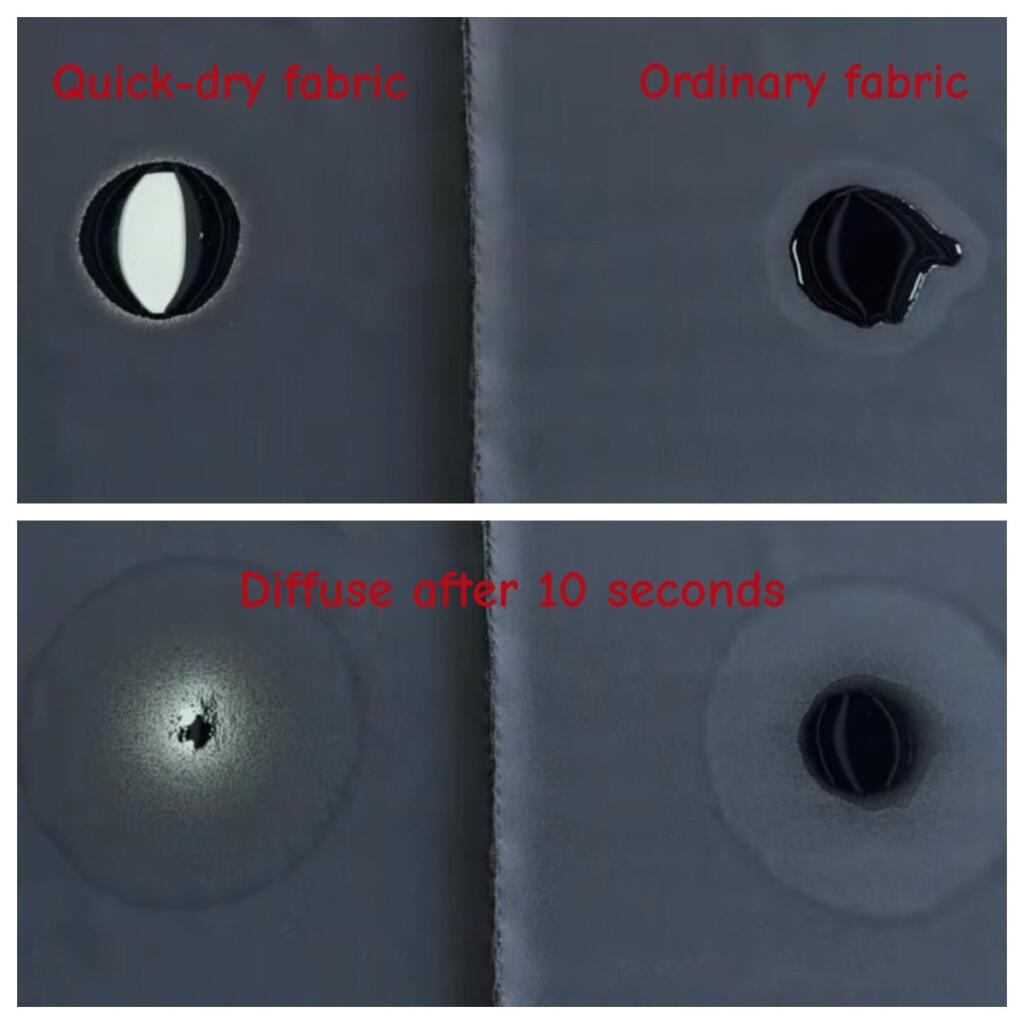
Droplet Diffusion Time Test: Drop standard water droplets on the fabric surface and record the time until the droplets are completely infiltrated without specular reflection. The shorter the time, the faster the instantaneous moisture absorption speed of the moisture-wicking & quick-dry fabric.
Wicking Height Test: Hang the fabric vertically with the bottom end immersed in water. After standing for a specified time, measure the climbing height of water to judge the moisture conduction and diffusion capacity of the moisture-wicking & quick-dry fabric.
Drying Rate Test: Hang the water-saturated fabric for natural air drying and record the time required for complete drying. High-quality moisture-wicking & quick-dry fabrics have a drying speed more than 5 times that of ordinary pure cotton fabrics.
1.3 European Standard (ISO) Testing Methods
In the European market, the detection of moisture-wicking & quick-dry fabric takes ISO international standards as the core basis, which are universal specifications for EU clothing access and outdoor functional fabric quality inspection. Different from static index detection of Chinese standards, ISO standards focus on simulating real dynamic sweating scenarios of human bodies and assessing the long-term wet and heat comfort stability of moisture-wicking & quick-dry fabric.
The mainstream testing combination adopts ISO 11092 (textile thermal and wet comfort performance test) matched with ISO 9237 (fabric air permeability test), focusing on the overall wet and heat conduction and dynamic moisture permeability of moisture-wicking & quick-dry fabrics, which is more in line with European outdoor clothing quality inspection requirements.
Testing Core: Professional instruments are used to simulate continuous sweating and heat dissipation of human bodies to detect core data such as water vapor transmission rate, liquid water conduction rate and residual moisture content of moisture-wicking & quick-dry fabrics. It focuses on the long-term dry and comfortable performance of fabrics in wearing state, rather than single instantaneous moisture absorption effect.
Judgment Characteristics: European standards have no fixed grade classification, and product access qualification is judged by measured data. They impose strict requirements on the performance stability of moisture-wicking & quick-dry fabrics after washing, requiring negligible fluctuation of wet resistance and water vapor transmission rate after multiple washes, which is highly suitable for outdoor functional clothing with frequent washing.
1.4 American Standard (ASTM) Testing Methods
The American market uniformly adopts ASTM D4944 for the detection of moisture-wicking & quick-dry fabric, which is the core quality inspection basis for high-end professional sports apparel and outdoor fabrics in North America. The standard is stringent and fits the real high-intensity sports sweating scenarios of moisture-wicking & quick-dry fabric applications.
The testing system is divided into two core modules: the first is basic performance detection, including water absorption rate and wicking height tests to verify the basic moisture absorption and conduction capacity of moisture-wicking & quick-dry fabrics; the second is quantitative quick-drying test. Under constant temperature and wind speed environment, the residual moisture ratio of fabrics at 30min, 60min and 120min after water absorption is recorded to quantify the quick-drying efficiency.
Judgment Characteristics: The threshold of American standards is much higher than that of Chinese civil standards. Qualified functional moisture-wicking & quick-dry fabrics are clearly required to have a residual moisture content ≤ 10% within 120 minutes. Meanwhile, it focuses on assessing the performance retention rate after 20 washes, which can effectively screen low-end moisture-wicking & quick-dry fabrics with adhesive auxiliaries and poor durability, meeting the quality requirements of high-end professional sports apparel.
1.5 Core Differences Among Chinese, European and American Standards
The three major standards have obvious differences in assessment focus and applicable scenarios. Chinese standards focus on four basic static indicators, suitable for the quality inspection of domestic civil moisture-wicking & quick-dry fabric. European standards emphasize dynamic wet and heat comfort, targeting outdoor leisure functional fabrics. American standards focus on residual drying moisture rate and washing durability, applicable to high-end professional sports moisture-wicking & quick-dry fabric. Exporters shall select corresponding testing standards according to target markets for moisture-wicking & quick-dry fabric products.
2. Industry Application Value and Applicable Scenarios of Moisture-Wicking & Quick-Dry Fabrics
2.1 Core Reasons for Wide Popularization in the Garment Industry
Pure cotton fabrics are skin-friendly and comfortable, but they have prominent functional defects. After absorbing water, cotton fibers expand and internal pores close, resulting in a large amount of water stored inside the fabric which is difficult to volatilize quickly.
After sweating, cotton garments become heavy and clingy with sharply reduced air permeability. Wet cotton fabrics fit closely to the skin, easily breeding bacteria and causing peculiar odor. In autumn and winter, wearing wet cotton clothes may cause colds. In addition, cotton fabrics are prone to deformation, wrinkling and hardening after washing with poor durability.
Moisture-wicking & quick-dry fabrics precisely solve the above pain points. They maintain continuous air permeability and dryness to avoid stuffiness and stickiness. The excellent quick-drying performance inhibits bacterial growth and odor residue, improving wearing hygiene. Meanwhile, moisture-wicking & quick-dry fabric are wrinkle-resistant, wear-resistant and non-deformable, adapting to frequent wearing and washing, thus being widely popularized in the garment industry.
2.2 Main Application Scenarios
The rise of moisture-wicking & quick-dry fabrics is essentially a product of consumer demand upgrading from simple covering and warmth retention to thermal and humidity comfort management. Its core value is to stabilize the dryness of the skin microclimate and eliminate cold, sticky and frictional discomfort caused by sweat retention.
The specific application scenarios are divided into three categories:
- Professional Sports and High-Intensity Training
In high-energy-consuming sports such as marathon, basketball, football and fitness, the human sweating volume can reach 1-2 liters per hour in a short time. The water content of traditional cotton garments after moisture absorption can reach 20%~30% of their own weight with extremely slow evaporation, forming a “wet and cold” effect in the later stage of sports and accelerating physical energy loss. Therefore, moisture-wicking & quick-dry fabrics are essential standard materials for such scenarios.
- Outdoor Adventure and Commuting & Business Travel
Outdoor hiking and mountaineering are faced with changeable weather and inconvenient replacement of clothes. Underwear and T-shirts made of moisture-wicking & quick-dry fabrics can be washed at night and completely dried the next morning, greatly improving the turnover efficiency of outdoor equipment. In urban commuting and business travel scenarios, the quick-drying performance of moisture-wicking & quick-dry fabrics reduces the dependence on frequent laundry, especially suitable for inner wear in hot and humid summer and rainy seasons.
- Special Occupational Clothing and Functional Underwear
Military and police training uniforms, fire-fighting inner clothes and medical protective clothing liners have higher requirements for humidity and heat management. This is not only a matter of comfort, but also related to skin health (reducing the risk of rash and fungal infection) and concentration maintenance during long-term operation. In addition, moisture-wicking & quick-dry fabrics have been gradually applied to maternity clothes, infant clothing and special underwear for menopausal hot flash crowds as a core functional selling point.
3. Two Implementation Technologies of Moisture-Wicking & Quick-Dry Fabrics and Their Advantages & Disadvantages
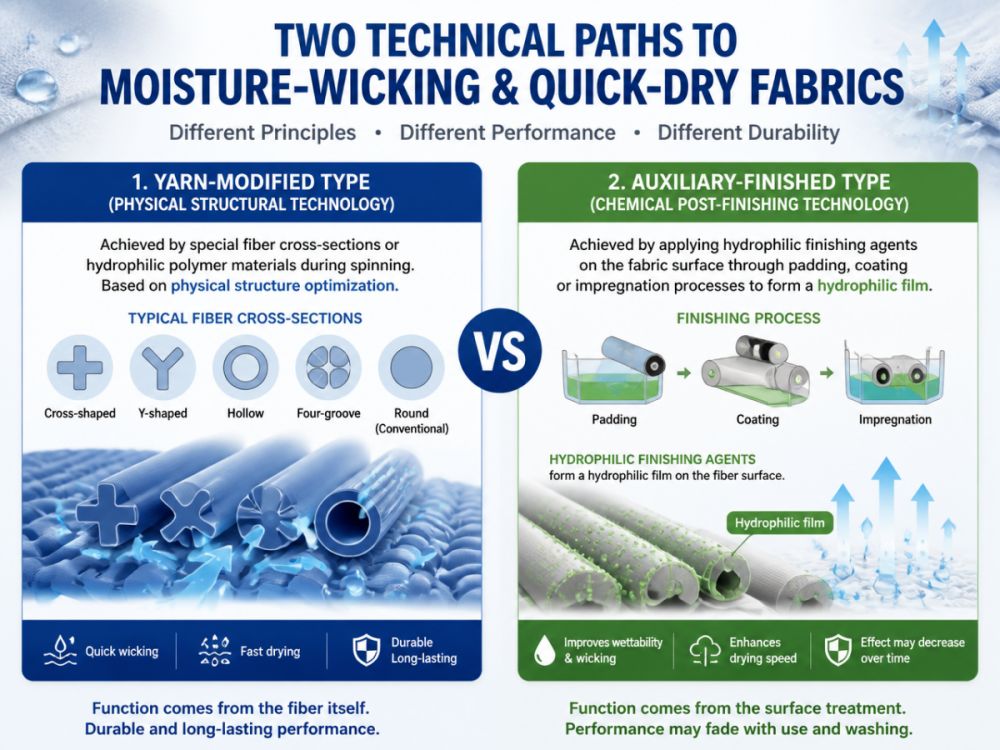
There are two completely different technical paths to realize the moisture-wicking & quick-dry function of fabrics: yarn-modified type (physical structural) and auxiliary-finished type (chemical). The two methods have essential differences in principle, performance and durability, which determine the quality level of finished moisture-wicking & quick-dry fabric products.
3.1 Yarn-Modified Type (Physical Structural Technology)
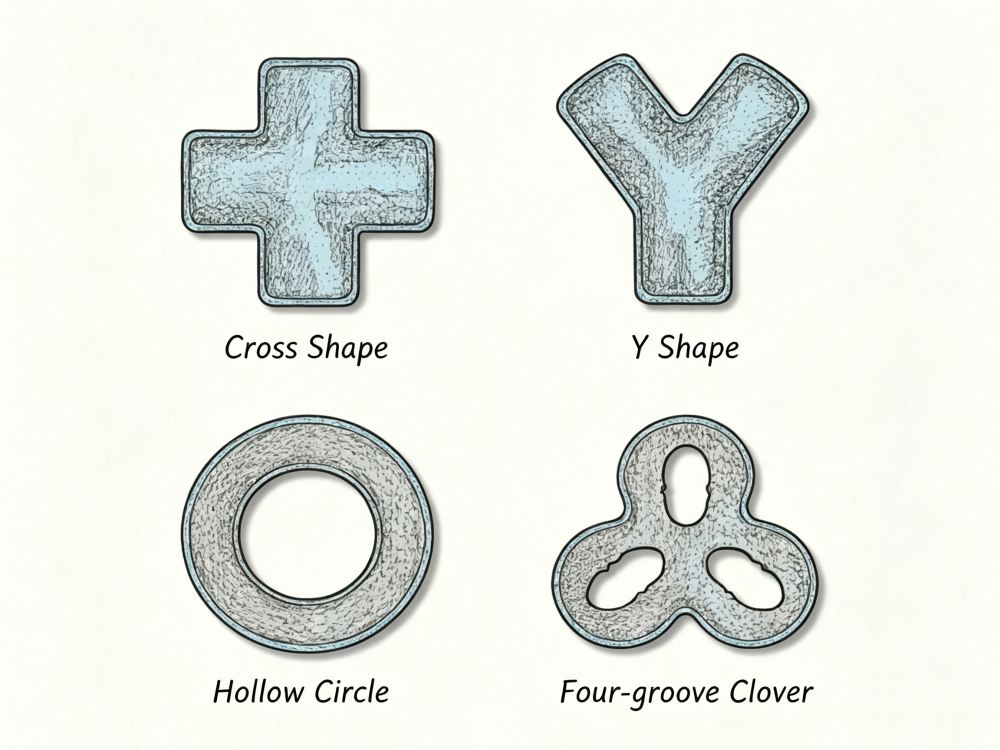
This technology adopts profiled cross-section fibers (cross-shaped, Y-shaped, hollow, four-groove, etc.) or hydrophilic polymer materials for direct spinning and forming. Its functional principle is based on physical structure optimization:
- Moisture Absorption: Capture water molecules through hydrophilic groups (such as -OH, -COOH) on the fiber molecular chain;
- Quick Drying: Utilize the capillary effect formed by fiber surface grooves or hollow structures to accelerate water diffusion and expand the evaporation area.
Advantages: The moisture-wicking & quick-dry function is permanent and non-degradable with excellent washing resistance. The performance retention rate remains above 90% after 50~100 washes. The fabric has soft natural hand feel without chemical residue risks, which is safe and skin-friendly, making it the preferred structure for high-qualitymoisture-wicking & quick-dry fabrics.
Disadvantages: It has extremely high requirements for spinning equipment and technology with significantly higher costs than ordinary fibers. Profiled cross-section fibers may have slight sacrifices in strength and wear resistance.
3.2 Auxiliary-Finished Type (Chemical Post-Finishing Technology)
Based on conventional synthetic fibers (ordinary polyester, nylon) or natural fiber fabrics, this technology attaches hydrophilic finishing agents (polyester ether, polyamide hydrophilic agents, etc.) to the fiber surface through padding, coating or impregnation processes to form a hydrophilic film and endow the fabric with moisture-absorbing and quick-drying properties.
Advantages: The process is mature with strong equipment universality and short development cycle. The production cost is low, which can quickly respond to market demand for mass production of moisture-wicking & quick-dry fabric.
Disadvantages: Poor durability. The moisture-wicking & quick-dry function of conventional hydrophilic auxiliaries decays significantly after 10~20 washes. Low-cost auxiliaries may cause hard hand feel and reduced air permeability of fabrics, and may have dissolution or sensitization risks, especially for sensitive skin, limiting the grade of such moisture-wicking & quick-dry fabrics.
3.3 Overall Performance Comparison
In terms of industry trends, high-end sports and outdoor brands are accelerating the transformation to yarn-modified moisture-wicking & quick-dry fabric to avoid consumer complaints about functional failure after washing. Fast fashion and disposable functional clothing still largely adopt auxiliary-finished moisture-wicking & quick-dry fabric to control costs.
4. Usage Notes and Fiber Performance Comparison of Moisture-Wicking & Quick-Dry Fabrics
4.1 Core Note: Conflict and Balance Between Moisture-Absorbing Quick-Drying and Waterproof Functions
Moisture absorption & quick drying and waterproof & water-repellent are naturally opposite performances, which cannot achieve extreme effects simultaneously, so reasonable trade-offs are required in selection and use.
- Moisture-absorbing and quick-drying fabrics require fiber surfaces with hydrophilic groups and open pore channels to capture and transfer sweat efficiently.
- Waterproof and water-repellent fabrics require high surface tension and closed structures to prevent liquid water from wetting and penetrating.
The two functions are mutually exclusive in essence. If a single fabric is required to have both moisture-wicking & quick-dry and waterproof properties, only compromised solutions can be adopted with inevitable performance losses:
- Zonal Splicing: Adopt moisture-wicking & quick-dry fabrics for sweat-prone areas (back, armpits) and waterproof fabrics for exposed areas (shoulders, cuffs);
- Laminated Composite: Compound outer waterproof and moisture-permeable film (ePTFE, etc.) with inner moisture-absorbing and quick-drying knitted layer, which will reduce the overall moisture permeability by 20%~40% and greatly increase cost;
- DWR Finishing: Apply durable water-repellent treatment on moisture-wicking & quick-dry fabrics, which will partially block fiber surface grooves, weaken capillary effect and reduce quick-drying performance.
Conclusion: There is no ideal fabric that is both moisture-wickwicking & & quick-dry and waterproof. Consumers should prioritize the core demand of “sweat drainage” or “rain protection” without pursuing dual extreme performances when selecting moisture-wicking & quick-dry fabrics.
4.2 Comprehensive Performance Comparison of Mainstream Fibers for Moisture-Wicking & Quick-Dry Fabrics
Different fiber materials have great differences in structural characteristics, resulting in uneven performance in moisture wicking, quick drying, skin friendliness and washing resistance. Their applicable scenarios vary correspondingly, as shown in the table below, which provides a clear reference for the selection of qualified moisture-wicking & quick-dry fabrics.
| Fiber Material | Moisture-Absorbing & Quick-Drying Performance | Core Advantages | Obvious Defects | Applicable Scenarios |
| Profiled Yarn Polyester | ⭐⭐⭐⭐⭐ Optimal, fast moisture conduction, thorough drying, permanent and stable performance | Excellent washing resistance, non-deformable, colorfast, high air permeability | Original fabric has ordinary skin friendliness, requiring process optimization | Professional sports apparel, high-end outdoor clothing, high-intensity sweating scenarios |
| Nylon Quick-Drying Fiber | ⭐⭐⭐⭐ Excellent, uniform moisture absorption, stable quick-drying effect | Soft hand feel, good elasticity, wear-resistant, better skin friendliness than polyester | Poor high temperature resistance, easy fiber damage under strong sunlight and high-temperature drying | Yoga wear, close-fitting quick-drying underwear, elastic sports apparel |
| Pure Cotton Fiber | ⭐⭐ Only moisture-absorbing without quick-drying ability, strong water storage and extremely slow drying | Skin-friendly, soft and non-irritating | Heavy and sticky after water absorption, easy deformation, hardening and odor breeding | Static wearing, low-sweat daily scenarios, not suitable for sports |
| Viscose / Modal Fiber | ⭐⭐ Basic moisture absorption, no long-term quick-drying capacity | Extremely soft, skin-friendly, breathable and good drapability | Easy sagging and deformation after water absorption, slow drying, poor washing resistance | Home wear, close-fitting base layers, static comfortable wearing |
| Blended Quick-Drying Fiber | ⭐⭐⭐⭐ Balanced performance, compatible with moisture absorption, quick drying and comfort | Integrates cotton’s skin friendliness and chemical fiber’s quick-drying property with high cost performance | Quick-drying efficiency and washing resistance are slightly lower than pure yarn-modified chemical fiber fabrics | Daily casual clothing, school uniforms, low-intensity activity wear |
- Natural fibers (cotton, linen, wool) have inherent advantages in moisture absorption speed, but their high crystallinity and dense hydrophilic groups will lock water molecules, resulting in innate defects in quick-drying performance.
- Through profiled cross-section design (increasing specific surface area) and copolymer modification (introducing hydrophilic components), synthetic fibers can achieve excellent moisture absorption and evaporation performance simultaneously, being the only stable material for high-grade moisture-wicking & quick-dry fabrics at present.
- Blending cannot always complement advantages. Cotton-polyester blending will drag down the overall water evaporation rate due to the water-locking effect of cotton fibers, resulting in lower quick-drying performance than pure polyester yarn-modified moisture-wicking & quick-dry fabrics.
5. Conclusion
The core value of moisture-wicking & quick-dry fabrics is not simple water absorption, but dynamic regulation of human skin microclimate humidity. Through the complete cycle of moisture conduction, diffusion and evaporation, moisture-wicking & quick-dry fabrics solve the pain points of traditional fabrics such as stuffiness, stickiness, peculiar odor and wet cold feeling, greatly improving wearing comfort and practicality.
From the perspective of consumer selection, two key points should be focused on: distinguishing yarn-modified and auxiliary-finished moisture-wicking & quick-dry fabrics (yarn-modified products are preferred for long-term high-frequency use); recognizing the inherent conflict between moisture-wicking & quick-dry and waterproof functions and making trade-offs according to actual scenarios. From the perspective of industry development, yarn modification, fluorine-free and recyclability are the three major technical trends of moisture-wicking & quick-dry fabrics. With the deepening of consumer market education, brands will transform from concept marketing to data-driven quality upgrading, making the excellent dry comfort of moisture-wicking & quick-dry fabrics more professional and reliable.
6. Official Standard Reference & Citation
All performance testing rules, evaluation thresholds and technical descriptions of moisture-wicking & quick-dry fabrics in this article are strictly based on official released national and international textile standards. All cited specifications are publicly verifiable and traceable via official authoritative websites, ensuring academic accuracy and industrial practicality for thesis, technical reports and enterprise product documents.
6.1 Chinese National Standard (GB/T 21655.1-2023)
Standard Content: Textiles – Evaluation of moisture absorption and quick-drying properties – Part 1: Testing method for single-layer fabrics
Official Inquiry Website: https://openstd.samr.gov.cn/bzgk/gb/index
Citation Note: This official platform provides full public access to Chinese national standards. The four core test indicators (water absorption rate, droplet diffusion time, wicking height, drying rate) involved in this paper are completely consistent with the official standard clauses.
6.2 European ISO Standards (ISO 11092, ISO 9237)
Standard Content: ISO 11092 (Textiles – Physiological effects – Measurement of thermal and water-vapour resistance under steady-state conditions); ISO 9237 (Textiles – Determination of permeability to air)
Official Inquiry Website: https://www.iso.org
Citation Note: The ISO official platform releases authoritative standard introductions, test principles and applicable scope. The article’s description of European standards focusing on dynamic wet-heat comfort and washing stability is fully matched with the official technical framework.
6.3 American ASTM Standard (ASTM D4944)
Standard Content: Standard Test Method for Water Absorption and Drying Rate of Textile Fabrics
Official Inquiry Website: https://www.astm.org
Citation Note: The ASTM official platform publishes the complete test specification of D4944. The core evaluation rules adopted in this paper, including 120-minute residual moisture content ≤10% and 20-time washing durability assessment, are derived from the official standard mandatory requirements.
6.4 Academic Citation Specification
This chapter complies with the international academic electronic document citation specification. All standard sources are open and traceable, supporting thesis review, technical report verification and enterprise product data filing. No non-official or third-party copied data is adopted in the full text.