Fabric shrinkage is the single most common reason a garment that fits perfectly at approval no longer fits after the customer’s first wash. In woven stretch fabrics the cause is rarely the fibre itself — it is the residual stress trapped inside the elastane during spinning, weaving and finishing, plus a handful of finishing shortcuts that release it all at once.
This guide covers where that stress comes from, what shrinkage is actually acceptable (with the standards buyers and mills both quote: AATCC 135, ISO 6330, ISO 5077), the five production stages where shrinkage is won or lost, and two real orders where uncontrolled shrinkage cost 460,000 CNY and 93,000 CNY.
1. Why Woven Stretch Fabric Shrinks After Washing
1.1 The Root Cause Is Stress Inside the Elastane, Not the Fibre
Woven stretch fabrics are built as cotton, nylon or polyester combined with spandex (elastane). During spinning, weaving and every wet process afterwards, the spandex core is stretched and held under tension. Water and heat let that stored tension relax — the yarn springs back towards its natural length, and the fabric moves with it. That is why a fabric can pass inspection in the warehouse and still fail after the customer’s first home launder.
1.2 Relaxation Shrinkage vs Residual Shrinkage: One Wash Is Not a Test
- Relaxation shrinkage — the large one-off change in the first wash, when the tension stored during production is released. This is the number that ruins garments.
- Residual shrinkage — the small continuing movement afterwards, normally under 1% per cycle in a well-finished stretch woven.
Testing a fabric dry and unwashed measures nothing, because the tension is still inside the cloth. This is why the standard test runs three wash-and-dry cycles: the first gives the relaxation figure, the second and third tell you whether the fabric has actually settled. If it is still moving 2% per cycle by the third wash, the finishing line under-compacted it and the problem will keep appearing as customer complaints rather than in the lab.
1.3 Warp and Weft Move Differently — and “Growth” Fails Too
Warp and weft must always be reported separately. Woven fabrics are more balanced than knits (typically 1–3% in both directions for a well-set synthetic woven), but in stretch wovens the weft direction carries the elastane and is usually the direction that moves first, because the fabric is pulled width-wise on the stenter and during finishing.
Buyers also get caught out by negative shrinkage. If the washed dimension is larger than the original, the shrinkage value is negative — the fabric grew. A 2% growth is just as much a failure as a 4% contraction: the skirt hem drops below the knee, the waistband slips off the waist. Case 2 below is exactly this failure.
2. How Much Shrinkage Is Acceptable? Tolerances and Test Standards
“3%” on its own is not a specification. A shrinkage figure only means something when it is written next to the test method, the wash programme, the number of cycles and the drying mode. Use the two tables below to set a tolerance that a mill can actually quote against.
2.1 Typical Shrinkage and Practical Tolerances by Fabric Type
| Fabric type | Typical relaxation shrinkage | Tolerance to write in your spec |
| Polyester woven, heat-set | Under 1% | 2% both directions |
| Nylon 4-way stretch woven (pre-set + compacted) | 1–2% | 3% both directions |
| Polyester/spandex woven, pre-set + compacted | 1–2% | 3% both directions |
| Spandex-free mechanical stretch (T400 / bi-component) | Under 1% | 2% both directions |
| Sanforized cotton woven | Around 1% | 3% both directions |
| Untreated cotton woven | 3–5% | 3% only after sanforizing |
| Cotton/spandex knit | 3–5% | 5% both directions |
For fit-critical programmes — compression wear, technical jackets, tailored skirts — tighten the warp figure to 2%. A warp result of −4.0% with weft at −1.0% is a clear fail: the weft passing does not rescue the warp.
For reference, the standard we hold ourselves to in production on woven stretch qualities is washing shrinkage ≤ ±3% and heat (ironing) shrinkage ≤ ±2%, both directions, with fit-critical qualities quoted tighter on request.
2.2 The Standards Behind the Number
| Standard | What it defines | What it gives you |
| AATCC 135 | Dimensional change after home laundering — the North American market reference | % change per direction after 3 wash/dry cycles |
| AATCC 179 | Spirality (twist) after tumble drying | % twist per direction — the seam-twist check |
| ISO 6330 | Wash programme, temperature, detergent and drying mode (Europe / global) | The conditions your number is only comparable within (e.g. Procedure 4A, 40°C delicate) |
| ISO 5077 | Calculation of dimensional change | How the % is measured and reported |
| ISO 3759 | Specimen preparation and marking | 50 × 50 cm samples with marked reference points |
| ASTM D3107 | Stretch properties of fabrics | Elongation and growth after repeated extension |
| GB/T 8628 / 8629 / 8630 | China’s equivalent washing, drying and dimensional-change methods | Domestic-lab reporting for CN-produced bulk |
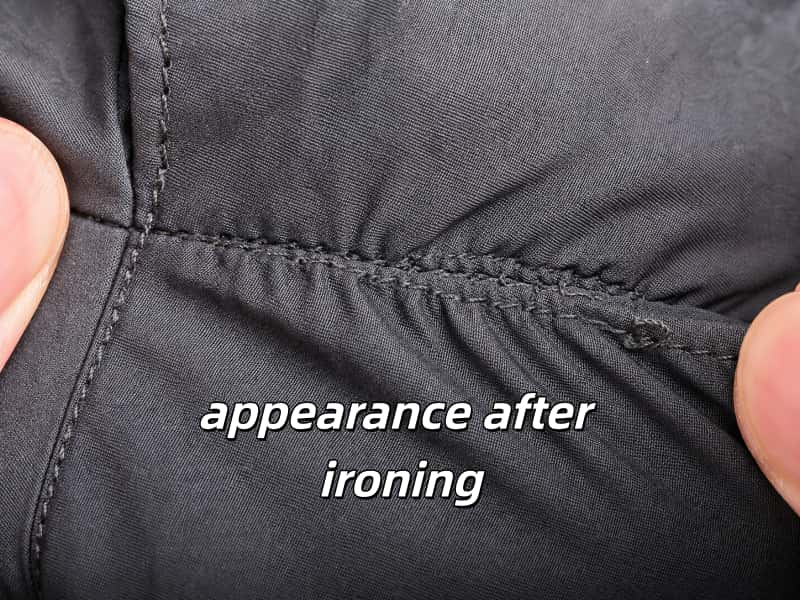
Two rules follow from the table. First, state the procedure next to the percentage — “3% per ISO 6330 Procedure 4A” is a specification, “3%” is not. Second, wash shrinkage and heat/ironing shrinkage are different tests: a fabric that passes washing can still fail ironing, which is why both are quoted separately.
2.3 How to Read a Shrinkage Test Report Without Being Fooled
- Check the method and year — AATCC 135-2018 and ISO 6330:2012 are not interchangeable.
- Check the drying mode — line dry, flat dry and tumble dry give three different answers on the same cloth.
- Check both directions and the sign — warp and weft, shrinkage and growth.
- Check the cycle count — a one-cycle report does not show whether the fabric has settled.
- Check the sample stage — a lab dip or a hand sample is not a bulk report. Re-test on every new dye lot, and after any change of heat-setting temperature, cooling rate or finishing formula.
3. The Five Production Stages That Decide Your Shrinkage Rate
Shrinkage cannot be corrected at the end of the line. It is controlled in segments, from yarn selection to packing. These are the five gates, in the order they need to be right.
3.1 Stage 1 — Yarn Selection and Weaving
- Pre-set the spandex yarn beforehand to eliminate spinning stress, and select low-shrinkage, dimensionally stable spandex types rather than the cheapest gauge on the market.
- Use DTY fully-covered spandex yarns. Exposed spandex leads to uneven tension and unpredictable shrinkage, especially in the weft after dyeing.
- Hold warp and weft loom tensions constant, so tightness does not vary from selvedge to centre. For the yarn side of selection, see our nylon 4-way stretch fabric and polyester 4-way stretch fabric range specifications.
- Let the greige fabric relax in a loose roll for more than 24 hours after weaving so weaving stress releases naturally. Do not send it straight into pre-treatment.
3.2 Stage 2 — Pre-treatment and Pre-setting (The Critical Step)
- Pre-setting temperature: nylon/spandex 210–220°C; polyester/spandex 200–210°C.
- Medium-slow running speed so width and structure are fully fixed and the spandex stress is locked in its relaxed state.
- Cold pad batch (CPB) desizing and open-width scouring. Never rope-form scouring in a jet — rope agitation creates latent shrinkage that only shows up after the customer washes the garment.
- Reserve allowance instead of stretching. Pre-set width should be 5–10 cm wider than the final finished width, and pre-set weight should be above the final target (for a 100 g/m² finish, pre-set at about 105 g/m²). The reserve is what the fabric gives back during compacting instead of during the customer’s wash.
3.3 Stage 3 — Dyeing
- Select room-temperature or compatible dyes, and control heating and cooling rates strictly — slow heating avoids thermal shock to the elastane.
- Let the fabric come off the machine in open width and cool naturally in a loose pile. Avoid forceful stretching or widening while it is still hot, which re-introduces the stress you just removed.
3.4 Stage 4 — Final Setting and Pre-shrinking (Compacting)
- Final setting temperature: nylon/spandex 150–160°C; polyester/spandex 140–150°C. This range is lower than conventional industry practice, and it is deliberate — see why high-temperature final setting damages colourfastness on spandex core-spun fabrics.
- Set the final width to the garment’s required allowance. Do not over-stretch the fabric to reach the width target — over-stretching is the number one cause of failed heat shrinkage and washing shrinkage.
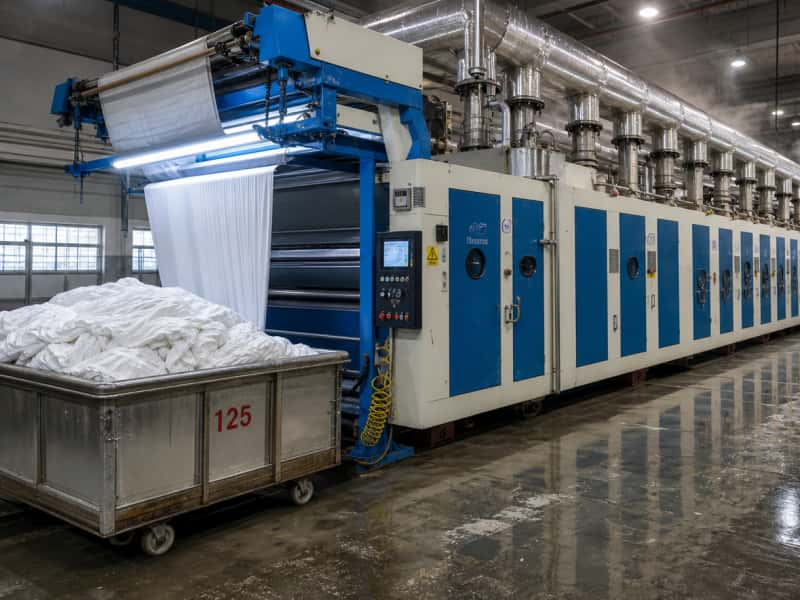
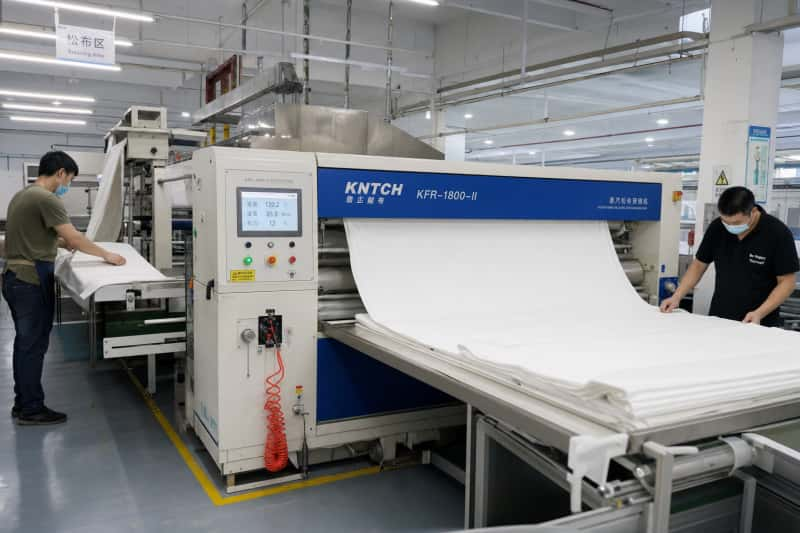
- Always run steam pre-shrinking (compacting). The core equipment is a high-temperature Teflon mesh or slat conveyor that supports the fabric without tension, an enclosed steam box steaming downwards into the cloth, and a hot-air drying duct. Using overfeed, the fabric is allowed to shrink naturally at source, which is what removes the remaining washing shrinkage.
3.5 Stage 5 — Storage and Packing Before Shipment
- Let finished fabric rest at room temperature for 6–12 hours before rolling and packing.
- Never store in hot, airless conditions. High-temperature storage causes slow natural shrinkage that shows up as an out-of-tolerance delivery at the garment factory, weeks after the fabric left the mill.
4. Five Post-Finishing Traps That Cause Surprise Shrinkage
Most “impossible” shrinkage claims trace back to one of these five finishing decisions. None of them shows up in a standard inspection report — they only appear after washing.
| Trap | What happens | How to avoid it |
| Brushing / napping without re-setting | The surface structure is broken and compactness drops, so the fabric is guaranteed to shrink after washing | Re-set or compact after any brushing pass, and re-test the finished roll |
| Excessive silicone softener at final setting | The softener acts as a lubricant under heat, letting spandex filaments slip inside the covering yarn — the fabric grows longer with every wash | Cap softener dosage and get hand feel from thorough pre-treatment instead of chemistry |
| Over-stretching to hit the width target | Elastane is stretched beyond recovery and gives back the difference in the customer’s machine | Reserve width at pre-setting (5–10 cm) and set final width to the garment allowance |
| Rope-form scouring in a jet | Rope agitation builds latent shrinkage into the cloth | Cold pad batch desizing and open-width scouring (see specified in the development brief) |
| Hot warehouse storage | Slow natural shrinkage over weeks, invisible at packing | Rest 6–12 hours at room temperature before rolling; store cool |
| Lamination or bonding after finishing | Heat and pressure from the laminating line re-activate the spandex stress the finishing line removed | Laminate before final compacting where possible; see how our in-house lamination line sequences it |
5. Two Real Orders: What Uncontrolled Shrinkage Actually Costs
5.1 Case 1 — The Export Jacket Order That Shrank 5 cm
Background: an export garment trading company bought 23,000 metres of nylon hiking fabric (woven stretch) for a European/US sportswear jacket programme. At acceptance inspection the team checked hand feel and colour — and did not test washing shrinkage.
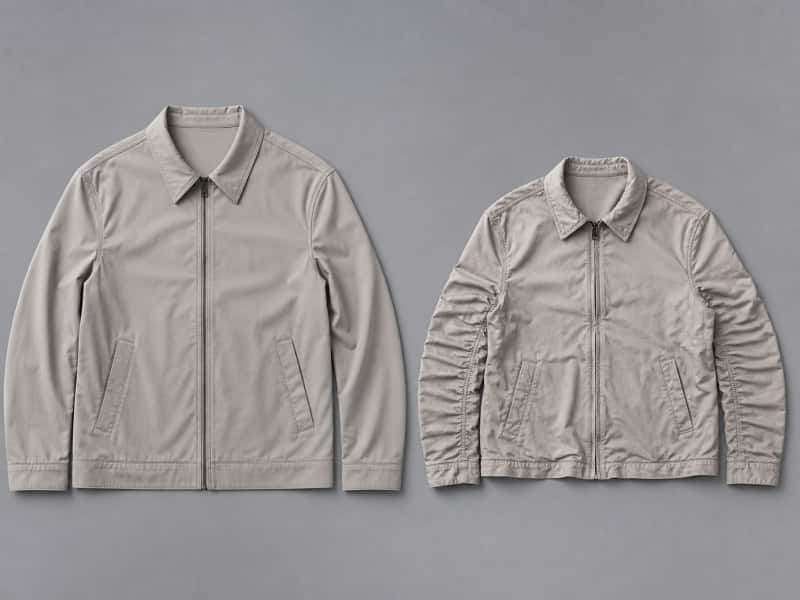
What happened: the fabric was cut and sewn immediately on arrival and shipped to an overseas warehouse. On random inspection, after a gentle warm-water wash, the jacket body had shortened by 5 cm and the chest by 3.5 cm. The whole batch was too tight to sell.
Findings: the shrink rate was only borderline acceptable after final setting — and the fabric was then brushed without being re-set. Brushing breaks the surface structure and reduces compactness, so the fabric inevitably shrank in the wash.
- The entire order was returned for rework.
- The garment company lost over 460,000 CNY in freight and processing fees.
- The mill had to compensate the full fabric payment.
- The foreign brand permanently terminated the relationship with the garment company.
5.2 Case 2 — The Skirt That Grew Longer With Every Wash
Background: a trading company in Keqiao, Shaoxing took an order for 47,000 metres of polyester woven stretch for a fast-fashion brand’s A-line skirt, with a required washing shrinkage of ≤2.5% in both directions.
The mistake: not a stretch specialist, the trader chose a dyeing mill quoting 15% below the market after being assured, “we run tens of thousands of metres of polyester stretch every day, no problems.”
What happened: bulk ran smoothly in 20 days, the garment factory cut and shipped 60,000 skirts into peak season — and customers started posting before/after photos. The hem dropped from above the knee to below it, the waistband slipped from the navel to the hip. An influencer’s comparison video (“wash it once and it’s a midi, twice and it’s a maxi, three times and it’s a nightgown”) passed 170,000 likes in a week.
Root cause: an excessive amount of silicone softener was added in the padding mangle to achieve a soft hand feel. Under high temperature the surplus softener acted as a lubricant, letting the spandex filaments slip inside the polyester covering layer. The mechanical action of washing then pulled the spandex longer, and it could not recover: after three washes, warp shrinkage measured −5.8% (i.e. 5.8% growth) and weft −3.2%.
- The remaining 54,000 skirts were returned to the fabric company.
- After losing the fabric payment, the company paid a further 93,000 CNY in compensation.
- The brand’s flagship style for the season failed, with lasting damage to consumer trust.
Both failures share one lesson: dimensional stability cannot be inspected in, and it cannot be recovered by a care label. The care label in Case 2 said “gentle machine wash” — consumers ignored it and used a regular 40-minute cycle, which is exactly what a buyer should assume will happen.
6. How We Control Shrinkage at Mifu
Shrinkage claims are usually a finishing-line discipline problem rather than a fibre problem. These are the four things we hold on every stretch quality we produce.
- Pre-setting is treated as the foundation, not final setting. For conventional fabrics most mills rely on final setting to fix dimensions. On stretch fabrics that is the wrong gate: we record pre-setting parameters on site and adjust the process during the run, which is why our woven elastic qualities stay inside tolerance rather than “borderline pass”.
- Low-temperature final setting. We finish nylon/spandex at 150–160°C and polyester/spandex at 140–150°C. Most peers assume those temperatures cannot meet heat-shrinkage requirements; in our production they are the range that balances dimension stability with colourfastness at the same time.
- Steam compacting on every stretch quality, never only on the styles that failed by the margin. If a quality is brushed or napped, it is re-set and re-tested afterwards.
- Reserve allowance instead of over-stretching, and a hard dosage cap on silicone softener. If a buyer asks for an exceptionally soft hand feel, we get there through pre-treatment rather than by adding softener, because softener is what lets spandex slip in the wash.
For programmes where shrinkage has been a recurring problem, the most reliable fix is to remove the elastane stress entirely: spandex-free mechanical stretch (T400 and bi-component) holds 1–2% shrinkage with no spandex to relax. If the construction is still open, we can specify the route from scratch through our custom woven fabric development service, including the shrinkage target in the development brief. Stretch recovery is the other half of the same specification — the three processes that set it are covered in elasticity boosting methods for woven stretch fabric.
7. What to Write Into Your Fabric Spec Before Ordering
A shrinkage claim almost always comes down to a sentence that was never written. Before you place bulk, put these points into the specification and into the PO:
- Shrinkage target, warp and weft separately — and state whether growth is permitted. “≤3% warp, ≤3% weft, no growth” leaves no room for argument.
- Test method, procedure, cycles and drying mode — for example “3% max per AATCC 135, 3 cycles, tumble dry low” or “per ISO 6330 Procedure 4A”.
- Heat / ironing shrinkage as a separate line — washing and ironing are different tests and both get quoted by your customer.
- Spirality limit if the garment has a side seam — a 4% skew twists the seam to the front after the first wash.
- Width and GSM with tolerance, pre-wash and post-wash.
- Test report on bulk, per dye lot — not only on the sales sample. A single 0.5% drift after a dye-lot change is enough to shift a graded size.
- Care label wording that matches the test conditions — a label the consumer will ignore is not a control.
- Pattern allowance agreed with your garment factory, so a 2% growth is compensated in the pattern rather than discovered on the shelf.
If you are writing that specification now, our guide to how to write an RFQ for woven stretch fabric turns these points into a one-page enquiry a mill can quote directly — and if you send us the garment, application and care conditions, we will come back with a shrinkage commitment in writing rather than a range.
8. References
- AATCC 135 — Dimensional changes of fabrics after home laundering. aatcc.org
- AATCC 179 — Skewness change after home laundering (spirality). aatcc.org
- ISO 6330 — Textiles: domestic washing and drying procedures for textile testing. iso.org
- ISO 5077 — Textiles: determination of dimensional change in washing and drying. iso.org
- ASTM D3107 — Standard test methods for stretch properties of fabrics woven from stretch yarns. astm.org
- GB/T 8628 / GB/T 8629 / GB/T 8630 — China’s washing, drying and dimensional-change test methods for textiles.