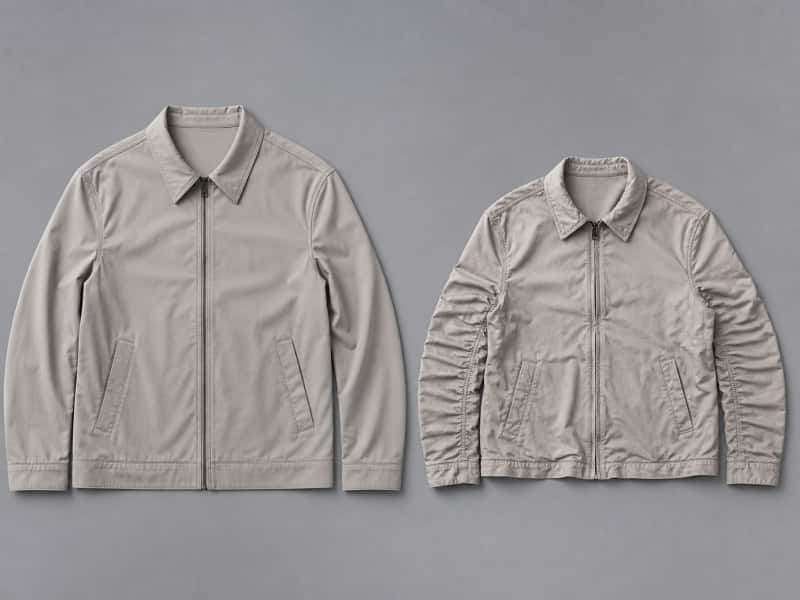
Two suppliers quote you the same thing: 100D four-way stretch, same yarn count, same weight, the same composition on paper. The sample from one stretches freely across the body. The sample from the other feels tight, fights the wearer, and bags at the knee after a week. Same specification sheet, completely different fabric.
That gap is not luck, and it is not a matter of taste. It is decided in three places: how the spandex is matched to the base yarn, how the cloth is woven, and how it is heat-set during dyeing. Get all three right and elasticity is built into the structure of the cloth. Rush any one of them and the finished fabric loses stretch that no amount of finishing can put back.
This guide breaks down what actually determines how stretchy a woven fabric is, how to tell a genuinely elastic quality from a cost-reduced one, and how to verify it before you place a bulk order.
1. What Actually Decides How Stretchy a Woven Fabric Is
Woven stretch fabric gets its elasticity from spandex core-spun into the base yarn. The spandex is not a coating and not a finish — it is a structural component of the yarn itself, which means it can be specified well or specified badly, and the difference shows up in the finished cloth rather than on the invoice.
Three variables decide how much of that potential the finished fabric actually keeps.
1.1 The Three Variables That Set Final Elasticity
| Production stage | What is decided here | What commonly goes wrong | Effect on the finished fabric |
| Raw material selection | Spandex denier, base yarn, and the ratio between them | Fine-denier spandex substituted in to cut cost | Spandex cannot carry the base yarn — lower stretch, coarser hand |
| Weaving | Warp and weft density, weave structure, loom tension | Density raised, grey fabric force-stretched on the loom | Yarn has no room to open — tight cloth, reduced stretch |
| Dyeing and finishing | Setting temperature, machine speed, overfeed, relaxation | High temperature at speed; over-stretching to gain output length | Spandex aged or permanently pulled — elasticity reduced or lost |
The three stages run in series, not in parallel: a mistake in any one of them caps the result of the other two. Correctly matched spandex in correctly woven cloth can still be ruined by fifteen minutes of careless setting. That is the failure buyers notice most often, because it does not show up in the sample — it shows up after the first wash.

1.2 Stretch, Growth and Recovery Are Three Different Numbers
Buyers usually say “elasticity” as if it were one property. The laboratory measures three, and they answer three different questions.
- Stretch (elongation) — how far the fabric extends under a defined load. This is the “how stretchy is it” number, and it decides whether a garment follows the body or fights it.
- Growth — how much of that extension the fabric keeps after the load is removed. This is the “will it bag out” number, and it is where cheap goods fail first.
- Recovery — the share of the extension that comes back, reported as a percentage. This is the “will it still hold its shape next season” number.
The three travel together on a test report but they are not interchangeable, and one can be strong while another is weak. A fabric that stretches 60% and grows 8% will look excellent in a fitting room and disappoint every consumer who wears it for a month — the garment strains to get on, then relaxes where it should hold. When you write a specification, put a floor under stretch and a ceiling over growth. The second number is the one that protects the finished garment.
Elasticity does not have to come from spandex at all. Mechanical stretch builds it out of textured yarn and weave geometry rather than an elastomeric core, which is a different route with different trade-offs — see T400 fabric versus spandex for how the two compare.
1.3 Why “Elastic Fabric” on a Quote Sheet Tells You Nothing
A market name like “100D four-way stretch” or “150D spandex twill” describes yarn count and stretch direction. It says nothing about how elastic the cloth actually is. The same market name covers low-elasticity, medium-elasticity and high-elasticity qualities that differ only in raw material formula, weaving parameters and finishing control. Two rolls can carry identical labels and sit ten percentage points apart in real stretch.
That is why the useful question is never “what is your price for 100D four-way stretch”, but “what stretch and growth data do you hold for this quality, on which test method”. A supplier who can answer the second question is working from a specification. A supplier who can only answer the first is quoting a name.
2. Factor One — Spandex and Base Yarn: The Ratio You Cannot Cheap Out On
Elasticity starts with whether the spandex is strong enough to pull the base yarn back. Get that relationship wrong and no downstream process can repair it.
2.1 Matching Spandex Denier to the Base Yarn
Spandex is bought in deniers — 20D, 40D and 70D are the common specifications on the open market — and the denier has to be sized to the load it will carry. For a 150D polyester DTY base yarn, the standard match is 40D spandex. Put 20D fine-denier spandex underneath the same 150D yarn to save money and the elastic core simply does not have the bearing capacity to drive the thicker yarn back into place. The fabric feels flat and stretches poorly, and it does so from the first meter, because the mismatch sits in the yarn itself and cannot be corrected later.
This is a sizing decision, not a quality preference. A thicker base yarn carries more load and needs a stronger elastic core to return it; a lighter base yarn is over-sprung by a heavy spandex and loses the soft hand the end use needs. The same logic runs through nylon qualities, where the base yarn is finer and the hand-feel target softer — nylon 4-way stretch fabric is normally built on a lighter spandex than an equivalent polyester twill, and matching it correctly is what keeps the cloth both elastic and supple.
2.2 The 91 / 9 Formula and the 96 / 4 Substitution
This is the most common way a stretch quality is quietly downgraded, and it happens at the yarn specification rather than in the loom or the dyehouse — so it survives almost every inspection until the fabric is worn.
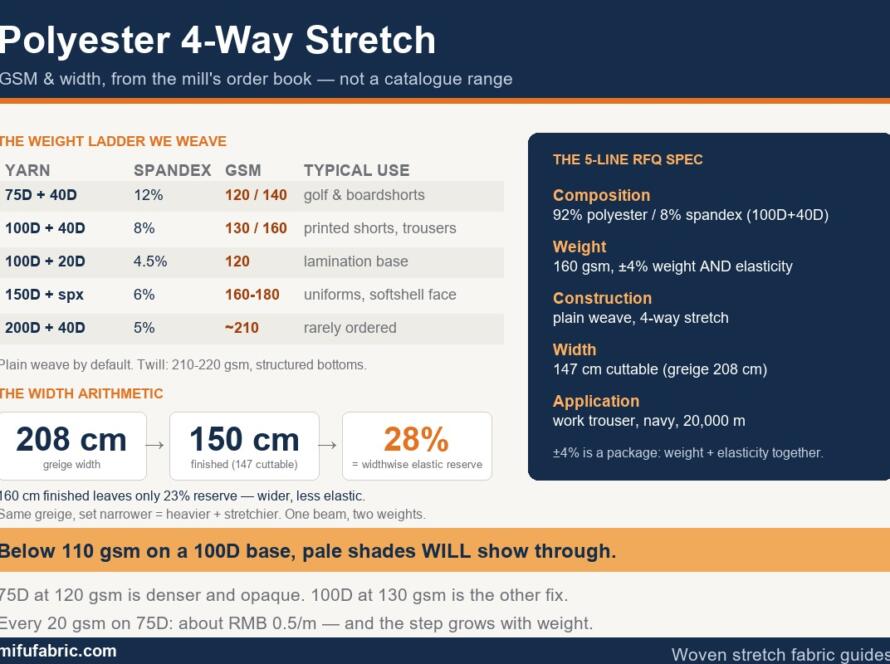
The standard formula for a 100D four-way stretch fabric is 100D polyester DTY wrapped with 40D spandex, giving a composition of roughly 91% polyester and 9% spandex. A cost-reduced version of the same market name replaces the base yarn with 110D coarse polyester and the spandex with 20D fine denier, moving the composition to 96% polyester and 4% spandex. On the quote sheet both are “100D four-way stretch”. In the hand they are not the same product.
| Specification item | Standard formula | Cost-reduced formula |
| Base yarn | 100D polyester DTY | 110D coarse polyester |
| Spandex | 40D | 20D fine denier |
| Composition | 91% polyester / 9% spandex | 96% polyester / 4% spandex |
| Finished result | Full stretch, soft even hand | Lower stretch, coarser and stiffer hand |
The two changes work against each other. There is more rigid fiber to pull and less elastic fiber to pull it with, so the fabric meets the yarn count on the label and misses the performance the buyer thought they were ordering. The same substitution appears in polyester 4-way stretch fabric programmes whenever a price is negotiated down without the specification being rewritten alongside it. A lower price is legitimate; a lower price with the same market name is where buyers get caught.
2.3 Why Spandex Percentage Alone Is Not a Specification
The industry rule of thumb is that genuine four-way stretch needs roughly 8% spandex or more, and that below that figure you are usually buying two-way stretch under a four-way label. That is a useful floor, but it is only a floor. Two fabrics can carry the same spandex percentage and perform very differently, because the percentage says nothing about which spandex was used, how thick the base yarn is, how densely the cloth is woven, or how it was set.
The practical consequence for a buyer is that spandex content cannot be used as a proxy for elasticity. Two 9% spandex qualities are only comparable through their stretch and growth data measured on the same test method — everything else is an assumption.
3. Factor Two — Weave Structure and Density: Where Stretch Is Won or Lost
Even with identical yarn and identical spandex content, two fabrics woven from the same beam can end up with different stretch, because the construction of the cloth decides how much the yarn is allowed to move.
3.1 Density: 90 Ends per Inch Against 115 Ends per Inch
Density is the most direct lever available. At the same yarn count and the same spandex content, the lower-density, lighter fabric stretches more; the higher-density fabric is tighter and stretches less. Within one family of 100D four-way stretch qualities, a construction at 90 ends per inch has noticeably more give than the same yarn woven at 115 ends per inch.
This is a deliberate trade rather than an accident. Denser cloth gives a firmer, more paper-like hand and better opacity, and it holds its shape in a structured garment. It buys those properties at the cost of stretch. A buyer specifying opacity for a light-coloured style is asking for density, and should know they are paying for it in elasticity — the two cannot both be maximised in the same cloth.
3.2 Structure Ranking: Twill, Mini Jacquard, Satin, Plain Weave
Structure matters as much as density, because it sets how much space exists between interlacements for the yarn to open into. At equal yarn count, spandex content and density, woven structures rank like this:
| Weave structure | Interlacing space | Stretch potential |
| Twill | Widest gaps between interlacements | Highest |
| Mini jacquard | Moderate, opens between the floats | High |
| Satin | Long floats but a tight face | Moderate |
| Plain weave | Most compact, minimum space | Lowest |
The reason is mechanical. Plain weave interlaces at every pick, so the structure is compact and there is almost nowhere for the yarn to contract into when the cloth relaxes. Twill interlaces less often, leaving larger gaps that let the spandex draw the yarn back after extension. It is why two qualities with the same yarn and the same spandex content can feel a generation apart in the hand, and why the structure has to be part of the conversation when a stretch target is specified.
3.3 Low-Tension Weaving: Giving the Yarn Room to Move
How the loom is run matters as much as what it weaves. Running at reduced tension throughout, and refusing to force-stretch the grey fabric during handling, keeps the yarn relaxed and preserves the physical space the spandex needs in order to extend. Force the grey goods and the filaments lock into a stretched position before finishing has even started; the fabric then behaves as though part of its stretch was already spent in the mill.
When a new construction is developed for a specific stretch target, the tension settings belong in the specification from the first sample. That is the difference between developing a quality around the performance you need and picking the closest item out of a catalogue — the process behind custom woven fabric development.
4. Factor Three — Heat Setting: The Step That Decides Whether Stretch Survives
Heat setting is where a good quality can be lost, and it is invisible on a sample. The cloth leaves the dyehouse looking correct and behaves correctly for exactly one wash.
4.1 What Over-Temperature Does to Spandex
Spandex is heat-sensitive, and setting is the one process where that sensitivity is decisive. Set it too hot and the fiber ages and deactivates — a permanent loss of elasticity. The fabric will not stretch as far, and whatever stretch survives decays quickly through wear and laundering. Set it too cool and the cloth never stabilises, so washing and ironing shrinkage fall outside tolerance and the garment is a dimensional risk rather than an elastic one.
The working window between those two failures is narrower than most setting ranges, which is why throughput pressure is dangerous. Running hot and fast to gain machine time is a direct transfer of value from the fabric to the dyehouse schedule, and the buyer is the one who pays for it.
4.2 Over-Stretching for Length: 62 M and 75 M From the Same Greige
The second failure is quieter than heat damage. A fabric can be stretched and widened during setting to increase the finished length it yields from a given piece of greige. In normal running, 100 meters of greige yields around 62 meters of finished fabric on our qualities. Push the setting line to over-stretch and the same 100 meters will yield 75 meters.
The extra length is not free. The spandex is held stretched through the setting process and stays partly stretched in the finished cloth, so the fabric arrives with less stretch available and returns less of what it uses. The buyer receives more meters of a weaker fabric, at a price that looks competitive per meter and is worse per garment. It is the single most common reason two rolls with the same label behave differently after washing.
4.3 Overfeeding and Steam Pre-Shrinking: Releasing the Stretch
The opposite technique is the correct one. Overfeeding lets the cloth contract naturally as it passes through the stenter instead of being held out to width, and a steam felt pre-shrinking pass before delivery relaxes the structure further. Both release the elasticity already built into the yarn rather than consuming it. A relaxed fabric carries more usable stretch into the finished garment than one that was held out tight, which is why the finishing step is where a well-built quality either arrives intact or does not.

4.4 What We Do Differently in Production
We build elasticity into the cloth at the yarn and the loom, then protect it in the dyehouse rather than trying to engineer it back at the end. In production that comes down to four things:
- Pre-setting as the governing step. Pre-setting parameters are recorded for every batch, and adjustments are made from those records rather than from a fixed recipe that assumes every greige behaves the same way.
- Low-temperature final setting. We finish at the low end of the spandex-safe window — 150–160°C on the final setting pass — instead of running hot for speed. Running cool only works if the pre-setting has already done the dimensional work, which is why the two steps are controlled together.
- Width and weight reserve instead of over-stretching. We hold the reserved width and weight allowance through finishing and accept the lower finished yield, because the alternative is shipping meters that have already spent their elastic potential.
- Overfeed and steam pre-shrinking before delivery, so the fabric reaches the customer relaxed instead of relaxing in the customer’s washing machine.
The same temperature discipline that protects spandex also protects colour, because setting and dyeing temperatures trade off against each other — the mechanism is covered in our note on colourfastness in spandex fabrics. Controlling one without the other is how a fabric ends up elastic but off-shade, or on-shade and weak.
5. How to Check Fabric Elasticity Before You Place a Bulk Order
You do not need a laboratory to catch most of the problems above, and a laboratory report will not tell you everything that matters to your garment. Two checks — one on the desk with a ruler, one on the supplier’s test report — will settle most sourcing decisions.
5.1 The 4-Inch Hand Test You Can Run in Your Own Office
This is a two-minute check on any swatch, and it separates a fabric with real stretch from one that has already been stretched once by someone else.
- Lay the swatch flat and relaxed. Do not pull it taut first — a pre-tensioned swatch reads high on stretch and hides the problem.
- Mark two points exactly 4 inches (10 cm) apart across the width.
- Pull at the marks until you feel firm resistance — the natural limit, not the point where the cloth distorts.
- Measure and calculate: (stretched length − 4) ÷ 4. A swatch that reaches 6 inches is stretching 50%.
- Repeat along the length. A fabric reading 60% across and 10% along is behaving as two-way stretch, whatever the label claims.
- Now the second half of the test: hold at the stretched position for 10 seconds, release, and measure immediately. If the marks read 4.1 inches or more, the fabric has grown by more than 2% and has failed the check.
Waving or buckling in the swatch while it is stretched is a separate red flag: it usually means the spandex has already been damaged. Reject the lot on that result rather than negotiating on price.
5.2 Test Standards Worth Asking Your Supplier For
| Standard | Applies to | What it reports |
| ASTM D3107 | Woven fabrics made wholly or partly from stretch yarns, with high stretch above roughly 12% | Fabric stretch, growth and recovery; 250 mm gauge, 1.35 kg or 1.8 kg load, readings at 10 seconds and 30 minutes |
| ASTM D4964 | Highly elastic woven and knit fabrics, above roughly 20% elongation | Elongation and modulus at defined extension levels |
| ASTM D2594 | Knitted fabrics with low power stretch | Fabric stretch and growth by the loop method |
| ISO 20932-1 | The international equivalent for woven stretch | Elasticity by strip test — the figure European buyers quote |
| BS EN 14704-1 | Woven and knitted fabrics; supersedes BS 4952 | Extension and residual extension, including after ageing |
Ask for the standard number, not just the result. A stretch figure without a method cannot be compared to anything, and specimens also need conditioning in a standard atmosphere (21°C, 65% relative humidity) before testing — a figure produced without that conditioning is not comparable to one produced with it. Note too that ASTM D3107 is not recommended for commercial acceptance testing because inter-laboratory precision is poor. It is a comparison tool: test your approved sample and the bulk lot on the same method, and compare them against each other rather than against an absolute target.
5.3 How to Read a Stretch Test Report
- Check both directions separately. Warp and weft figures are not interchangeable, and some qualities are elastic in one direction only.
- Check the load. 1.35 kg and 1.8 kg give different numbers on the same cloth; a stretch figure means nothing without the load it was measured at.
- Check the reading times. Stretch is read at 10 seconds and 30 minutes, and growth over a series of intervals. A single number hides which point it came from.
- Check the cycle count. Recovery after 5 cycles says very little; recovery after 25 or 50 cycles is what predicts a garment’s second season.
- Check the sample stage. A lab dip or an office swatch is not a bulk report. Re-test on every new dye lot, and after any change in setting temperature, cooling rate or finishing formula.
6. What Better Elasticity Is Worth in the Finished Garment
Elasticity is not a technicality that only the mill cares about. It is the difference between a garment that gets worn and one that gets returned, and it shows up at four points in the supply chain.
6.1 Free Movement in Wear and Fewer Fit Complaints
A genuinely elastic stretch woven has enough give in both directions that reaching, bending and squatting do not pull against the body. Cloth that is tight on the wearer restricts movement, and slim-fit styles built on it bind and bulge in wear — the complaint that reaches the brand is always about the fit, never about the fabric specification. Building the garment on properly elastic cloth, such as the qualities listed under nylon spandex fabric, removes the problem before the pattern is cut.
6.2 Stable Dimensions and Controllable Shrinkage
Elasticity and dimensional stability are engineered together, because a fabric that stretches well but relaxes unpredictably is unusable on a production line. Dimensional control comes from the setting and pre-shrinking steps described above, and the practical outcome is washing and ironing shrinkage held within ±2% under our production standard. The mechanism behind that figure, and the tolerances worth writing into a specification, are set out in woven stretch fabric shrinkage.
6.3 Lower Cutting and Sewing Loss
Consistent elasticity across the roll makes fabric predictable under the needle. Even, stable surface tension gives a flat seam without puckering or yarn deviation, so sewing runs at speed without operator correction. Unstable elasticity does the opposite: the cloth twists and deforms as it feeds, panels come out asymmetric, and the defect rate on finished garments climbs. That cost appears in the cutting room, not on the fabric invoice, which is why it is so often underestimated at the sourcing stage.
6.4 More Room to Price the Finished Garment
Garments built on high-elasticity fabric sell on feel. For the same design, a product made from cloth with real stretch can be positioned 15% to 35% above the same style in ordinary bulk fabric, because the consumer pays for comfort they can feel the moment they try it on. That margin is the return on the production discipline described in this article — and it is the one part of the chain where the buyer, not the mill, collects it.

7. Sourcing Checklist for Stretch Fabric Buyers
Use this to turn the discussion above into questions a supplier can answer in writing, before price becomes the only variable on the table.
- Yarn specification: spandex denier, base yarn, and percentage composition — not just the market name.
- Construction: warp and weft density, weave structure, and the direction or directions in which the fabric actually stretches.
- Stretch data: elongation in both directions, growth, and recovery, with the test standard and load quoted alongside each figure.
- Dimensional data: washing and ironing shrinkage, with the test method and wash programme stated.
- Setting parameters: whether the supplier pre-sets and records it, and the final setting temperature range used.
- Consistency: lot-to-lot variation on spandex content and stretch, and whether samples from different production runs can be provided.
- Sampling before bulk: approve a physical sample for any new quality, then re-test on the first bulk lot. The questions that get you this information in writing are listed in how to write an RFQ for woven stretch fabric.
- Alternative routes: if chlorine exposure or spandex ageing is a concern in the end use, ask about spandex-free constructions — T400 fabric is the usual answer.
8. Conclusion
How stretchy a woven fabric turns out is not decided by the number in its market name. It is decided by the spandex denier matched to the base yarn, by the density, structure and tension of the weave, and by the temperature and restraint applied during heat setting. A buyer who checks those three stages — and asks for stretch and growth data on a named test method — can tell a genuinely elastic quality from a cost-reduced one before the bulk order is placed, rather than after the first shipment reaches the cutting room.