

I. Order Background & Quality Requirements
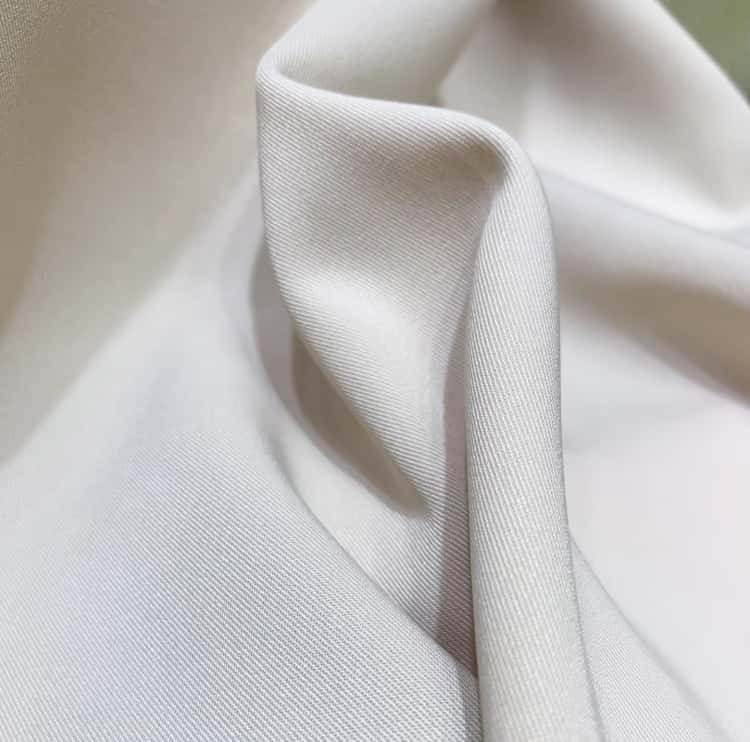
General Overview: This case targets a high-end customized production project of 150D+75D+40D warp/weft continuous polyester filament four-way stretch fabric. The fabric features fine filaments and high elasticity with extremely strict end-user appearance and handfeel standards, bringing unique process challenges for dyeing and finishing production.
This order was a high-end fabric order referred by an existing customer. The product specification is 150D+75D+40D warp/weft continuous polyester filament four-way stretch fabric, a type of high-elasticity, fine-filament four-way stretch material with stringent end-user quality standards.
The customer explicitly required: No abrasion marks, no “chicken paw marks,” no crease marks on the fabric surface. The overall fabric surface must be clean, uniform, with natural elasticity. Furthermore, the customer proactively provided samples of defective fabric produced by their previous cooperative mill as a reference for our company to avoid similar pitfalls, demonstrating the end-user’s zero tolerance for appearance defects on this fabric.
Initial process assessment: This filament four-way stretch fabric could typically be produced using a beam dyeing machine, and was initially evaluated as having low production difficulty. However, the customer strictly mandated the use of an overflow/airflow dyeing machine, requiring a softer, fuller fabric hand feel and more relaxed elasticity, avoiding the stiff hand feel associated with beam dyeing. This requirement introduced potential process adaptability risks for this production batch.
In the initial project phase, our company first referred to standard simulated silk dyeing and finishing processes, using over-edging and relaxed pretreatment concepts for trial sampling.
Section Summary: The high-standard appearance requirements and mandatory overflow dyeing process laid strict production prerequisites, while conventional silk simulation processes could not match the fabric’s structural characteristics, hiding potential quality risks.
II. Initial Trial Production Plan & Equipment Loading Logic for Filament Polyester Four-Way Stretch
General Overview: To eliminate man-made and equipment loading defects, we adopted a low-load trial production scheme with sufficient relaxation space and verified the stability of the process through dual-factory trial production, excluding basic production environment errors.
To avoid crease and fold marks caused by excessive batch ratios and fabric crowding, the loading quantity was strictly controlled for this trial:
A 600KG overflow dyeing machine was used, loading only 1450 meters of greige fabric per batch. This represents only 70% of the machine’s capacity, reserving ample relaxation space inside the machine. Theoretically, this should completely avoid abrasion and crease marks, ruling out insufficient loading as a basic cause of defects.
To verify the universality of any issues, our company conducted independent trial productions across two batches in two different reputable dyeing mills, using a uniform process flow to eliminate individual variances in equipment, operation, and water quality between mills.
Section Summary: The trial production adopted a scientific low-load configuration and cross-factory verification method, which completely excluded equipment overload, single-factory operation errors and environmental factors, indicating that subsequent defects belonged to core process flaws.
III. Initial Unified Process Flow (Identical for Both Mills)
General Overview: Both cooperative dyeing factories adopted the identical conventional simulated silk finishing process, covering complete pre-treatment, dyeing and post-finishing procedures to ensure unified trial production standards.
Open-width caustic weight reduction → Machine scouring → Pre-stentering and batching → Over-edging treatment → Relaxed caustic weight reduction → Machine washing → Dyeing → Dewatering and opening → Unsewing edges and stentering
Section Summary: The unified and standardized conventional process was universally applied in trial production, which confirmed that the process itself has inherent inadaptability for this high-elastic filament four-way stretch fabric.
IV. Adverse Results from Initial Trial Production
General Overview: Two batches of trial products showed consistent batch defects, mainly chicken paw marks and partial uneven dyeing, which failed to meet customer acceptance standards and exposed the limitations of conventional processes.
After both trial batches were completed, they exhibited highly consistent defects:
1. Slight uneven dyeing (color shading) and uneven color segments on the fabric surface.
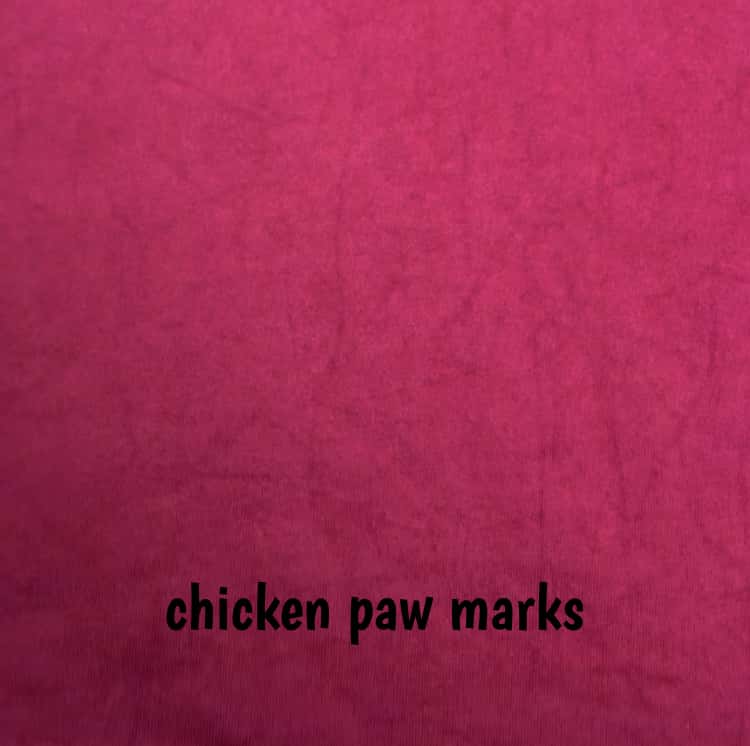
2. Prominent “chicken paw marks” and relaxed crease marks (constituting the majority of defects).
The finished fabric’s texture and appearance defects could not pass the end customer’s inspection; all were rejected.
This outcome was perplexing: even with a low batch ratio, ample relaxation, and a standard process, stubborn “chicken paw marks” and uneven dyeing appeared in bulk. This indicated that the standard simulated silk process was not suitable for this high-elasticity filament four-way stretch fabric.
Section Summary: Conventional silk simulation processes cannot adapt to the production of high-elastic filament four-way stretch fabric, and will inevitably cause batch appearance defects and color problems.
V. Second Trial Production with Modified Process for Filament Polyester Four-Way Stretch (Verification at Second Mill)
General Overview: Through controlled contrast trials of old and new processes in the second dyeing factory, it was further verified that conventional processes have structural defects, and simple pre-treatment optimization cannot completely solve fabric quality problems.
To rule out random factors, a controlled verification was conducted at the second mill:
Batch 1: Completely replicated the old process from the first mill. The finished defects were identical, showing “chicken paw marks” and slight uneven dyeing again. This confirmed the issue was a structural process problem, not operational errors at a specific mill.
Batch 2: Used a brand new modified pre-treatment process. Cold pad batch → Open-width caustic weight reduction → Machine scouring → Pre-stentering → Over-edging → Relaxed caustic treatment → Machine washing → Dyeing → Dewatering → Opening
Although the defects on the filament four-way stretch fabric slightly improved after optimizing the pre-treatment, noticeable “chicken paw marks” and localized uneven dyeing remained. The fabric still could not meet the customer’s acceptance standards, and the second trial was declared a failure.
Section Summary: Simply adjusting the pre-treatment process cannot offset the fabric’s inherent stress and slow dyeing characteristics, and the core quality problems still exist.
VI. Root Cause Analysis
General Overview: After multiple batches of comparative trials, three core root causes of recurrent defects were accurately located, covering dyeing temperature control, edge fixing technology and pre-shrinking batch setting.
Through comparative trials across multiple batches, the core issues were finally identified:
1. This filament four-way stretch fabric has a slow dye uptake rate, tight fibers, and strong fabric resilience. The conventional temperature ramp-up/ramp-down rates were too fast, leading to uneven dye uptake and creating uneven color shading.
2. Single over-edging and single pre-shrinking processes could not counteract the relaxation shrinkage stress of the filament fabric. The swinging motion inside the dyeing machine easily formed regular “chicken paw” crease marks.
3. The pre-shrinking batch size was too large, causing overlapping pressure and friction on the fabric body, leading to hidden crease marks and abrasion risks.
Section Summary: All defects stemmed from mismatched process parameters and imperfect craftsmanship, rather than equipment or operational problems, providing clear directional guidance for subsequent process optimization.
VII. Final Standardized & Effective Process (Successful Mass Production Solution)
General Overview: Targeted at the three major defect root causes, we optimized temperature control parameters, adopted double over-edging technology and segmented batch production mode, and finally formed a stable and mature mass production process.
Our company organized a process team meeting for review and conducted multiple small-batch tests. Ultimately, a mature mass production process was established, completely solving the three major problems of “chicken paw marks,” abrasion, and uneven dyeing for polyester filament four-way stretch fabric:
1. Precise Temperature Control for Dyeing (Solving Uneven Dyeing & Color Segments)
Replaced with high-precision temperature control equipment, using slow, balanced temperature ramp-up and ramp-down throughout the process: Ramp-up at 1.5°C/min, ramp-down at 1.2°C/min. This matches the slow dye uptake and stable coloring characteristics of the filament four-way stretch, eliminating uneven dyeing and shading caused by rapid temperature changes.
2. Double Over-Edging Process (Completely Eradicating Chicken Paw Marks & Abrasion)
Perform the first over-edging before machine pre-shrinking → Dewater and remove edges → Pre-stentering → Second over-edging → Then perform relaxed caustic weight reduction.
The double over-edging neutralizes the fiber’s shrinkage stress, ensuring uniform tension on the fabric edges. This results in no curling, no crease marks, and no machine abrasion throughout the process, completely eliminating the source of “chicken paw marks.”
3. Separate Batch Pre-shrinking, Combined Batch Dyeing (Optimizing In-Machine Tension)Filament Four-Way Stretch Fabric
Strictly control the quantity for pre-shrinking/scouring: Only 750–800 meters per batch, using small liquor ratios and low tension to ensure the fabric body is completely relaxed with no compression creases.
After pre-shrinking, combine two batches of greige fabric into one batch for dyeing (e.g., pre-shrink 8 pieces, combine to dye 16 pieces for the finished product), balancing quality and production capacity.
Section Summary: The three optimized process measures target the core pain points precisely, achieving zero appearance defects and uniform dyeing effect, and realizing stable mass production of high-standard filament four-way stretch fabric.
VIII. Filament Four-Way Stretch Fabric Project Summary & Cost Review
General Overview: This project accumulated rich practical experience through repeated trial and error and cost losses, verifying that customized personalized processes are the core guarantee for high-elastic filament four-way stretch fabric production.
This 150D+75D+40D filament polyester four-way stretch fabric is a highly process-sensitive, high-elasticity filament material. Standard processes for regular four-way stretch or simulated silk cannot be applied.
In the early project stages, a total of 5 batches of greige fabric were scrapped, resulting in a direct economic loss of nearly 100,000 RMB. After repeated trial-and-error across multiple mills and processes, combined with small-batch problem-solving, we successfully produced finished fabric with zero “chicken paw marks,” zero abrasion, and a uniform, even-colored surface. The fabric successfully passed the end customer’s inspection.
Core Lesson: Color difference and crease mark issues on polyester filament four-way stretch fabric are mostly not problems with the equipment or batch ratio, but rather a mismatch in “temperature control rhythm + number of over-edging steps + segmented pre-shrinking process.” Customized processes must be developed for stable mass production of such fabrics.
Section Summary: High-end process-sensitive filament four-way stretch fabric cannot rely on universal processes. Targeted process customization and parameter optimization are essential to avoid quality risks and production losses.